
The year started with weak demand for new passenger cars in the European Union, with registrations across the bloc declining 3.9% year on year in January, according to the European Car Manufacturers’ Association. It is the second consecutive year of decline in the EU auto market, underscoring persistent fragility in consumer sentiment, even as electrified models gain ground.
Europe’s automotive sector is a mainstay of the continent’s economy, supporting 13.6 million jobs, equivalent to 8.1% of EU manufacturing employment, and generating €414.7 billion in tax revenues and a €93.9 billion trade surplus, ACEA said. The industry accounts for more than 8% of EU GDP and invests €84.6 billion annually in research and development, or roughly a third of total EU research and development spending. The shift from internal combustion engines to electrified powertrains carries significant implications not only for the car industry but also for automotive and metalworking fluid lubricant suppliers.
Battery-electric vehicle registrations continued to grow despite the broader market contraction, according to ACEA’s monthly data. Registrations reached 154,230 units in January, lifting EV market share to 19.3%, up from 14.9% a year earlier. The four largest EU markets represent about 60% of BEV volumes, with France posting a 52.1% surge and Germany rising 23.8%, while Belgium declined 11.5% and the Netherlands fell 35.4%, ACEA reported.
Hybrid EVs remain the EU’s dominant powertrain. Registrations climbed to 308,364 units, capturing 38.6% of the market. Growth jumped 24.9% in Italy and 9% in Spain. Plug-in hybrids also advanced, with 78,741 units registered, pushing market share to 9.8% from 7.4% a year earlier.
By contrast, internal combustion engine models continued to fall, with petrol engine registrations dropping 28.2% across the EU. France was down 48.9%, Germany 29.9%, Italy 25.5% and Spain 22.5%. Petrol’s share fell to 22% from 29.5% a year earlier, with 175,989 units registered in January. Diesel extended its structural decline, dropping 22.3% and accounting for just 8.1% of new car registrations.
Even though the EU announced in December 2025 that it was lifting the ban on fossil-fuel-powered car sales by 2035, petrol and diesel vehicles now account for 30.1% of the market, down from 39.5% in January 2025.
Some disagree with the EU’s new stance on ICEs, regarding electrification as a fait accompli.
“Delaying the inevitable will only push more legacy automakers into the death throes,” Nick Augusteijn, a Netherlands-based motoring journalist, told Lube Report. “They would fall even further behind the Chinese in the development of ultra-fast-charging BEVs with good range. Not to mention infotainment software!”
Augusteijn cites the China-only Audi E5, an EV and brand developed by Audi and its Chinese partner SAIC, lauded by industry insiders as Audi’s best product in 30 years.
By contrast, EV sales in the United States are cooling, with EV market share dipping to around 6% of new-vehicle sales in early 2026 as federal tax credits expired. New EV deliveries in January were down roughly 30% year on year, with Tesla still dominating and increasing its share amid broader industry declines.
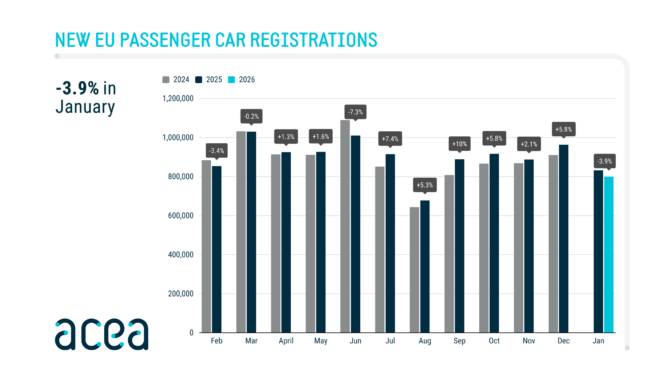
Courtesy of ACEA