Get Lube Report Global FREE

  • Lubes’n’Greases weekly lubricants industry newsletter.

  • Register for FREE

Several of the world’s major lubricant manufacturers and a growing number of smaller players have stepped into the dedicated electric vehicle fluid arena. The future of personal mobility will almost certainly be electric, and even though there’s plenty of road left to travel in internal combustion engines, this group of EV fluid producers are investing in EV-optimized lubrication products.

In addition, lubricant and additive companies, as well as chemicals companies, are focusing on thermal management fluids for batteries and electronics. Many of the current crop of EV coolants were developed for ICEs and were further optimized for EVs. But development is shifting toward EV-specific products that can meet the demands of the e-mobility future. The R&D push for in-car coolants can be spun off into fluids for heat management at data centers.

Below is a sample of some of the companies producing EV and data center fluids. If you are a manufacturer of an e-fluid not mentioned in this list or would like to provide additional information about a product, contact info@lubesngreases.com.

Arteco
Belgian company Arteco launched Freecor EV Multi 10, its multifunctional coolant for EVs in April 2023 for e-motors, power electronics, batteries and all other components in BEVs and hybrids.

In the same month, the company launched its Zitrec EC range of heat transfer fluids designed for electronics and data center cooling. Zitrec is a direct-to-chip coolant for optimal performance and efficiency, enabling components to operate at higher speeds without the risk of overheating.

Arteco is a coolant company and is not in the traditional lubricant space. But the company could face stiffening competition as legacy lube companies move into the coolant business.

BASF
BASF’s Glysantin launched a battery coolant specifically developed for indirectly cooled systems and for higher reliability and safety, into the Chinese automotive aftermarket. Glysantin the is a ready-to-use coolant, in addition to well-known protection, offers low electrical conductivity and maintains low and stable currents when exposed to a voltage source. 

German chemical company BASF patented Glysantin in 1929 and is the world’s first engine coolant. With the latest product innovation, the company now specifically targets BEVs.

Castrol
More than half of the world’s major automakers use Castrol’s e-fluids in their factory fill lineups, the company claims. A Castrol e-fluid is even used on Nasa’s InSight Mars lander.

Products include On Transmission wet and dry transmissions, On Grease for e-motors and On Thermal dielectric battery coolant.

Castrol and EV propulsion specialist Sprint Power will jointly develop ultra-fast battery packs using Castrol’s ON EV thermal fluid as the coolant. The collaboration follows Castrol’s announcement that it will build a new EV battery test center, further cementing the company’s commitment to e-mobility. 

In April 2022, the U.K. company released its e-transmission fluid to aftermarket sales.

Castrol’s ON and EV propulsion specialist Sprint Power will jointly develop ultra-fast battery packs using Castrol’s ON EV thermal fluid as the coolant. The collaboration follows Castrol’s announcement that it will build a new EV battery test center, further cementing the company’s commitment to e-mobility.  

Cepsa
Spain’s Cepsa extended its conventional Xtar range to include fluids optimized for EVs and hybrids. Cepsa will distribute these products to more than 80 countries and will make them available through 1,800 service stations in Spain and Portugal, as well as in workshops and official distributors. What the range comprises is to be announced.

Champion Lubricants
Champion launched its E-pulse range of transmission and gear fluids, coolants, greases and brake fluids tailored for electric vehicles at the end of 2024.

ExxonMobil
ExxonMobil launched its Mobil EV range in 2019, including Therm Elite 701 and 702 thermal management fluids; Drive 201, Drive EP 202 and 203, and Drive Elite EP 801 reduction gearbox fluids; Cool Drive 301 and 302, and Cool Drive Elite 901 integrated e-motor and reduction gear fluids; EM 100 electric drive motor grease; and WB 100 and WB Elite 150 wheel bearing greases.

In January 2022, Exxon announced that effective on April 1, it would streamline EV lubrication and plastics developed for EVs under the auspices of ExxonMobil Product Solutions Company. Two other business units will be ExxonMobil Product Solutions and ExxonMobil Low Carbon Solutions.

In November 2023, the company launched a suite of data centre immersion cooling fluids.

Fuchs Petrolub SE
Germany’s heavyweight independent producer Fuchs makes a range called Blue EV. When it was first launched in September 2022, the range included DriveFluid transmission oil for electric and hybrid drivetrains; MotorGrease specifically designed for electric motors; and ThermalFluid dielectric heat transfer fluid.

In May 2020, the company bought a 28% stake of E-Lyte Innovations GmbH. E-Lyte is a start-up that develops and produces electrolytes for high-performance batteries in the industrial and automotive sectors.

Fuchs released its Renolin fluids for electronic component cooling global product line, which is formulated with synthetic base oils.

GS Caltex
GS Caltex from the US and South Korea’s Kixx Oil produce Kixx EV transmission oil for gear or motor reducers and a coolant for the battery system.

Kixx Oil introduced a data centre cooling product, Kixx Immersion Fluid S, in November 2023.

Gulf Oil Lubricants India
In India, Gulf Oil Lubricants developed and launched eLEC in 2020. The range includes eLEC brake fluids, eLEC coolant, eLEC driveline fluid.

HP Lubricants
Also in India, HP Lubricants released HPEV ,n early 2020. The range includes HP EV Brake Fluid; HP EV Hubgrease; HP EV Koolgard, a coolant; HP EV Polygrease; HP EV Steering Fluid; and HP EV Transmission Fluid.

Idemitsu
Idemitsu from Japan offers Type‑A, for e-motors integrated with the gears; Type-C, for e-motors applied to the engine or the existing transmission with specific electrical and material compatibility and added thermal transfer requirements; and Type-G, For e-motors at the rear axle with extremely high speeds and small sump volumes.

Liqui Moly
Battery Coolant EV 200 is Liquid Moly’s ready-to-use indirect battery cooling fluid. The fluid contains organic acid and corrosion inhibitors to extend service life. Flux inhibitors prevent damage caused by flux residues in the cooling system, and reduces hydrogen in the system that and lead to hydrolysis. The product is intended for indirect battery cooling systems that require reduced conductivity. The product is aimed at Korean OEMs.

JXTG EV Fluid
Originating in Japan, in 2020 JXTG launched Eneos Gear Protection, Eneos HV AT for automatic transmissions of electric and hybrid vehicles, Eneos Motor Cool, Eneos Energy Saving, Eneos Isolation for electrical insulation and Eneos Battery Cool.

Petronas
Petronas’ Iona came out in 2019. It features Iona Integra DNF transmission, final reduction gear and wet brake fluid; Iona Thermal HPFD thermal management fluid; and Iona Integra Plus FCA transmission fluid.

The Malaysian national oil company co-developed Iona Integra Plus for vehicle maker Iveco’s zero-emission vehicle eDaily, specifically the e-Transfer case.

Petro-Canada Lubricants
Petro Canada Lubricants launched its line of purpose-built lubricants – Petro-Canada Lubricants EVR – in July 2023. The range includes EVR Driveline, EVR Thermal Management and EVR Motor Greases.

Phillips 66
Lube company Phillips 66 makes e-Shield, which it launched in March 2021. It features the usual trio of system fluid, grease and coolant. Several major original equipment manufacturers use the e-Shield EV fluid system in their EV factory-fills, the company claims.

Q8
Q8Oils range of transmission fluids and coolants is mainly targeted at hybrids.

Repsol
Spain’s Respol began to market EV fluids in March 2021. Products include a battery thermal fluid, motors or inverters; a coolant antifreeze 50% for batteries, motors, or inverters; an automatic transmission fluid; a brake fluid; and a complex synthetic grease for bearings and motors.

Shell
Global giant Shell first released a range of greases, coolants and transmission fluids in 2019, later expanded in 2020 to include new products for light- to heavy-duty commercial BEVs and fuel-cell EVs.

S-Oil
Seven EV is available to South Korean EV drivers from 2021.

SK Enmove
SK Enmove, headquartered in South Korea, has been providing specialized fluids for integrated e-motors and reduction gears to leading EV manufacturers worldwide since the early 2010s, spanning markets in Korea, the US, China and Europe under the newly introduced brand ZIC e-FLO. Additionally, in 2023, SK Enmove introduced a thermal fluid tailored for immersion cooling, catering to applications in data centers, EV chargers and ESS battery packs.

Total
French major energy company Total markets Quartz for hybrids and Rubia for industrial, commercial and utility EVs.
Products include Quartz features EV-AT, EV-AMT, EV-DCT and EV-CVT transmission fluids for automatic hybrids, automated manual hybrids, dual-clutch transmissions and continuously variable transmissions, respectively.

EV-Drive R for EV drivetrain reducers; EV-Drive MP lube and coolant fluid for EV drivetrains, EV-Battery thermal management fluid for EV and hybrid batteries; and EV-Motor thermal management fluid for EV and PHEVs. Rubia features the same products tuned for industrial vehicles minus the DVT and CVT transmission fluids.

Valvoline
Heavyweight U.S. lubricant company Valvoline launched Performance Fluids and XEV in September 2019. The range includes a heat transfer fluid for battery applications, fuel-cells and charging applications; a transmission fluid; a brake fluid; and a grease for e-motors and seal bearings. Two years later, it launched a hybrid motor oil, battery protection fluid and fluids for transmissions and brakes in China.

ZF
In August 2022, German car parts maker ZF launched ZF Lifeguard for reduction gears, electric motors and power electronics, ZF Lifeguard Hybrid for ZF passenger car hybrid transmissions.

The German company introduced a range of aftermarket e-Fluids. The company recognises the growth in independent workshops and so developed a range of fluids to fill the need for aftermarket products for EVs and PHEVs. 

3M
Novec direct contact cooling for battery systems.

The EU EV market is growing apace, with registrations increasing by triple-digits in some states. Year-to-date sales reached 1.2 million, 53.1% more than the same month in 2022, which snagged a 14% market over the 10 months this year, according to data gathered by the European Automobile Manufacturers’ Association.

Belgium registered 147.3% more BEVs in October, with Denmark clocking 100.7% growth. Germany, the largest market for BEVs, grew by 4.3% in the same month, having had a slow September.

New EU registrations of hybrid-electric cars rose by 38.6%, driven by the bloc’s top-three markets, Germany, France and Italy. Between them, they accounted for an increase of 29.8%, totalling 2.2 million units sold in the first 10 months of the year, ACEA said.

As the EU EV market keeps growing, plug-in hybrids sales fell by 5% year-on-year to 72,002 units. This decline was most acutely seen in Germany, where 49% fewer plug-in hybrids were bought in October. Strong growth in Belgium of 70.2% and France of 34.2% wasn’t enough to compensate for Germans turning away from plug-ins.

President Joe Biden’s administration has come out strongly in favor of zero-emissions transport, in stark contrast with the rollback during the Trump era, which has itself been reversed. On the table is millions of dollars in funding to get the public onboard and close gaps in charging infrastructure, especially in rural areas. 

President Biden has set a target of a 50% share of electric vehicles by 2030 as part of what is known as the Build Back Better Aagenda and to advance smart fuel efficiency and emission standards. The drivers of Biden’s policy are not just the environment but also job creation and competition with China, a concern he shares with his predecessor. 

According to a U.S. government statement of intent, the Build Back Better agenda includes:
Installing the first-ever national network of EV charging stations,
Delivering point-of-sale consumer incentives to spur U.S. manufacturing and union jobs,
Financing the retooling and expansion of the full domestic manufacturing supply chain,
And innovating the next generation of clean technologies to maintain our competitive edge.

To achieve this goal, the President lobbied the Detroit establishment at a White House summit to throw their weight behind the plan. Critics pointed out that newcomers were left off the invitation list, including Tesla, Rivian, Fisker, Faraday, Bollinger, Arrival, Lucid and Lordstown. A number of the companies are not unionized, while the attendees – Ford, GM and Stellantis, are the biggest three employers of United Auto Workers members.

In the U.S., the federal government under the Obama administration enacted several policies to promote EVs. Efforts have also been proposed to support advanced-technology vehicle adoption through improvements to tax credits in current law, investments in research and development and competitive programs to encourage communities to invest in infrastructure supporting these vehicles.

The biggest boost Congress gave to EVs was the American Recovery and Reinvestment Act of 2009, which established tax credits for purchasing EVs of between U.S. $2,500 and $7,500 per vehicle, depending on the battery capacity, and conversion kits to retrofit conventionally powered vehicles with EV capability ($4,000 per vehicle, maximum). However, a majority of those credits have expired, but proponents of EVs said they were the cornerstone of the growing demand for such vehicles.

The credit phases out when 200,000 qualified vehicles are produced by each manufacturer and are sold in the U.S., a limit that has been met by two companies so far: Tesla and GM. According to EV website My EV, BMW and Volkswagen will keep full credits until 2023.

The first mandate in the U.S. for EV purchases took effect in 2018 under California’s Zero Emission Vehicle Program. The program, part of a policy that dates to 1990, had previously promoted EV sales in a variety of ways but now requires any automaker selling passenger cars or trucks in the state to ensure that a portion of them be BEVs, PHEVs or hydrogen fuel-cell vehicles. For each unit falling into those categories, automakers receive a credit based on the range of each vehicle, and the number of credits is required to reach a certain percent of total units sold in the state.

The percentage increases every year. It was 4.5% in 2018, 7% in 2019 and is scheduled to reach 22% in 2025. Automakers failing to comply will be fined $5,000 per credit short of the requirement. Credits earned in excess of the requirement in any year may be banked for future use or sold to other automakers.

Thirteen other states – Colorado, Connecticut, Delaware, Maine, Maryland, Massachusetts, New Jersey, New York, Oregon, Pennsylvania, Rhode Island, Vermont and Washington, plus the District of Columbia – have adopted California’s ZEV program.

Those mandates were challenged 2019 when the Trump administration revoked California’s ability to set its own automotive emission and fuel economy standards. The federal Environmental Protection Agency and the Department of Transportation contended that consumers would benefit from lower prices if the country had one set of national automotive standards.

The Department of Justice investigated whether Ford, Volkswagen, Nissan and BMW violated antitrust rules when they agreed not to challenge California’s standards, but the probe was dropped in 2020.

The new Biden administration quickly moved to repeal the rollbacks enacted by the previous administration. Almost two dozen states had filed suits to block the rollbacks in court.

Many states have adopted other types of policies encouraging purchases of EVs. California offers rebates of up to $7,000 on purchases of EVs depending on the applicant’s income and is building an extensive charging network. Thirty-nine other states also provide tax benefits or rebates for EV purchases. 

California Governor Gavin Newsom also signed an executive order in September 2020 setting targets to transition the state’s transportation sector to zero emissions.

A U.S. Senate committee is currently advancing legislation that would bump up EV tax credits to as much as $12,500. The maximum credit would apply to EVs assembled in the U.S. by union workers. It would also limit any credits to EVs with a retail price below $80,000.

The bill would also eliminate the existing EV cap, and the new credit would phase-out the three years following 50% of passenger vehicle sales being EVs in the country.

President Biden made it a campaign promise to enact more ambitious fuel economy standards. This year, he proposed $174 billion for electric vehicles and charging stations.

“EVs are rapidly growing, but policies still play a really important role in sending signals to the private sector that a state or city is excited to support EVs and will help the private sector,” Cassie Powers, senior program director at the National Association of State Energy Officials, told Utility Drive.

Up north, Canada had set targets to increase sales across the country, similar to those in California. It starts small, 10% of vehicle sales to be zero-emission by 2025, eventually reaching 100% by 2040. To achieve these goals, the government has introduced incentives for purchasing EVs. Currently, EVs cost between $29,000 and $135,500. Now, the government proposes a rebate of $5,000 for battery electric or hydrogen fuel-cell vehicles costing less than $45,000. 

Over the next three years, the country will dedicate $300 million to implement the program. The government also promised to spend $130 million for EV charging and hydrogen stations across the vast country over the next five years. 

A federal report in late 2020, however, found that the country wasn’t on track to hit even the first target of 10% vehicle sales to be ZEVs by 2025. The committee that authored the report recommended such measures as a national ZEV standard that would require manufacturers to sell a certain amount of EVs, and a program offering money for trade-ins of older vehicles that could be used to purchase EVs.

Major oil extractor and refiner ExxonMobil will start producing lithium from a well in Arkansas. The U.S. company aims to be a leading supplier of the strategic mineral for EVs by 2030.

Lithium is an essential component of lithium-ion batteries and is used in electric vehicles, as well as consumer electronics. Demand for lithium is expected to quadruple by 2030. Virtually all lithium today is produced outside of North America.

Exxon believes it will be able to unlock vast supplies of lithium in North America.” Much of the world’s lithium deposits are in Argentina, Bolivia and Chile, with reserves of 50 million metric tons. Australia is the largest producer, accounting for roughly 50% of global output.

The company acquired the rights to 486 square kilometers of the Smackover formation. It expects to start producing in 2027 under the name Mobil Lithium. 

Electrification of the four-wheeler passenger vehicle fleet may affect the quantities of transmission fluids, greases and other types of lubricants used in automobiles, but the impact of electric vehicles on overall consumption can largely be distilled down to engine oils.

Engine oils account for around 20% of global automotive lubricant demand, but battery EVs need no engine oil. The size of that impact, therefore, will depend mostly on the future of the entire automobile population, the extent to which EVs replace vehicles powered solely by internal combustion engines, the pace at which that shift occurs and the mix between BEVs and plug-in hybrid EVs, since the latter still use engine oil.

Global annual sales of EVs passed 10 million units in 2022, accounting for 14% of all car sales that year, according to the International Energy Agency. This even as total passengers in spite of wilting car sales in the face of the COVID-19 pandemic. By the end of 2023, they are projected to go beyond 12 million, even though the market has cooled slightly.

The world’s passenger car parc grew steadily over the past decade, from 748 million in 2009 to up to 1.4 billion in 2020, depending on the source. Most analysts agree that the overall car population will continue to increase, so in assessing the impact on engine oil volumes, the questions are: How much will that number increase and to what extent will it shift from ICE vehicles to EVs? Crucially, does this give PCMO blenders and other automotive lubricant stakeholder cause to panic or is there life left in the market?

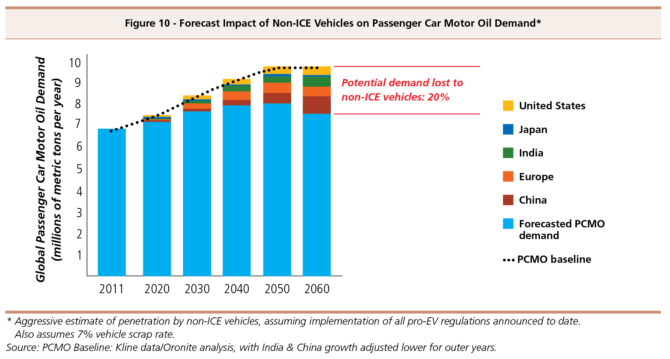
PCMO demand would peak at roughly 8.2 million tons in 2050, Oronite said, then fall to 7.5 million tons by 2060 – at that point 20% less than it would be without EVs.

Cost to Demand Volumes

Analysts deem such impacts significant but not devastating for lubricant marketers. Oronite officials said they would not expect EVs to have a severe impact on the industry unless the shift away from ICE-only vehicles happens much faster than currently forecast in China, which is by far the world’s largest EV market and one of the two largest lube markets.

Additive company Chevron Oronite calculated that demand for passenger car motor oil will continue to rise, although not as much as if ICE vehicles retain their dominance in the car parc.

By 2040, the company estimates, global PCMO demand will be 8.1 million metric tons, up from 7.2 million tons in 2020, but still 13% less than it would be by that date were it not for the impact of EVs.

Of course, the potential losses will keep increasing as the trend continues toward EVs. Oronite’s analysis calculated that numbers of both EVs and ICE-only cars will continue rising until 2050, at which point the numbers of conventional vehicles will start to decrease. PCMO demand will peak at roughly 8.2 million tons in 2050, Oronite thinks, then fall to 7.5 million tons by 2060 – at that point 20% less than it would be without EVs.

Fellow additive company Afton Chemical largely concurs with Oronite. It also believes there is a decade or so of consistent growth in PCMO demand. Adam Banks, Afton’s senior e-mobility marketing manager, says there are two factors are setting the pace of change from ICEs to EVs, and therefore the rate of PCMO demand decline. The first is the rate of fleet change. Even in a country like Norway, where EV registrations are more than 90% of ew cars, there is still an ICE fleet with many years of functional life.

The second factor is the growth of the total vehicle parc. This will accelerate in Southeast Asia, where a projected 1.5 billion people will reach the key income bracket for vehicle ownership. These vehicles are unlikely to be EVs.

“‘You put those two things together … and it means that the sky is not about to falling on our heads in the projections for 2040 that we’ve got, I think I referenced it in the talk was it’s effectively steady demand at 2040 for passenger car, let alone the other sectors that we see. So, I think there’s cause for optimism there

Dissenting Voices

Other analysts predict different degrees of impact. IHS Markit said in 2018 that it expected global PCMO demand to be 7% lower in 2040 than it would be were it not for EVs, adding that it believes the transition to e-mobility will be slower than some forecasters predict because the lengthening average lifespan of cars slows the rate of turnover.

U.S.-based consultancy Kline & Co. estimates that by 2040, EVs will cause combined PCMO demand in the 15 countries to be about 20% lower than it would be had it not been for EVs. The demand volume will decrease at a cumulative annual rate of 0.1% over that period, whereas it would have increased at a rate of 0.9% without EVs.

Some analysts deem such impacts significant but not devastating for lubricant marketers. Oronite officials say they do not expect EVs to have a severe impact on the lubricant industry unless the shift away from ICE-only vehicles happens much faster than currently forecast in China, which is by far the world’s single-largest EV-buying country and one of the two largest lube markets.

“After studying the data, one of the key takeaways from the Oronite assessment is that unless China adopts EVs at a much more aggressive rate, EVs would be a moderating rather than disrupting force on PCMO demand,” the company told Lubes’n’Greases.

Others are even more sanguine. “Penetration of electric vehicles will reduce lubricant volumes, but the impact on global demand will be limited,” Blake Eskew, former vice president of global consulting at IHS Markit, said.

Kline frequently notes that it expects the trend toward longer drain intervals to cut into PCMO demand more than EVs.

“The expansion of EVs will clearly dampen PCMO demand, but the most intense negative impact will be felt in the long term – 2030 and beyond,” George Morvey, industry manager for Kline’s energy practice, said during a presentation at the ICIS World Base Oils & Lubricants Conference in London in February 2019. “In the short and medium term, through 2027, oil drain intervals will remain the main factor driving PCMO demand.”

The Society of Tribologists and Lubrication Engineers (STLE) released a new white paper on electric vehicles’ impact on tribology. The 60-page Tribology and Lubrication for E-Mobility: Findings from the Second STLE Conference on Electric Vehicles summarizes its 2022 conference in San Antonio, Texas.

STLE released the paper ahead of the third edition of its EV conference on Nov. 14-15 in Cleveland Ohio.

The society’s technical advisor Neil Canter wrote the paper, which covers efficiency, test methods, grease, thermal management and formulation development.  

“STLE’s second conference on electric vehicles built on the findings from the initial conference in 2021 and demonstrates how the tribology and lubrication field is taking on the challenge of developing products that meet the requirements for operating EVs,” Canter said. “By offering the tribology and lubrication community further opportunities to learn together, STLE hopes to advance the development of EV fluids, greases and test methods, paving the way for widespread EV adoption.”  

STLE provides the lubricant industry resources, training courses, events and periodicals on safety, energy usage, maintenance, natural resources, wear and productivity.  

The hopes and expectations for EV sales to rapidly scale up are based on assumptions that their costs will drop significantly – enough for them to reach price parity with ICE vehicles. BEVs generally cost more than PHEVs today, but many think that BEV costs will drop faster and sooner, allowing them to achieve price parity in the near term. In fact, because they contain both electric and internal combustion engines, as well as a battery, it is less certain whether PHEVs will ever reach cost parity, despite PHEVs gaining market share in new registrations.

Market share: BEVs captured about 15% of new car registrations and hybrids 27% toward the end of 2023 in Europe. In the USA, BEVs accounted for 9% and hybrids 7%. In China, BEVs took 22% and hybrids 11%.

Batteries Included

EV batteries are central to discussions on price parity. They are by far the most expensive single components in EVs, accounting for 30-40% of the entire vehicle’s value. Of course, they differ in cost depending on the size and manufacturer.

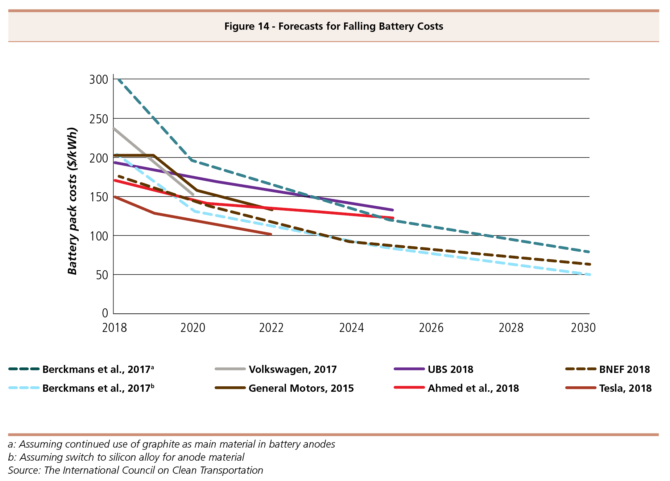
The average cost per kilowatt-hour was U.S. $137 in 2020, according to a survey conducted by BNEF. Tesla paid an estimated $115/kWh in December 2020. At that price, the leading EV manufacturer’s 80.5 kWh battery pack in its Model Y cost the automaker about $9,250.

The value of power: The cost per kilowatt hour gives the battery pack a comparable value. A battery pack that has capacity of 100 kWh and cost $15,000 has a cost per kilowatt hour of $150.

That cost has dropped fast and steadily for the past decade, from $1,000/kWh in 2010. Automakers and outside analysts predict it will continue to fall, though their forecasts vary. Per-unit battery pack costs differ between automakers, partly because of technology and manufacturing techniques, but also depending on sales numbers; companies with higher sales can spread out fixed costs more than competitors.

Some predict costs will take step decreases if the industry is able to switch to battery designs that have not yet been commercialized, for example changing the lithium nickel manganese cobalt oxide cathode in today’s lithium-ion batteries to lithium nickel manganese aluminum oxide; or switching the anode material from mostly graphite to a silicon alloy; or, more radically, switching to solid state batteries that use solid electrolytes instead of the liquid or polymer electrolytes in today’s lithium-ion batteries.

Predictions were that battery pack costs would decrease to $130 to $160/kWh between 2020 and 2022, though Tesla stated that it would reach an average of $100/kWh by 2022. BNEF predicted in December 2020 that the industry would reach that number by 2023. Researchers at Vrije University in Brussels believed costs could fall to $62/kWh by 2030. Any of these outcomes would more than offset the increased cost of shifting to larger battery packs, which is an ongoing trend. The reality is that the price per kilowatt hour increased by 7% in 2022 due to the rising costs of cobalt and nickel. Expectations are that costs will still fall.

Other costs are falling, however. A 2019 analysis by the International Council for Clean Transportation estimated that combined costs for nine items ranging from the power distribution module to the inverter/converter, the electric drive module and the charging cord will fall 12% between 2017 and 2025 to $2,800. Bigger savings will come from indirect costs, such as administration, research and development as increasing sales allow them to be spread across greater numbers of vehicles. ICCT estimated that the per-unit tally for these indirect costs will be slashed by more than $7,000 over the same time period to just $3,200.

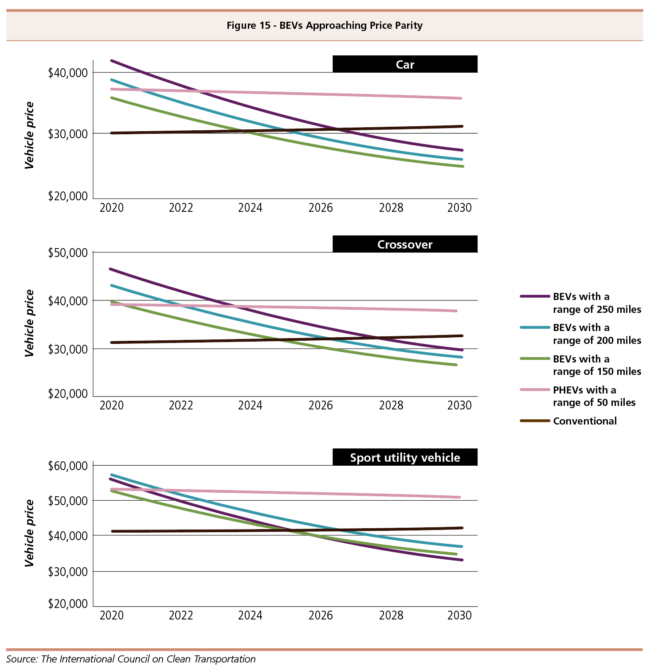
Adding it all together, ICCT predicted that BEVs with a range of 150 miles will reach cost parity in 2024, and that those with range of 200 and 250 miles will do so in 2025 and 2027, respectively. Parity for the same categories of crossover and SUV will come in 2025-2028 and 2025-2027, respectively.

Other analyses have somewhat different timeframes, but most models show EVs having price tags equivalent to ICE vehicles – without any government subsidies – during the next 10 years. When that happens, EVs should jump in popularity for a broader spectrum of motorists, thanks to the fuel savings they offer. Sales would increase exponentially, analysts say, assuming that sufficient recharging networks are developed and that recharging speeds continue to progress.

Total Cost of Ownership

Outright cost parity between ICEs and EVs could also take into consideration the total cost of ownership over the vehicle’s lifespan. However, calculating that cost is complicated and gives mixed results. Many assume that in the absence of engine oil and fuel expenses, EVs would obviously be cheaper to run over a period of time. Not necessarily so, found the automotive journal Car and Driver.

In a comparison of two cars that have both EVs and ICE variants – the Ford F-150 and F-150 Lightning EV and the Hyundai Kona and Kona Electric – the Ford EV was cheaper to run than the ICE version and the vice versa for the Hyundais.

Car and Driver found that variables including tax breaks, trim packages, depreciation and lacking ICE/EV equivalents made calculating the total cost of ownership complicated and too varied to make useful comparisons.

Moving to Mandates

Some of the cost reductions necessary to reach price parity are expected to come from research and development of components such as batteries, but it is assumed that others will come from manufacturers gaining economies of scale that allow them to spread fixed costs over greater numbers of vehicles. Sales still need to increase significantly for that to happen.

That means the industry could be in a key phase – needing to grow at even faster rates and therefore needing to win over a widening range of consumers, but with government subsidies possibly starting to wind down at the same time.

Many analysts agree that navigating that transition will require governments to shift their strategy, to implement mandates that prohibit sales of cars powered solely by ICEs or that require purchases of EVs and other low-emission models.

A number of countries are indeed moving in that direction. In the U.S., a California policy followed by nine other states began in 2018 to require large automakers to ensure that portions of cars sold in those states be zero-emissions vehicles – a category that includes fuel-cell vehicles but that for now mostly means BEVs. In Europe, a few countries have resolved or proposed to prohibit sales of new ICE-only vehicles – bans that have been targeted to take effect as early as 2022 and as late as 2040.

According to the International Energy Agency, more than 20 countries had either announced bans on sales of conventional cars or mandated all new sales be zero-emission vehicles by the end of 2020.

In China, by far the biggest EV market, it’s not yet clear how well mandates will work or if they will endure. Sales stalled in 2019 as the government cut back on subsidies, and the country was overtaken by Europe in 2020 sales. Those numbers could rebound, however, after the government mandated last year that EVs must make up 40% of all sales by 2030.

In the U.S., former President Donald Trump’s administration sought to revoke California’s permission to set its own emissions regulations – the basis for state-level zero-emissions vehicle requirements – arguing that it fragments the U.S. auto market and raises costs for consumers. States subsequently counter-sued, and current President Joe Biden’s administration said it was acting to withdraw the 2019 law in April of this year.

The sailing is smoother in Europe at the moment. For the first time, it overtook China in EV sales with 1.4 million new registrations in 2020 compared with China’s 1.2 million. The European Union is also set to target at least 30 million ZEVs on the road by 2030, Reuters reported in December 2020.

Still, it should be noted that pro-EV mandates have yet to take effect in Europe, and it is worth considering whether such rules could spur public opposition, such as the “yellow vest” protests that rocked France after the government raised fuel taxes in 2018.

BNEF, which has been among the most bullish forecasters for EV uptake, advises that it is not a foregone conclusion that these vehicles will gain mass market appeal.

“Mass market adoption is still, I think, very uncertain,” said Aleksandra O’Donovan, BNEF’s head of electrified transportation. “There is still a very good possibility that the middle market will not happen.”

She added, however, that the organization believes that obstacles are more likely to arise from issues such as inadequate charging networks or consumer concerns about depreciation of EVs. Given the degree to which environmental consciousness has taken hold in Europe, EVs are unlikely to be derailed there by public opposition to policies prohibiting ICE vehicles.

“To be honest, I don’t think that influences what will happen in Europe,” she said. “The overall drivers for EVs, health and environmental [considerations], are very real and widely recognized by the public.” She also predicted that European governments will make EVs easier to swallow. “At some point we’ll see some prize for using EVs. We have yet to see what that’s going to be.”

BNEF believes the 2019 slump in China was temporary.

“For China EVs are very much an industrial policy,” she said, citing the central government’s goal of helping the country become the world leader in EV technology. “It’s not going to be a hiccup-free growth. We cannot expect any market to grow at 200% every year, including China. But the long-term drivers for EV growth in China are there.”

Japanese car giant Toyota claims it has solved the technological problem in solid-state battery design that could double range and slash electric vehicle charging time to 10 minutes. It would also put an EV’s total cost of ownership on par with an internal combustion engine car.

EV enthusiasts have long-touted solid-state batteries as a key to unlocking mass EV adoption. Other automakers are working to produce safe and reliable solid-state batteries, including Toyota’s domestic rival Nissan and American manufacturer Ford.

Replacing the liquid electrolyte in a typical lithium-ion battery with a solid can increase power density and the battery’s functional life. The less complex design of a solid-state battery doesn’t require liquid cooling systems and reduces the likelihood of thermal runaway.

The company claims its new technology – an undisclosed gel, according to motoring website Top Gear – can offer a range of 1,200 kilometers. This is almost threee times that of the Tesla Model S, which is the current longest-range EV. Toyota also says charging times of only 10 minutes are achievable.

Toyota estimates that mass production could start by 2027 or 2028. This would accelerate EV uptake in markets where it has been stumbling in 2023, such as the United States.

“The era of the solid-state battery is right around the corner,” said Idemitsu’s CEO Shunichi Kito, announcing the deal with Toyota, adding that recent innovations will help the batteries now in the works overcome the edge lithium-ion batteries have had over EVs.

Challenges

Producing solid-state batteries in large volumes is not without its challenges. They are costly and difficult to make, requiring high levels of precision to stack cathode and anode cells. Toyota can look forward to a “relatively tough path towards scaling up over the coming decade,” thinks Goldman Sachs. Problems include extreme sensitivity to moisture and oxygen and preventing formation of metal filaments that can cause short circuits. 

Toyota has formed a partnership with Idemitsu, a Japanese oil major and lubricant producer, to work on the technology. Idemitsu has been researching basic technologies for all-solid-state batteries since 2001, while Toyota started little bit later, in 2006.

Solid-state battery is made up of a cathode, a thinner metal anode, and solid electrolyte between them. It is different from lithium-ion batteries that use liquid or semi-liquid electrolyte so they risk damage such as swelling or leakage.

The German government withdrew incentives for plug-in hybrids at the end of 2022 and has phased them for private buyers of battery EVs on Sept. 1, 2023. Over the next two years incentives will also go for fleet buyers.

Until then, the government temporarily contributed an “innovation bonus” of up to €9,000 to each purchase for BEVs and fuel cell EVs priced up to €40,000, and €7,500 for those priced over €40,000. EVs are still immune from vehicle taxes for up to 10 years.

Another tax bonus is also offered based on the car’s battery size. The list price of the car is discounted by €200 per kilowatt-hour battery capacity, and the discount applied for up to €10,000 in 2019, lessening the list price as well as the amount due for income tax. This total is reduced each year by €50 and is expected to apply until 2022, although extensions may be possible. 

In 2020, the German government passed a bill that will abolish the vehicle tax for EVs by the end of 2030. The bill also supports a transition to electric fleets for German organizations, and wants to increase the demand for electric buses. It also mandated that every gas station in the country include electric charging stations.

Registrations of new battery electric vehicles and hybrids continued steady growth in September, according to data collected by the European Automobile Manufacturers’ Association.

While year-on-year sales of all cars grew, they have yet to return to pre-pandemic levels. Registrations in 2019 were 15.5 million units, crashing to 9.3 million in 2022. Automotive analysts from Jato speculate that annual sales are unlikely to return to the numbers seen before 2020.

BEVs captured 14.8% of the market, behind petrol and hybrid as the most-popular vehicle choice. This is the third time this year that BEVs have outsold diesels, ACEA said. Hybrids took 27.3% of the market while petrol cars saw market share decline to 34.1% from 35.3% this time last year.

Petrol car sales increased in absolute numbers by 5.5%, while market share shrank to 34.1% from 35.3%, year-on-year. Growth was kept bouffant in the bloc’s largest, namely Italy, Germany, Spain and France. Sales of diesel cars slumped by 12.5% in the same periods. The decline could have been greater were it not for Germans buying 4.6% more diesel cars. Diesels took a 12.7% market share, down from 15.9% in September 2022.

Russia is well behind the curve when it comes to electric vehicle ownership, but that’s not to say it’s not trying. The Russian government has taken several steps to get the nation’s transport carbon footprint down, but they’re not happening apace.

Its main policy objective is to domestically produce an EV. The country has a long history of car manufacturing cars – designed and produced locally, made in joint ventures with foreign carmakers or are built under license. It approved the so-called “Concept” for the production and use of electric vehicles until 2030. These include both battery and hydrogen fuel cell passenger cars and trucks.

EV account for 0.07% of an estimated total of 46 million cars driven in Russia. The government is aiming for output of 220,000 units, which would increase the proportion of EVs on the road to 0.4%.

The government intends implement the concept in two stages. In phase one until 2024, at least 25,000 locally manufactured EVs and 9,400 e-charging stations. In 2022, 2,000 units.

During the second phase, EVs should account for at least 10% of total vehicle production. It also envisions the launch of launch of at least 72,000 e-charging stations and 1,000 hydrogen charging stations. It also includes battery manufacturing capacity.  

To kick start domestic EV production, special investment contracts will entice investors to finance localized production of EVs, motors, batteries, fuel cells, cathode and anode material, electronics and other equipment. Sanctions will likely dissuade foreign investors.

On the consumer side, the government is offering incentives such as lower rates of transport tax, parking fees free toll roads and favourable loans to purchase cars. It also aims to stamp up 25% of the purchase price of Russian-made EVs, or up to U.S.$6,400.

Russia’s passenger car fleet is electrifying at high rates, but in absolute numbers the country is lagging. The world’s largest automobile markets in Europe, the United States and China are making large strides switching to zero- and low-emissions transport.

Electric vehicle registrations reached 4,455 units in the first half of 2023, up 244% year-on-year 2022. Used EV sales in August were 1,204 units, up 67% from August 2022, the largest monthly sales so far, according to Moscow-based automotive consultant Autostat.

In 2021, the government said it wants 10% of new cars on the road be electric by 2030. Last year, it published its its New Strategic Development Project that estimates the country’s EV sales will reach 15% of total car sales by the same year. To encourage uptake, Kremlin said it would stump up 25% of the price of a Russian-made EV to a maximum of 625,000 rubles (U.S.$ 6,400).

Russia’s on-road passenger car parc is currently 46 million units, yet battery EVs and plug-in hybrids constitute 32,700 of them, or a fractional 0.07% of the total.

The chances that the government can reach these targets are unlikely. Most Western carmakers left the county in protest of Russia’s invasion of Ukraine. The most popular EV in Russia is the VW ID.4. The German carmaker exited Russia this year, and Toyota, Mercedes and Renault, among others, soon followed.

Until 2021, Russia only produced electric busses. Now, the country makes three EVs: Moskvich 3e and Evolute, built on the Chinese platform of JAC, as well as the commercial vehicle EVM PRO a product by the classic Russian commercial vehicle maker Uaz. The goal for 2023 is to get 18,500 new EVs off the production line, according to data from the Ministry of Industry and Trade.

Many of the world’s largest car markets have bans on internal combustion engine sales by 2035. Many have an outright ban by 2050. Smaller economies such as Armenia, Azerbaijan, Cambodia, India, Kenya and Mexico are signatories of the COP26 climate change summit in 2021 and set targets to ban ICEs by 2040. Russia is not a signatory of COP26 and lacks regulations for adoption of any feasible net-zero policy. 


Almost all EU member states, as well as several non-members on the continent, have some kind of EV incentive policy in place, from tax breaks and purchase grants to fee waivers and scrappage schemes. But they vary widely from country to country.

Austria’s government exempts EVs from fuel consumption and pollution tax, ownership tax and company car tax, plus lower VAT on zero-emission cars. Until the end of 2020, there is a bonus for the purchase of cars and vans with a fully electric range of 50 km and a gross market price of €60,000 or less. In 2020, it upped its purchase bonus from €3,000 to €5,000 for BEVs and fuel cell EVs, and €1,250 can be gleaned for plug-in hybrids and extended-range EVs. Austria also provides €600 for home charging stations and €1,800 for charging stations in multi-occupancy buildings.

In Belgium, EVs boast the lowest annual ownership tax (€74 as opposed to €1,900) in all three provinces, and the expense tax deductible for companies is 100% for BEVs and 100% for vehicles emitting less than 42 g/km of CO2.

Those who want to buy an EV in Croatia enjoy exemption from excise duties and environmental taxes for EVs, as well as incentives worth €9,200 for BEVs and €4,600 for PHEVs from a fund worth €5.8 million for commercial and private purchasers. The scheme, which came into effect in July 2020, proved so popular that the online application system crashed after 20 minutes of coming online.

Denmark passed a deal at the end of 2020 to secure financing to put at least 775,000 EVs on the road by 2030. Taxes on cars using fossil fuels will gradually increase, while taxes on new cars will scale based on the carbon dioxide they emit. The government will set aside approximately €335 million to fund the deal. Denmark also offers tax reductions on electricity used to power commercial EV charging stations.

At the end of 2019, Estonia’s parliament introduced a bill that gives companies (limited to 15 vehicles) and individuals a grant of up to €5,000 to buy a BEV car or van that costs no more than €50,000, excluding VAT. There are some conditions, though: The vehicle must be driven at least 80,000 kilometers within four years, mostly in Estonia, be bought from an Estonian Vehicle Dealers and Services Association-certified dealer and go at least 60 km per hour.

Until 2021, buyers in Finland get €2,000 per households to buy or lease a BEV worth up to €50,000. These vehicles are taxed at the minimum rate. The Finnish government also provides subsidies for charging infrastructure: a 35% refund of total purchase and installation cost of commercial charging infrastructure and a 35% refund, up to €90,000, of the purchase and installation for residential charging infrastructure, plus a tax return of €300 for such installations.

France’s bonus-malus system puts a surcharge on vehicles with the highest CO2 emissions, with over €10,000 being charged for the highest-emissions vehicles, thus creating an EV purchase incentive. An EV then earns an “eco-bonus” of up to €5,000, which cannot surpass 27% of the car’s value. There is also a scrappage bonus of up to €2,500 for ICE vehicles. This results in a total of €7,500 of incentives available to private EV buyers.

French President Emmanuel Macron announced an €8 billion plan to rejuvenate the country’s struggling auto industry. He included in the plan increased incentives to buy EVs and an ambition to become a leader in zero-emission vehicle manufacturing.

Greece’s prime minister proposed a €100 million package of incentives in June 2020 that includes purchase subsidies worth 15% of the cost of a private passenger and light commercial BEV or PHEV up to a limit of €5,500, 20% for a two-wheelers up to €800 and 25% for taxis up to €8,000, as well as road tax exemption and free parking. They are also offering a scrappage bonus of €2,500 and tax-free charging. The benefit for a single car could be as much as €10,000.

As of June 2020, BEVs and PHEV owners in Hungary get €7,350 for EVs with a gross price of up to €32,000 or €1,500 for vehicles with a cost in the range of €32,000 to €44,000. They also pay no registration tax, circulation tax or company car tax.

Iceland’s EV market is going full steam ahead. It is second to Norway in the ratio of EV to ICE vehicle sales in Europe, with 19% of sales. The government exempts plug-in EVs from import duties, which are between zero and 65% depending on the vehicle’s CO2 emission level, and they get free parking in the center of Reykjavik. EVs are also exempt from VAT up to approximately €40,000, with standard rate applied for the remainder of the price.

At 1.5% of all vehicles on the road in 2019, Ireland’s EV fleet is modest, but its ambitions are grand; the country hopes that EVs will make up 10% of the car parc by the end of 2020. The country also hopes to end the sales of cars powered only by fossil fuels by 2030. Privately purchased EVs costing at least €14,000 get a purchase subsidy up to €5,000 and a domestic charging point subsidy of €2,000. They also enjoy the lowest road tax of €120, and companies can write off 100% of the purchase price of EVs and PHEVs.

Italy employs a bonus-malus system in which EV buyers can receive a cash bonus of up to €6,000 for vehicles that emit less than 70 g/kg CO2 and cost less than €50,000.

Liechtenstein offers approximately €2,700 for the purchase of EVs that cost at least €18,279.

EV and fuel-cell cars in Luxembourg get a €5,000 credit on their tax returns as well as the lowest benefit-in-kind tax for company cars. EV owners also pay the lowest annual circulation tax rate.

Malta offers various subsidies: €7,000 for new EVs while scrapping an ICE vehicle at least 10 years old; €6,000 for new EVs without scrapping an ICE vehicle; €2,000 for the purchase of a previously owned EV less than 3 years old and 15,000 kilometers on the odometer without scrapping an ICE vehicle; and 25%, capped at €6,000, off the purchase of an electric quadricycle or motorcycle. Other tax and registration benefits are also provided.

Monaco offers drivers up to $12,600 to buy a BEV or PHEV, which can then park free in public parking spots.

Drivers in the Netherlands enjoy no registration taxes for BEVs, as these taxes are based on CO2 emissions. For drivers of company cars who use their vehicles privately, only 8% of the car’s value is included in that person’s income tax, which beats the rate of 22% for ICE vehicles. The scheme applies to vehicles priced up to €45,000. PHEVs no longer qualify for tax relief.

The EU’s 2021-27 budget contains a proposal to spend 60% of the €42.3 billion infrastructure fund on projects that contribute to reversing climate change, such as EV charging infrastructure. The EU is also committed to decarbonizing transport, so European carmakers can expect ever more stringent emissions targets.

In Poland, BEVs and PHEVs up to 2,000 cc are exempt from purchase tax until the end of 2020 and get $10,156 for BEVs worth up to $33,853, and $24,374 for fuel-cell EVs costing up to $81,249 until the end of 2027.

Motorists in Portugal are aided by €3 million in EV purchase subsidies for private citizens worth €3,000 per vehicle, while company EVs are exempt from motor vehicle tax and single road tax. The government is also investing in charging infrastructure.

Romania offer a BEV purchase incentive up to €10,000, €4,250 for a PHEV and an extra €1,250 for scrapping a vehicle more than eight years old. It is the most generous in Europe, if not globally. Electric and hybrid vehicles are exempt from registration tax and an emissions-based tax reduction is also in place.

BEVs in Slovakia are subject to the lowest registration tax rate and no motor vehicle tax, while hybrids and CNG cars get 50% off.

Like Romania, Slovenia is also generous to EV buyers. Its sliding-scale incentive scheme offers €7,500 for BEV cars, €4,500 for vans and heavy quadricycles, €4,500 for PHEV cars, vans and EREVs, and €3,000 for light BEV quadricycles. BEVs also pay the lowest tax rate among vehicles.

Spain earmarked €45 million in purchase grants of €4,000 to €5,000 for BEVs and €1,900 to €2,600 for PHEVs, dependent on whether a vehicle seven years or older is being scrapped. Electric vans and trucks are eligible for grants from €4,400 to €6,000, also dependent on scrapping of older vehicles. There is also no registration tax for BEVs.

Starting mid-2018, Sweden offered a €5,700 bonus on purchases of electric cars, light trucks and buses, but the incentive cannot exceed 25% of the vehicle’s value. The incentive for companies purchasing an eligible vehicle cannot exceed 40% of the difference between the prices of a new EV and a similar ICE vehicle. Bonuses are paid directly to vehicle owners six months after registration, a protocol designed to prevent the vehicle from being sold during that time period. The bonus is decreased by $87 for each gram of CO2 emitted by the car for up to 60 g/km.

Certain zero- and low-emissions vehicles in Bulgaria, CyprusLatvia, Lithuania, Switzerland and Turkey are variously exempt from or have reduced duties, fees and road taxes. None has purchase incentives, per se.

U.K. Prime Minister Rishi Sunak said the ban on new internal combustion engine vehicles will be pushed back five years. He made the announcement at a Downing Street press conference in response to leaks revealing his government’s intentions to water down its climate commitments.

Under the leadership of Conservative Prime Minister Theresa May, the government set a net-zero target for 2050. The country emits about 307 million metric tons of carbon dioxide equivalent per year. Per capita emissions have been more than halved in 30 years.

Many criticized Sunak’s announcement, including members of his own party, climate scientists and former U.S. Vice-president Al Gore, who said Sunak was “doing the wrong thing.”

Sources in Number 10 said the Prime Minister initiated the u-turn on the ICE ban himself with Conservative electioneer Isaac Levido providing ideological support. Levido’s aim was to dig a deeper political trench between the Conservatives and the opposition Labour ahead of the general election next year, media reports said.

Labour’s Shadow Energy Secretary Ed Milliband condemned the u-turn. “This is an act of weakness from a desperate, directionless prime minister, dancing to the tune of a small minority of his party. Liz Truss crashed the economy and Rishi Sunak is trashing our economic future,” he said.

UK electric vehicle policy has evolved over the past two decades as zero- and low-emissions vehicles have steadily gained market share. In March 2023, the United Kingdom government launched the Zero-emissions Vehicle mandate. The mandate sets out yearly sales targets for original equipment manufacturers from 2024 until 2030. It culminates in all new car and van sales being zero emissions. Next year, in 2024, 22% of cars and 10% of vans must be ZEVs, rising to 80% and 70% in 2030, respectively.

In September the same year, UK Prime Minister Rishi Sunak stunned environmentalists and climate scientists when he pushed the date back for the ban by five years to 2039 a u-turn on the policy.

The ZEV Mandate takes the baton from the Plug-in Car Grant. Launched in 2011, it awarded grants of up to £5,000 off the list price of a new zero-emission car. Plug-in hybrids qualified for smaller grants in 2018. The grant was reduced to £1,500 in 2021 as EVs gained market share

The number of EVs registered in the UK shot up from fewer than 1,000 to hundreds of thousands in a decade. As EVs hit the mainstream, the government gradually reduced the PiGC to £1,500 by the end of 2021, ending it completely for private cars in June 2022.  

The Plug-in Van grant is still on offer to commercial drivers. Small vans are eligible for up to £2,500 as long as it has a gross vehicle weight of less than 2,500 kilograms emit less than 50 grams per kilometer of carbon dioxide offer a range of at least 60 miles.  

In 2020, the private use of company cars benefitted from a minimum tax rate of 0%, which increased to 1% in 2021 and 2% in 2022. EVs are also exempt from London’s daily congestion zone charge of £11.50 and ultra-low emission zone charge of £12.50 until December 2025.

U.K.-based specialty chemicals company Infineum launched the first market-general additive package tailored to hybrid cars that meets the Group PSA test for SAE OW-20.

Hybrids are gaining more market share globally, and there is potential for growth especially in places where charging infrastructure for battery electric vehicles is inadequate or non-existent. In France, where Group PSA is based, the hybrid fleet is about 300,000 vehicles.

Infineum estimates that the hybrid fluid segment could see volumes reach up to 30 million litres per year for finished oil opportunities in new vehicles and up to 65 million per year in legacy vehicles, the company said in a press release. 

Formulated to meet current industry specifications, including the latest claims from major French original equipment manufacturers, the pack can deliver mid-SAPs-targeted OEM requirements for both new and legacy vehicles across a range of viscosity grades (SAE 5W-30, SAE 0W-30 and SAE 0W-20) and with the latest bio derived base stocks, the company said.

Electric vehicles are continuing to grab market share of new vehicle sales, despite global economic uncertainty. Even though sales of EVs are increasing exponentially around the world – over a still-small base – they have had little impact on lubricant formulations to date. Will this change? Opinion is divided.

Mass-produced electrified vehicles have been on the market for a couple of decades, but the development of dedicated lubricants and fluids for them is just beginning to gain momentum. Since late 2018, a handful of companies have introduced lubricants marketed specifically for electrified passenger cars. They include Total, Motul, Petronas, Shell, ExxonMobil, Fuchs, Castrol and Valvoline, among others.

However, at least some original equipment manufacturers are not yet convinced that the market is providing the products that they want. Industry sources say most EVs are operating on conventional fluids developed for vehicles that employ only internal combustion engines. These sources stop short of saying that the EV lubes on the market do not offer differentiated performance, but they do maintain that they do not yet offer enough of what EVs need to warrant using them.

Work continues to develop the lubricants and fluids, while automakers are still evolving designs. Indeed, in some markets, such as China, the line-up of manufacturers is still very much in flux, and there is consensus that engines and drivetrains will yet undergo significant evolutions. As always, lubrication demands follow equipment design, so to some extent requirements of future EVs have not been defined.

There is an important distinction to be made between hybrids and battery electrics and hydrogen fuel cell vehicles. Hybrids have all the lubrication requirements of an ICE, and not only have an electric motor that needs lubrication but the e-motor also gives rise to more severe operating conditions that the lubricant must tolerate.

The need for conventional engine oils is eliminated in battery EVs altogether, but they still require numerous types of fluids and greases. The two main ones are some kind of thermal management fluid for the battery and a transmission fluid for the e-axle and/or electric motors that can be either dry or wet depending on the model of car.

In the case of hybrid lubricants, while they have performance requirements in common with those of conventional vehicles there is as yet no specific standard for hybrid lubricants. There is a general push toward lighter viscosities to help maximize efficiency, and antiwear and detergency remain important parameters.

Lower engine running temperatures in a hybrid’s ICE when running mostly on battery power can impair the performance of antiwear and antioxidant additives that are designed to activate above a certain temperature. The fact that ICEs in full and plug-in hybrids also operate less than full-time means the oils lubricating them must also cope with increased water and fuel dilution, along with increased contamination by organic acids. EVs also use different materials for things such as sealants, creating different requirements for material compatibility. 

Electric motors and the batteries that power them – especially upcoming generations of batteries, which will be have ever-greater energy density – generate so much heat that they are creating demand for coolants, which could represent a new opportunity for lubricant suppliers.

Three performance requirements are drawing much of the auto and lubricant industries’ focus at the moment: cooling, electrical conductivity and copper compatibility. The thermal management needs of the latest e-motors and batteries are already significant, but they are expected to increase as manufacturers employ even larger batteries and as charging speeds of those batteries continue to increase. Mechanisms for thermal management are still very much in a state of change, but the use of coolants to transfer heat is already one of the main approaches and is expected to remain so. Some say the industry is still searching for fluids that will be able to provide the necessary performance.

EVs operate with much higher electrical currents than conventional ICE vehicles, leading to concerns of potential problems. First, lubricants and fluids might conduct electricity too easily, resulting in current bleed that saps operational efficiency and is a physical threat to the occupants. Alternatively, fluids might insulate current, causing a static charge build-up that leads to arcing – again, a safety threat. Research over the past year has indicated that conductivity is affected by polarity of chemical additives and fluid viscosity and that it changes as fluid ages. Research in this area will continue.

EVs contain much more copper than ICE-only vehicles, much of it carrying current and some of which comes into direct contact with lubricants or coolants. Preventing that copper from corroding is of obvious importance and so has become a new parameter for EVs. Formulators researching the issue reported this year that it could require adjustments in use of additives containing chemicals such as phosphorus, boron and sulfur.

Lubricant development can be an ongoing activity even for categories of equipment that are much more established than EVs. In this case, it is clear that lubricants and fluids will be much researched and undergo much development in the coming years.

What is certain is that as we move toward greater electrification of the global vehicle parc, engine oils will be exposed to more electrical current and operating conditions will change.  

Engines aside, fluid development continues to face new challenges, from new materials used for seals or light-weighting hardware to injection systems combined with advanced electrification systems.

Fluids will also be both exposed to electric current at voltages not seen in today’s engines and be in contact with electric insulating materials. The use of electric motors will also expose fluids to magnetic fields that may also impact the fluids used in tomorrow’s vehicles. Will fluids be compatible with new materials to ensure longevity of both the fluid and the new materials, seen as critical to successful innovation? Engineers need solutions before problems develop, especially when it comes to consumer acceptance of new technology. 

Fluids’ electrical properties will have to be considered and balanced. Too much conductivity can cause leakage, which may lead to risk of shock or short circuiting of key components to the e-motor. If fluids are too effective as insulators, static charge can build up until it results in electrical discharge that can damage components in the vehicle. Either is clearly unacceptable for consumers or mechanics, and issues that cause EVs to be less reliable will delay acceptance. Properties need to be understood and defined for optimum fluid performance.

As the sale of new types of low-emission vehicles is becoming more mainstream, there is greater potential to develop and optimize bespoke lubricants for new electrified powertrains and hardware. This extends to the need for collaboration between OEMs and the lubricant industry and includes both additive suppliers and potentially improved base stock options that will allow for better heat transfer properties and longer life. There are significant examples of collaborations in the world of transmissions, where fluids are optimized for the given transmission and are designed for long life under normal driving conditions. Some OEMs may work with more than one additive company, but in many cases a single additive will emerge at least early on. These collaborations are not public information.

There are also opportunities to design fluids for e-motor and battery cooling. Similar to grease and other fluids today, EV makers are using off-the-shelf solutions that are widely available. Today, EVs are air-cooled or use glycol-water systems. Both batteries and e-motors need to be cooled to maintain efficiency and ensure long life. OEMs would like options that provide the heat transfer benefits of a glycol-water fluid, for example, but are lower in density and can last longer, reduce maintenance and potentially improve overall efficiency, which could have a positive impact on range. 

The 2020s will be a period of transition for the lubricant industry, as innovation leads to more products well suited to hybrids and advanced ICE designs. Meanwhile, EV manufacturers will look for more tailored solutions for their lubricant needs and will decide which fluids will play what role in e-motor and battery cooling. It is likely that the lubricant industry will also see a greater impact on demand in the next decade, emanating from extended-life products that are the result of advanced additive and base oil technology, as well as a rapid upgrade to higher-quality products in all regions of the world. 

Innovation that improves the lubricant’s thermal and electrical conductivity impacts will become important features, whether for conventional hybrids or transmissions for EVs – on top of wear, deposits and all the other critical issues that lubricants protect against. No matter what technologies win out, there is little doubt that the lubricant industry needs to be ready to meet those needs.

BMW said earlier this week that it would invest £600 million (U.S. $750 million) in production of new-generation Mini EVs at it plants in Oxford and Swindon.

BMW, the owner of the iconic British car Mini, is expected to churn out its last gasoline-powered unit by the end of the decade, gearing up to build its two models – the three-door Mini Cooper and the small SUV Mini Aceman – as all-electric from 2026. The investment will transform the plant in Oxford to an all-electric production site from 2030.

“With this new investment we will develop the Oxford plant for production of the new generation of electric Minis and set the path for purely electric car manufacturing in the future,” Milan Nedeljković, BMW’s head of production, said in a news release on September 11 “By 2030 production volume will be exclusively electric and the BMW Group will have spent over £3 billion on its Swindon, Hams Hall and Oxford plants since 2000.”

The development has been supported with £75 million from the UK Government and will help to secure jobs at the Oxford manufacturing plant and at the body-pressing facility in Swindon. However, the company plans to import batteries from Europe and China.

The German carmaker is the third major car company in the UK in recent months that has committed to the transition to e-mobility. Tata Group, the owner of two other classic British marques Jaguar Land Rover, said in July that it would spend £4 billion to build a battery plant in western England. And last week, Stellantis, the UK’s leading commercial vans maker, began producing electric vans at its plant near Liverpool, after an investment of £100 million.

The BMW’s Oxford plant celebrated its 110th anniversary this year and has been successfully producing the current Mini Electric since 2019, where it is fully integrated into the production line with the conventional internal combustion engine models, the company said.

The plant’s future was uncertain after BMW said last year that it would cease production of the first electric Mini model there and move it to China. The plans in the UK included only continuation of the operations to produce ICE cars, which the automotive giant promised to phase out by 2030.

“Mini has always been aware of its history – Oxford is and remains the heart of the brand,” said Stefanie Wurst, head of the Mini brand at BMW.

BMW will still build the same models at a new facility in China as part of its joint venture with Great Wall Motor and expects exports from that plant to begin in 2024. It will make the new Mini Countryman at a plant in Leipzig, Germany.