Get Lube Report Global FREE

  • Lubes’n’Greases weekly lubricants industry newsletter.

  • Register for FREE

Two European lubricants associations, ATIEL and UEIL, have formed a sustainability committee to address the industry’s critical environmental and legislative challenges. It comes at a time when Europe’s broader chemical industry is under mounting pressure from global competition and environmental legislation.

Legislation includes the European Green Deal and changes to REACh, which controls chemicals manufacturing and distribution in the bloc. They might also have negative financial impacts on many of the continent’s lubricants companies.

The ATIEL and UEIL committee will look at product and corporate carbon footprint, the use-phase of lubricant, end-of-life eco-design for sustainable products, according to a press release.

In November 2023, the two associations published the Methodology for Product Carbon Footprint Calculations for Lubricants and Other Specialties. It is the world’s first such standardized methodology.

“The development of the sector-specific, cradle-to-gate ‘Methodology for Product Carbon Footprint Calculations for Lubricants and Other Specialties’ is an important milestone, but it is just the beginning of our journey. The industry still needs to incorporate and adapt to this methodology as well as accelerate its recognition across the value chain,” Mika Kettunen, Chevron’s technical product manager of base oils and global lead on sustainability, told Lubes’n’Greases. Kettunen is cochair, alongside Markus Garb of Fuchs.

Kettunen pointed out rerefining and lubricants’ contribution in energy and fuel saving, as well as supporting the circular economy, align with the European Green Deal. The Green Deal is a raft of interconnected environmental goals for the bloc’s entire economy and society.

“For the lubricants industry, it is equally important to understand the use-phase and end-of-life processes,” he said

Soon after the announcement, the Society of Tribologists and Lubrication Engineers launched an equivalent committee in the United States. 

It ensures transparency and consistency across the entire supply chain. It allows industry actors to analyze and reduce the carbon emissions associated with their products. Enhancing efforts towards greenhouse gas reduction. 

Industry associations have been busy developing life cycle assessment and product carbon footprint calculation methodologies. As end-user demand for low-carbon products grows, so does the need for data provided by LCAs and PCFs. LCAs measure a range of impact categories, while a PCF concentrates on one impact, namely carbon emissions.

In April 2023, the American Petroleum Institute rolled out its new methodology for lubricants life cycle assessment and product carbon footprint calculation. Around the same time, the Union of the European Lubricant Industry and the Technical Association of the European Lubricants Industry announced they were co-developing a methodology to calculate and report product carbon footprints for lubricants and greases across the European Union.

A life cycle assessment quantifies the environmental impacts of materials, products, systems and services. An LCA gathers data, aids decision-making and is typically structured to meet a specific goal, like making a lubricant package more sustainable or reducing the carbon footprint of an additive.An LCA examines such things as potential toxicity, acidification or eutrophication, associated greenhouse gas emissions, embodied* and operational energy and water usage, waste generation and land clearing. This helps identify where impacts can be reduced and products and processes can be improved.

LCAs can also help organizations comply with mandatory emissions regulations or carry out Scope 3 greenhouse gas reporting; create cost-efficient automated benchmarks from existing data against which new assessments can be made; and improve transparency for internal and external stakeholders.

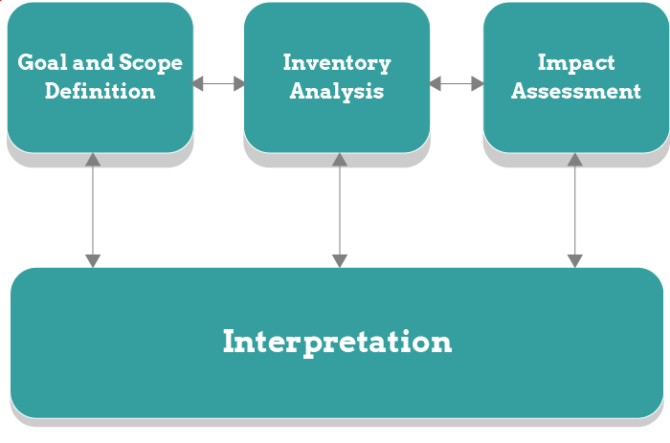
Focusing on products, the stages of an LCA can be separated into distinct phases:

Each phase has a number of inputs and outputs, like consuming a resource and producing waste or byproducts. Examples of inputs related to the lubricant industry might be:

And outputs:

  • Greenhouse gas emissions – operational facilities, product distribution, workforce transport
  • Waste – chemical waste, discarded storage drums, facility solid waste, waste water

Gathering data from the numerous phases of a product’s life cycle and their various inputs and outputs make an LCA a complex and potentially expensive task, especially when a product portfolio is extensive. The process can be broken down into several stages.

  1. Inventory (LCI) – a protracted and painstaking process of collecting and compiling relevant data on the types and flows of raw materials, energy inputs, product life expectancy and outputs.
  2. Impact assessment (LCIA) – the evaluation and refining of data gathered in the LCI associated with identified inputs and outputs into a smaller number of impact categories. LCIA data turns LCI data into environmental impacts using characterization modeling. According to the Encyclopaedia of Energy, an LCIA consists of:
    • Selecting the relevant impact categories
    • Classification – assigning the elementary flows to the impact categories
    • Characterization – modeling potential impacts using conversion factors to obtain an indicator for the impact category
    • Normalization (optional) – expressing potential impacts relative to a reference
    • Grouping – sorting or ranking impact indicators
    • Weighting – relative weighting of impact categories, along with evaluation and reporting
  3. Interpretation – Analyzing the results to reach a set of conclusions that will assist in decision-making. According to the International Standards Organization’s ISO 14040, interpretation should include:
    • Identification of significant issues based on the results of the LCI and LCIA
    • Evaluation of the study, considering completeness, sensitivity and consistency checks
    • Conclusions, limitations and recommendations

LCA Scope

Two familiar phrases associated with LCAs are “cradle to gate” and “cradle to grave.” They both define the scope of the LCA by the point at which measurement ends.

In the first case, cradle to gate, it ends at the point of distribution from the hypothetical factory gates. This can be the basis for a business-to-business environmental product declaration.

A cradle-to-grave approach tracks a product’s impacts until the disposal or recycling phase. The less-common “cradle to cradle” reaches to the point of product reuse, as in a rerefinery.

Environmental Product Declaration

According to the ISO, an environmental product declaration “quantifies environmental information on the life cycle of a product to enable comparisons between products fulfilling the same function.”  

The results of an EPD help a manufacturer to communicate a product’s environmental impact and a buyer to compare that impact with similar products during a business-to-business transaction.

Products are defined using specific product category rules, a patchwork of specifications developed by states and associations, which are verified by an independent third-party panel. Once verified, the EPD report can be registered and published.

LCA and Sustainability

The methodical approach of an LCA, using the ISO’s 14040 family of standards LCA and Eco-efficiency ISO 14040, ISO 14044 and ISO 14045 (see International Standards Organization), can be a useful tool for gathering data on all three sustainability pillars, not just environmental.

LCAs are pertinent to the lubricants industry because the products have identifiable environmental impacts, use phases and disposal requirements. Used lubrication products can be incinerated to create heat and electricity, recycled into other products and rerefined back into base oil.

LCAs are also useful for finding environmentally preferable alternatives to materials, products, systems and services.

A Note About Footprint/Handprint

Two more terms associated with LCA and sustainability are footprint and handprint. Footprint refers to the environmental impact, and measuring it helps reduce that impact as much as possible. The handprint approach aims to reduce a product or service user’s footprint, too. This is assessed by measuring the potential positive impacts when the product or service is used by a customer, as compared to a baseline.

*Embodied energy is energy consumed by all of the processes associated with production.

Oil and natural gas facilities in the United States will need to increase the accuracy of methane emissions data under a final new rule issued by the U.S. Environmental Protection Agency.

The country’s biggest industrial source of methane comes from oil and gas facilities. Methane accounts for a third of greenhouse gases and although it dissipates more quickly than carbon dioxide has a greater effect on climate change.

According to the EPA, the rule strengthens, expands and updates methane emissions reporting requirements for petroleum and natural gas systems under the Greenhouse Gas Reporting Program. The program is required by the Inflation Reduction Act’s Methane Emissions Reduction Program.

“Together, a combination of strong standards, good monitoring and reporting, and historic investments to cut methane pollution will ensure the U.S. leads in the global transition to a clean energy economy,” said EPA Administrator Michael S. Regan in an EPA press release.

The data will be used to calculate a waste emissions fee, which is part of Joe Biden’s Inflation Reduction Act. Operators face a charge of U.S. $900 per metric ton for 2024 emissions. This will increase to $1,200/t next year and $1,500/t thereafter.

The new rule applies to fossil fuels extraction and transportation. But costs derived from compliance with the rule could be passed down the value chain. Industry insiders are said to have raised concerns over the potential for inflated data.

“We are reviewing the final rule and will work with Congress and the administration as we continue to reduce GHG emissions while producing the energy the world needs,” Argus reported American Petroleum Institute Vice President of Corporate Policy Aaron Padilla as saying.

European Union parliamentarians and the Biden Administration are simultaneously working on new laws to curb emissions from industry and the power generation sectors.

The United States, the European Union and China emit half of the world’s annual amount of greenhouse gases. Action on reducing this is high on the political agenda on either side of the Atlantic. The EU and U.S. already have a number of environmental laws bt these new laws put further pressure on major emitters to cut down and to capture carbon.

In Brussels, the European Parliament approved the Net-Zero Industry Act. The act sets a target for EU countries to meet 40% of decarbonization technology needs by 2030 with local production.

“To achieve all our economic, climate and energy ambitions, we need industry in Europe. This Act is the first step to making our market fit for this purpose,” Member of the European Parliament Christian Ehler said.

There is already concern in the bloc over the competitiveness of Europe’s industrial sector. Overcapacity in China and subsidies in the U.S. place increasing pressure on European industries such as chemicals. Signatories to the Antwerp Declaration, which seeks to redress these challenges, is signed by several base oil, lubricant and additive companies and associations.

At the same time in the U.S., the Democratic presidency is introducing a new regulation to reduce emissions from coal and natural gas electricity generation using carbon capture technology. The regulation would require coal- and gas-fired power generators to capture 90% of their carbon emissions. The U.S. Energy Information Agency estimates this could reduce emissions by 1.4 billion metric tons by 2047.

While not singled out explicitly in either legislation, the European and US lubricants industries are consumers of large quantities of electricity.

MEPs from Italy, Austria and Germany signalled they would block a crucial vote on the Corporate Sustainability Due Diligence Directive, believing it would place too great a burden on SMEs.

The vote was postponed last week that would have enacted the new CSDDD. Half of MEPs opposed the directive, media reported. The vote was scheduled for March 8, having been postponed in February. It was rescheduled because the necessary majority not being there for it to pass.

Ahead of another vote on Friday, diplomats from Belgium and technical staff at the European Commission added text to assuage fears that SMEs would be negatively impacted by the law, Euractiv reported.

“CSDDD could be a very good standard but if it is perceived to be so burdensome on introduction, something needs to be scaled back,” said Claire O’Neill, the co-chair at the global imperatives advisory board of the World Business Council for Sustainable Development, to sustainability website Edie.

The EU Presidency had reworded the Directive to ensure that it only applies to businesses with 1,000 or more staff plus annual turnovers above €300 million.

Many of Europe’s lubricant companies will likely be affected by this directive.

Once in law, the CSDDD will mandate requirements for businesses of a certain size to be responsible for their supply chains’ human rights and environmental standards. Germany enacted a similar, albeit less stringent, law last year.

End-users’ increased awareness of their environmental impact is creating a growing market for renewable base stocks and finished products.

Base Stocks

BioAccelergy

BioAccelergy makes plant-based hydrocarbon base stocks for lubricants, transformer fluids and drilling fluids. ExxonMobil entered a joint development agreement with bio-based base stock manufacturer BioAccelergy to commercially scale the company’s products. Its plant-based stocks have BioPreferred status by conforming to U.S. Department of Agriculture specifications.

Biosynthetic Technologies: Estolides

Biosythetic Technologies is leading the charge with an estolide made from soy and castor oil, which provide 12 hydroxy stearic acid. The soy is sourced in the United States and the castor is grown in India, in a very arid environment where nothing else grows and so doesn’t compete with food yet can sustain the local community.

Novvi: Synova

Novvi’s base stock Synova is made in Texas with proprietary technology using plant oil feedstocks. A sugar fermentation technology was previously used but now Novvi mines the best molecules it can from plant sources. Since 2016, Chevron has been an equity investor in the California-based company.

Lubricants

Adnoc: Voyager Green

Voyager PX Green is a carbon neutral and sustainable engine oil formulated with SynNova, a synthetic API Group III base oil manufactured by Novvi from palm, soy, coconut and rapeseed sourced in the United States, Brazil and Southeast Asia. According to Adnoc Distribution, this move into biobased material is part of a sustainability project in which the company is “geared up for readying with plant based synthetic engine oils.” The company is developing DX Green for heavy-duty vehicles and an automatic transmission fluid.

Nynas: Nytro Bio 300X and Nytex Bio 6200

Sweden’s Nynas introduced a bio-based high-performance transformer fluid called Nytro Bio 300X, the first product in its new bio-based range. Nytex Bio 6200 is its first tyre and rubber oil produced using renewable feedstock.

Companies can no longer avoid sustainability. Their upstream suppliers and downstream customers also demand partners take into consideration their own sustainability targets. Lubricant producers and end-user businesses – original equipment manufacturers, metal machinists and food producers – are in the same sustainability boat. They are all looking to suppliers and customers to help meet their own targets. As sustainability continues taking hold in the business world, there could eventually be no choice for entities, big or small, public or private, but to follow suit. And those that enter the arena sooner stand to benefit the most.

Supply Chains

In many industries, supply chains are being replaced by supply networks. Companies are nodes in networks of suppliers and customers that connect with others. What emanates from one node affects other companies that may not be directly connected with each other. 

“No company operates in a vacuum,” said Elaine Cohen, founder and manager of Beyond Business, an environmental CSR consultancy. “Smaller, private companies are all part of larger supply chains, and larger companies are now demanding sustainable practices in their supply chains, and so companies that do not comply may be left out.”  

Major lubricant and chemical companies such as BASF, Croda and Fuchs are building sustainability requirements into their core documents, as are original equipment manufacturers such as Daimler, Volvo and Mercedes. Mercedes went one large step further when it announced in December 2020 that all production materials must be carbon neutral by 2039 at the latest. Suppliers that decline to sign the carmaker’s letter of intent will not be considered for new contracts. Half of its suppliers have signed up to the commitment already. 

Mercedes’ policy has the potential to impact various segments of the lubricant industry, directly and indirectly. Its factory fill lubricant suppliers will have not only to improve their operational sustainability but also examine the carbon footprint of their feedstock. One supplier, Petronas, has set a target of carbon neutrality by 2050, some 11 years after the Mercedes deadline. 

The same would apply to suppliers of industrial fluids used in the automaker’s factories – gear oils, hydraulic fluids, greases and so on. Might it also affect lube suppliers serving Mercedes’ tier one and two suppliers, such as metalworking fluid marketers? 

Value

Proponents argue that instead of being a burden, assessing and improving sustainability increases efficiency and profitability, while also reducing negative environmental and social impacts. Adhering to the principles of sustainability by effectively managing business, treating workers equitably, considering external stakeholders and minimizing environmental impact, they say, help make a business sustainable. 

“We should be discussing sustainability, but not in a generic way, such as mega trends, such as carbon footprint, but in a much more specific way, such as, What does exactly that mean to my customers? What do I aspire to be as a responsible company?” Yana Wilkinson, vice president of the energy practice for Kline & Co., told Lubes’n’Greases.

Compliance Mode

When a company makes an aspect of sustainability a condition of a contract to enhance its own sustainability performance, suppliers in its network have little choice but to fulfil the requirement or lose the ability to bid on a contract. Depending on the particulars, suppliers that do participate may pass requirements on to their suppliers, and so on, rippling outward from the first node.  

They enter what Wilkinson calls “compliance mode.” All efforts become a series of box-checking exercises to satisfy whatever demands the supply chain and regulators have.

“What is happening often is that this conversation is happening, but more as compliance … But then there is a disconnect between doing and saying, and that creates potentially reverse impact,” Wilkinson said.

Beyond the existing regulatory mandates on energy and waste in certain jurisdictions around the world, what compels a company, especially one that is privately held, to engage with sustainability? In this unprecedented period of market chaos, many boardrooms are focused on maintaining operations in the short term. To ask them to scrutinize operations and implement a sustainability strategy that may incur immediate operational expenses could be a financial burden too far. 

Drivers

Markets are currently the chief driver of corporate sustainability. There are a growing number of investors looking to make what is known variously as green, eco or responsible investment in companies with low environmental impact. This is driving publicly traded companies to invest in sustainability impact assessments and reporting along with technologies to reduce resource consumption, to set carbon reduction targets and to streamline operations. 

The business of analyzing corporate sustainability performance has grown rapidly, and now the majority of publicly traded companies and many privately held businesses have sustainability profiles, which are scrutinized and ranked. 

Sustainability is measured through an environmental, social and corporate governance, or ESG, rating generated by third-party agencies. ESG ratings allow internal and external stakeholders a way to compare performance internally with competitors and across sectors, and also a way to measure a company’s value and assets. (See The Investor’s Perspective.)

The investment community’s central role in driving sustainability was underscored by the 2020 annual letter to corporate executives written by Larry Fink, the CEO of U.S. investment firm Blackrock. Fink said his firm will center sustainability in its portfolio and risk management strategy and quit investments with high sustainability-related risk. The firm said it will exit investments in coal, increase investment in sustainable exchange-traded funds and urge index providers to establish sustainable versions of their indices, according to a report by Bloomberg.

In his 2021 letter, Fink told companies they should “disclose a plan for how their business model will be compatible with a net-zero economy.” Generally, what Fink says, goes. “We expect you to disclose how this plan is incorporated into your long-term strategy and reviewed by your board of directors,” he wrote. 

The significance of Fink’s announcements is that Blackrock is the world’s largest asset manager, with U.S. $7.48 trillion in assets under management, of which $1.8 trillion are actively managed. It has a presence in more than 30 countries with, according to Bloomberg, one of the largest shareholders of most U.S. publicly traded companies and clients that include sovereign wealth funds and pension plans. Where it goes, others follow. 

Blackrock is also part of an association of 370 investment firms that pressure greenhouse gas emitters to reform. Combined they manage $41 trillion in assets. 

Aside from attracting the attention of investors, companies that want to improve sustainability performance have access to a new segment of the credit market known as sustainability-linked finance. (See Sustainability-linked Finance.) 

According to EcoVadis, one of a growing number of rating agencies, those companies that report their performance sustainability have scores on the Kaplan-Zingales Index that are 0.6 lower than those for low-sustainability companies.

The Kaplan-Zingales Index is a relative measurement of a company’s reliance on external financing. A higher score implies a greater likelihood a company will struggle under tighter financial conditions since it may have difficulty financing ongoing operations.

“The real mover for a company is financial,” Melissa Menzies, a member of the sustainable finance solutions team at Sustainalytics, an agency that rates organizational sustainability, told Lubes’n’Greases. “If you want to exist as a company and to continue bringing value to your shareholders and … society … you have to seriously think about what material sustainability risks face your business.” 

Talent

Much has been written on the importance of brand loyalty and trust for long-term success. Without them, longevity is impossible. Telling your sustainability story is an ideal platform for building and maintaining stakeholder trust and brand loyalty, as demonstrated by multiple surveys.

“Reputationally, a company that is transparent and operates according to sustainable principles will build trusting relationships with customers, employees, communities, etc., and therefore have a better chance of long-term success,” Cohen said. “This is just as important for smaller companies as it is for larger ones.” 

Moving toward making more sustainable products, such as bio-based lubricants or fluids for electric vehicles, appeals to a demographic that is highly concerned by its environmental impact – millennials. 

“Millennials are the most up-and-coming demographic for investment, they’re the most up-and-coming demographics for just buying products and services and being consumers in a capitalist economy, and they’re increasingly looking for that sustainability angle in a company’s business model to make decisions about what to purchase and what type of investment product they want,” Menzies said. 

According to Pew Research, the number of Millennials exceeded Baby Boomers in 2019. While the environmental attitude gap between Boomers and Millennials is far narrower than most people perceive, according to research carried by the MIT Center for Transportation and Logistics, these youngsters still represent a large and proportionally growing demographic with economic clout. 

Employees are immediately and most strongly affected by sustainability measures that largely play out in their workplace. These go beyond things such as renewable energy installations and schemes to reduce water use into the realms of staff retention, salaries, relations between labor groups and management, occupational safety, morale and loyalty. A valued, content and well remunerated workforce is certainly more sustainable than the reverse. 

Hot on millennials’ heels are younger generations of graduates also take more notice of a company’s sustainability performance when applying for jobs.  

Reporting

The process of reporting sustainability is an effective way of taking a holistic look at where a company can make efficiency gains across the board and where supply network risk might be. Aside from savings on energy use and carbon emissions, there is also an opportunity to examine: 

This detailed examination can lead to profitability gains that feed back into the virtuous sustainability cycle. 

“If you want to exist as a company and to continue bringing value to your shareholders and … society … you have to seriously think about what material sustainability risks face your business,” said Menzies. 

Reporting current sustainability activities has a role to play in determining long-term strategy, not just sustainability. (See Material Issues.) It can also focus the senior team’s attention on compliance with existing and impending regulations, pay equity and employee wellbeing. 

Last, but by no means least, reporting addresses the first and most often emphasized core principles of sustainability – environmental impact. 

“For the company, understanding their impacts on people and planet as a business, and showing transparency, will ultimately make the company stronger and more resilient,” Thijs Reuten, head of policy at the Global Reporting Initiative, told Lubes’n’Greases. 

For some companies, however, the challenge of decarbonization may be too great to overcome. 

“They will always be businesses that by virtue of what they do will cease to exist. That’s the unfortunate truth,” said Menzies.

The drive toward sustainable business is happening, whether companies choose to get onboard or not. 

“The other financial component is that you don’t want your business to become redundant, you don’t want stranded assets on your books and you don’t want to start losing investors and customers because it’s too expensive to continue – you’re either in a dying industry or you haven’t diversified,” she said. 

Swedish lubricant maker Nynas formed a partnership with a leading recycler Stena Recycling to make transformer oils part of the circular economy.

Research firm Markets and Markets predicts demand for transformer oil will increase to U.S.$3.3 billion by 2030. Wider adoption of smart grid infrastructure, greenhouse gas reduction and stricter energy efficiency legislation, will drive this growth especially in Europe.

There are more than 100 collection centres and a number of storage depots for transformer oil in Northern Europe. Stena Recycling has a collection network throughout the continent.

Stena will supply Nynas with used mineral insulating oils from these transformers. Nynas will then process this oil into new transformer fluids.

Nynas uses a catalytic hydrogenation technology to repurpose mineral oils from decommissioned transformers, which power generators would otherwise incinerate. This cuts more than 70% of greenhouse gas emissions compared with virgin oil throughout its lifecycle, the company said.

Nynas produces a range of transformer oil products, including Nitro RR 900X made from rerefined material. This product aligns with the stringent IEC 60296 edition 5 (2020) specifications and ensures all feedstock is sourced from power equipment.

The European Union greenlit a directive regulating how companies can avoid damaging the environment and safeguard human rights. The directive has wide-ranging implications for companies across the EU that do business in and outside the bloc.

On Dec. 14, 2023, the European Parliament, European Commission and Council of Ministers agreed on the Corporate Sustainability Due Diligence Directive (CSDDD) for global supply chains. The Commission published the legislative proposal back in February 2022, and it was adopted in December the same year.

The directive’s reach extends globally and failure to comply risks fines of up to 5% of a company’s turnover. It encompasses a company’s own operations and those of its subsidiaries and partners, both upstream and partially downstream, such as distribution or recycling.

Companies must publicly communicate fulfilment of due diligence obligations, having made them an integral part of corporate policy and risk management. They must also identify, prevent and mitigate actual or potential negative impacts on human rights and the environment, as well as eliminate or minimize actual impacts. They  also need to monitor the effectiveness of due diligence strategies and measures, and establish a grievance mechanism.

These obligations apply to companies of certain size and financial weight. This includes EU limited liability companies with more than 500 employees and global net turnover exceeding €150 million; companies operating in certain sectors – textiles, agriculture, raw materials – with a high loss potential, more than 250 employees and global net turnover of €40 million; and non-EU companies that fulfil the above thresholds and generate turnover in the EU. This, of course, includes lubricant manufacturers. The new directive does not yet affect SMEs.

The trailblazing German Supply Chain Law (LkSG), which has been in force since Jan. 1, 2023, affects companies with more than 3,000 employees. From Jan. 1, 2024, this threshold will be 1,000 employees. 

The CSDDD’ requirements are much broader. It requires companies must also observe environmental obligations in particular, such as the 1.5 degrees Celsius climate target.

If business partners cannot prevent or end the adverse effects on human rights or the environment, companies must terminate business relationships as a last resort, as in the LkSG. 

The CSDDD also lays down rules on penalties and civil liability for infringing those obligations. It requires companies adopt a plan ensuring that their business model and strategy are compatible with the Paris Agreement. 

Sanctions are significant and must be published, leading to reputational damage. In addition to fines, the directive introduces civil liability. Affected parties, including unions and NGOs, can assert claims within five years.

The CSDDD will surely have an impact on the LkSG, which will have to be amended once the directive is adopted. There are apparently discussions as to whether the LkSG, which is perceived by companies as a heavy bureaucratic burden, should be weakened or even suspended in certain areas until the CSDDD is implemented. However, there are no concrete formulation proposals for this as yet. 

Rumors are that these could come in the short term with the draft bill on the implementation of the Corporate Sustainability Reporting Directive.

The Commission and the Council will endorse and formally adopt the provisional agreement in the coming weeks.

STAY SuSTAYnable!

Apu Gosalia

Two ISO sustainability standards have been either launched or are in the pipeline. If widely embraced, both have the potential to simplify a currently complicated mosaic of standards, guidelines and verbiage that surround the drive to reduce companies’ climate impacts.

ISO 14068

The International Standards Organization finally published last week the long-anticipated ISO 14068 standard after a three-year wait. The new standard has the promising title, “Climate change management, Transition to net zero, Part 1: Carbon neutrality.”

The name gives an indication of the hope that this publication could bring a comprehensive and standardized wording and clear recommendations for action to achieve and demonstrate carbon neutrality. It remains to be seen whether ISO 14068 will prevail in the net-zero standard jungle.

Suppliers are labelling a steadily increasing number of organizations, products and services as “climate neutral.” The aim is communication of their environmental credentials to appeal to consumers. From a consumer perspective, environmental claims on climate neutrality must be credible and based on reliable methods of greenhouse gas accounting and communication of the results.

However, there are currently many approaches. Rather than offering choice, it makes the market opaque for the observer. There is also a risk of greenwashing and consumers can be misled by dubious claims.

In 2019, the British Standards Institute initiated the development of the ISO standard 14068 Carbon neutrality to remedy this situation. The standard is intended to define requirements and principles that must be demonstrated when the term carbon neutrality is used in communications. These relate to the management of greenhouse gas emissions with aspects of quantification, avoidance, reduction, substitution, compensation and sequestration.

The primary focus of ISO 14068 is on organizations and products. The standard prioritizes striving for and achieving carbon neutrality by reducing direct greenhouse gas emissions. Central to this is a hierarchical approach in the climate management plan. The plan places first avoidance, reduction and substitution of direct and indirect greenhouse gas emissions. Offsetting the remaining emissions follows. 

In addition to requirements for targets, the standard will set out specifications for achieving and verifying carbon neutrality. The scope of application is broad and includes besides organizations and products, also companies, local authorities, products, buildings, events and services. It is therefore particularly important that the standard helps to ensure a transparent and responsible use of the term carbon neutrality in the future. 

With the rising scrutiny on carbon neutrality claims and the imperative to combat greenwashing, the timing couldn’t be better. ISO 14068 is, therefore, poised to become a vital resource for professionals and organizations in search of authentic methods to attain carbon neutrality for their company and its products.

ISO 53001

The successful application by organizations of the 17 UN Sustainable Development Goals (SDGs) will be certifiable in future. To do so, ISO are currently developing a new management system standard with ISO 53001. This will allow companies to certify themselves. The focus will be on organizations making an effective, efficient, systematic and measurable contribution to achieving the SDGs.

This sounds good news for many reasons. We need to speed up the implementation of the SDGs. Organizations of all kinds can and should contribute to this in a targeted manner. For sustainability to succeed effectively in organizations, a well-functioning and holistic sustainability management system is essential. In the future, organizations will be able to show that progress is based on certified processes, responsibilities and measurability in addition to their sustainability report.

All good news in the last month of the year. But at the end of the day, any standard can only be as good and useful as the people, companies and organizations living up to and following them.

STAY SuSTAYnable!

Apu Gosalia

The International Standards Organization is recognized for its catalog of more than 21,500 standards that cover almost everything. Standards, developed by the ISO’s 244 technical committees, help companies operate transparently, track progress against targets and compare performance with peers. They also make verification easier and can harmonize with other reporting frameworks.

The implementation of ISO standards helps identify carbon-intensive processes, potential energy savings and places where improvements can be made in corporate governance and social benefits, similar to a materiality assessment (see Materiality). 

ISO 14000 Environmental management is a suite of standards that help organizations measure their operational impact on the environment, as well as with compliance and improvement. The focus of ISO 14000 is on production processes rather than products themselves. The ISO 14000 family of standards is in line with the United Nations Sustainable Development Goal 13 Climate Action.

ISO 14001 Environmental management systems maps out a framework that a company or organization can follow to set up an effective environmental management system so it can enhance its environmental performance and achieve goals. ISO 14001 is an integral part of the European Union’s Eco-Management and Audit Scheme, a voluntary environmental management scheme that has similar aims as ISO 14000. 

ISO 14007 Environmental management — Guidelines for determining environmental costs and benefits is used to determine an organization’s environmental costs and benefits by identifying, documenting and disclosing its dependence on natural resources. These costs and benefits can be expressed quantitatively or qualitatively. 

ISO 14008 Monetary valuation of environmental impacts and aspects is a framework for the monetary valuation of an organization’s activities, products or services that interact or can interact with the environment, i.e., aspects, and impacts on the environment resulting from aspects. 

ISO 14040  Environmental management — Life cycle assessment — Principles and framework is a general introduction to the principles of life cycle assessment and life cycle interpretation, which is described as “a systematic technique to identify, quantify, check and evaluate information from the results of the life cycle inventory and/or the life cycle impact assessment.”

ISO 14044 Environmental management — Life cycle assessment — Requirements and guidelines specifies requirements and provides guidelines for life cycle assessments, including the definition of goals and scope, the life cycle inventory analysis phase, impact assessment phase, interpretation phase, reporting and critical review, limitations, relationship between phases and conditions for use of value choices and optional elements. 

ISO 14045 Environmental management — Eco-efficiency assessment of product systems — Principles, requirements and guideline for product systems sets out the goal and scope definition of an eco-efficiency assessment; environmental assessment; product-system-value assessment; the quantification of eco-efficiency; interpretation, including quality assurance; reporting; and critical review of the eco-efficiency assessment. 

ISO 14064 Greenhouse gases — Part 1: Specification with guidance at the organization level for quantification and reporting of greenhouse gas emissions and removals is a complementary set of tools for programs to quantify, monitor, report and verify greenhouse gas emissions. The ISO 14064 standard supports organizations to participate in both regulated and voluntary programs such as emissions trading schemes and public reporting using a globally recognized standard. 

ISO 14067 Greenhouse gases — Carbon footprint of products — Requirements and guidelines for quantification is a framework for measuring and reporting products’ greenhouse gas emissions with a focus solely on environmental impact. It sets out the design, development, management, reporting and verification of a product’s carbon footprint and is consistent with the life cycle assessment standards ISO 14040 and ISO 14044. It also complements the 13th United Nations sustainable development goal on climate action and is formally similar to the Greenhouse Gas Protocol, allowing either to be used when submitting emissions data. 

ISO 14068 Climate change management, Transition to net zero, Part 1: Carbon neutrality focuses on organizations and products. Priority is given to striving for and achieving carbon neutrality by reducing direct greenhouse gas emissions. Central to this is a hierarchical approach in the climate management plan, in which avoidance, reduction and substitution of direct and indirect greenhouse gas emissions come first, followed by offsetting the remaining emissions. 

ISO 50001 Energy management is guidance for a company that wants to address its environmental impact and reduce resource consumption by implementing, maintaining and improving its energy management systems. It provides a framework for energy policy development; setting targets and objectives; using data to understand and make decisions, measuring results; reviewing policy effectiveness; and continually improving. Certification is optional but could be competitively advantageous. ISO 50001 is in line with UN SDG 7, affordable and clean energy.

ISO 53001 Management Systems for UN Sustainable development goals – Requirements will allow companies to certify themselves. The focus will be on organizations making an effective, efficient, systematic and measurable contribution to achieving the SDGs.

ISO 14030 Environmental performance evaluation — Green debt instruments, and ISO 14097 Climate-related metrics for the finance sector are still in development. 

ISO 26000 Social responsibility is a set of guidelines, not requirements, that clarify what social responsibility is, helps businesses and organizations translate principles into effective actions and shares best practices relating to social responsibility, globally. It is aimed at all types of organizations regardless of their activity, size or location. ISO 26000 is in line with UN SDG 5 Gender Equality and SDG 10 Reduced Inequalities.

ISO 37101 Sustainable development in communities helps them establish a management system for sustainable development through strategies, programs, projects, plans and services. The community can designate an organization to implement the standard. 

ISO 45001 Occupational Health and Safety Management Systems helps organizations improve employee safety and reduce workplace risks.

ISO 19600 Compliance management systems – Guidelines helps organizations establish, develop, implement, evaluate, maintain and improve on an effective and responsive compliance management system. Certification is not mandatory. 

ISO 37001 Anti-bribery management systems helps organizations of any size or type to implement procedures that tackle bribery. It provides a framework for devising an anti-bribery policy; appointing an anti-bribery compliance officer; carrying out training, risk assessments and due diligence on projects and business associates implementing financial and commercial controls; and instituting reporting and investigation procedures. It is limited to management systems and can be standalone or integrated with other systems, like ISO 9001 Quality Management System. ISO 37001 is in line with UN SDG 1 No Poverty, SDG 8 Decent Work and Economic Growth and SDG 10 Peace, Justice and Strong Institutions.

The Environmental Protection Agency has stepped back from reclassifying used oil and wastewater mixtures as hazardous waste, leaving existing regulations in place. The decision is good news, says the Independent Lubricant Manufacturers’ Association (ILMA).

ILMA was keen to persuade the EPA against designating recycled oil and oily water hazardous waste. The association thinks that current regulations have been effective at encouraging used oil collection since the early 1990s. Changing the regulations could reduce collection and recycling rates.

In the mid-1980s, the EPA announced its intention to make used oil hazardous waste under the Resource Conservation and Recovery Act (RCRA). Had this happened, this would have had several financial and compliance implications. Some state officials more recently urged the EPA to subject oily wastewater with less than 50% oil to testing and should it fail those tests be managed as hazardous waste. They felt exempting oily wastewater of this concentration was a loophole in the regulations. 

“ILMA worked tirelessly … to convince EPA that the best way to increase the collection and recycling of used oil was to create a regulatory incentive — manage it properly and it won’t be an RCRA hazardous waste; manage it improperly and you’re in the RCRA hazardous waste scheme,” Jeff Leiter, ILMA’s general counsel, told Lubes’n’Greases via email.

The EPA’s Used Oil Management Standards (40 CFR Part 279) went into effect as part of the RCRA in 1992. At the time, ILMA convinced the EPA that used oil, including oily wastewater mixtures, should not be classified and therefore handled as hazardous wastes if properly managed and recycled. The Used Oil Management Standards are largely unchanged since. ILMA believes they have increased the volumes of used oils collected and recycled.

Rerefiners supported the initiative, primarily Safety-Kleen, which is the country’s largest collector and rerefiner of used lubricant.

“The Used Oil Management Standards have worked effectively for over three decades. Importantly, it has created a market for used oil to make its way back for rerefining or other processing. It has reduced environmental releases. It’s been a smart way to regulate,” Leiter said.

The adverse effects from altering the Used Oil Management Standards could have been significant, Leiter explained. If the EPA had modified the standards for used oil and wastewater mixtures with less than 50% oil, parties would face an immediate cost from testing and handling oily wastewater as hazardous waste, along with compliance issues from being subject to the RCRA Subtitle C (hazardous waste) regulations.

It would have also made parties liable under the recently passed Comprehensive Environmental Response, Compensation, and Liability Act. The act, known colloquially as the Superfund, is a tax levied on chemicals and petroleum industries to pay for clean-up of spills, compensation and emergency responses.

This would be especially burdensome for ILMA members that produce metal working fluids. Reclaiming and polishing customers’ spent MWFs would have to be carried out under hazardous waste rules, including transportation.

Can a steel producer and a wind turbine manufacturer both be considered “sustainable”? Steel is one of the most energy-intensive industries while wind turbines are a vital component in the future of low-emissions energy. It somewhat depends on what these two companies do, how they do it, how you define what sustainable means, how you measure it and who you ask.  

Sustainability means different things to different people and has different impacts depending on the organization. A starting place to look for a useful definition is the dictionary. Sustainability is “the ability to be maintained at a certain rate or level.”

The United Nations World Commission on Environment and Development adds to this definition with its core principle about sustainable development:

“Sustainable development is development that meets the needs of the present without compromising the ability of future generations to meet their own needs.” (See UN 17 SDGs.) 

The University of California at Los Angeles Sustainability Committee further builds on this principle:

“Sustainable practices support ecological, human and economic health and vitality. Sustainability presumes that resources are finite, and should be used conservatively and wisely with a view to long-term priorities and consequences of the ways in which resources are used.” 

Corporate sustainability is typically understood to mean an attempt to use resources responsibly, carry out business profitably and treat the workforce and communities equitably. It includes factors such as manmade climate change, resource use, social responsibility and corporate governance.

“I believe that at its core, corporate sustainability means continuous improvement and there is no bigger room than room for improvement,” said Apu Gosalia, an independent sustainability consultant and academic, told Lubes’n’Greases.

This can include innovating and developing environmentally friendly lubricating products, continually improving processes, reducing energy use, resources and waste, not to mention the de facto contribution lubricants make to sustainability by reducing friction, wear and corrosion, as about 30% of the world’s energy is consumed in friction and wear processes.


Three Pillars 

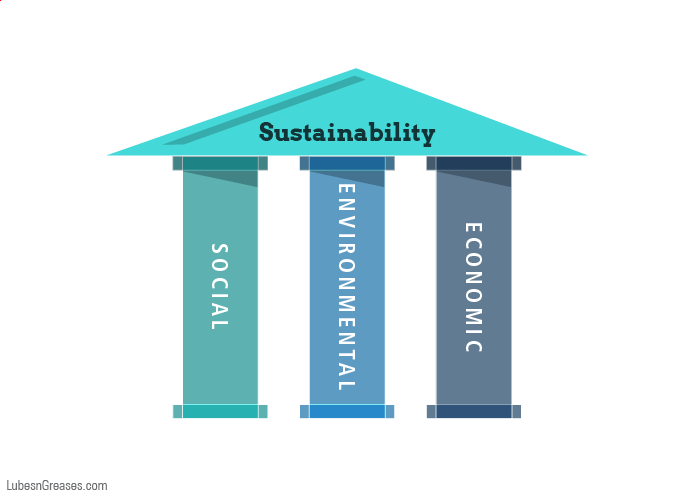
The definitions above can be depicted by the “three pillars” or “triple bottom line” of sustainability. Each pillar represents a broad area of concern – social, environmental and economic – against which an organization’s impact can be examined. Many of the principles and goals of sustainability apply across all types of businesses. But Sustainability InSite will also look more closely at how they apply to the lubricants industry and the companies that form it. In this context, what is sustainability? Is it reducing carbon emissions and waste? Or is it more to do with innovation and profitability? Is it corporate social responsibility and accountability? It is creating a balance of all of those things.  

Each pillar can be further divided into impacts a business might have on the world and the impacts from outside it faces in return, as well as the opportunities sustainable operations might present. For example, the environmental pillar can be divided into a company’s carbon emissions, energy efficiency, resource use and waste management. The social pillar can be divided into the treatment of the workforce, position on human rights, corporate citizenship, community engagement and data privacy. The economic pillar can be split into, increasing  shareholder and stakeholder value.

Examining these impacts lays the foundation for a strategy to use resources responsibly and efficiently, do business transparently and profitably, and treat the workforce and communities equitably. It also helps communicate these efforts to stakeholders. Sustainability advocates – along with a growing number of business analysts – would say that the process future proofs your business.  

It’s easy to see how acting with consideration for such things can benefit workers, the community and the environment. A 2020 report by the Organization for Economic Co-operation and Development examining the ESG investment market contends that companies themselves can also benefit. “A poor environmental record may make a firm vulnerable to legal action or regulatory penalties; poor treatment of workers may lead to high absenteeism, lower productivity, and weak client relations; and weak corporate governance can incentivize unethical behaviors related to pay, accounting and disclosure irregularities, and fraud.” 

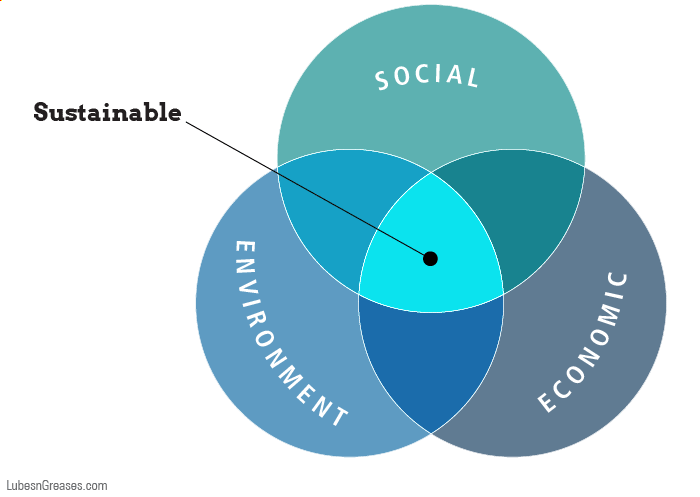
Having each grown independently over time, the three pillars join up to form an overarching concept of sustainability, as can be seen in the diagram above – the intersection of the three circles creates a sustainable sweet spot. This diagram first appears in 1987, and the three pillars concept predates it. Sustainability is not a new concern.  

“Sustainability is a core element of sound corporate management in which economic, ecological and social aspects are taken into consideration and harmonized,” independent German lubricant company Fuchs Petrolub states on its website.

Yet it is still difficult to pin down a universal definition, say Ben Purvis, Yong Mao and Darren Robinson, researchers from the University of Nottingham in the United Kingdom, in a paper published in the journal Sustainability Science. This, they think, “frustrates approaches towards a theoretically rigorous operationalization of ‘sustainability’.” There’s no one-size-fits-all solution and no consensus about what constitutes material action. 

A key challenge is that there are some standard definitions but they still leave room for interpretation. That said, there are concerted efforts by a number of organizations to develop overarching frameworks and standards, which is discussed in more detail further on. What follows presents the current t

The European Automobile Manufacturers’ Association said the European Union’s new proposal for heavy-duty transport emissions reduction is not fit purpose. Original equipment manufacturers would struggle to comply with targets that are ambitious on paper to avoid heavy penalties, despite “unwavering commitment to decarbonisation and record investment levels in zero-emission vehicles.”

ACEA expressed its concerns after Members of the European Parliament voted on October 24 to adopt proposals to strengthen carbon dioxide reduction targets for medium and heavy-duty trucks and buses. These targets would be a reduction of 45% for 2030-2034, 70% for 2035-2039 and 90% as of 2040.

Heavy-duty vehicles account for more than 25% of the EU’s road transport greenhouse gas emissions. They also account for more than 6% of total EU emissions. ACEA thinks that proposal places the onus to decarbonise too far on its members’ shoulders. Customers are reluctant to buy zero-emissions vehicles because of a “pervasive lack of charging and refilling infrastructure.”

“Decarbonising heavy-duty transport is not a solo endeavour,” said Sigrid de Vries, ACEA director general, in a press release. “We operate within a highly interconnected transport ecosystem. To create an environment where vehicle manufacturers can thrive and meet targets, we need a collaborative effort from all stakeholders, including policymakers.” 

de Vries argues that until uptake enablers are in place, such as purchase and tax schemes, compliance is largely dependant on factors outside of OEMs’ direct control. This makes the EU’s carbon targets unachievable.

“The transition towards zero-emission trucks and buses is not only key to meeting our climate targets, but also a crucial driver for cleaner air in our cities. We are providing clarity for one of the major manufacturing industries in Europe and a clear incentive to invest in electrification and hydrogen,” said Rapporteur Bas Eickhout. “We’re building on the Commission’s proposal, but with more ambition. We want to expand the scope of the rules to small and medium-sized lorries and vocational vehicles – sectors which are especially important for urban air quality – and we’re adapting several targets and benchmarks to catch up with reality, as the transition is moving faster than expected.”

Sustainable development is one of the European Union’s fundamental policy objectives. Over the decades, EU lawmakers have introduced a raft of treaties and regulations that manage how European companies impact the environment, workplace and corporate governance. 

Brussels’ current sustainability drive is encapsulated in the Fit for 55 initiative, a package of proposals that the EU hopes will achieve its goal of reducing net greenhouse gas emissions by at least 55% by 2030. The aim is to ensure a just and socially fair transition to a sustainable future, and maintain and strengthen innovation and the competitiveness of European industry.

Sustainability provisions are in the Treaty of Amsterdam, the Treaty of European Unionthe Sustainable Development Strategy, the Better Regulation Agenda, the Environmental Action Program, the Non-financial Reporting Directive and the Green Deal. The EU’s sustainability policy direction is in part guided by the United Nation’s 2030 Agenda and 17 Sustainable Development Goals, of which it was an instrumental contributor.  

Non-financial Reporting

The EU’s aims are economic growth, price stability, competitive market economy, full employment, social progress and the protection and improvement of the environment across all member states. Yet, being the world’s largest trading bloc, the implications of EU sustainability policies on companies that wish to do business with or in Europe will be substantial. This is already observed in the effects that the Registration, Evaluation, Authorization and Restriction of Chemicals, or Reach, has had on the global chemicals industry and many other industries. The Green Deal and the updated Non-Financial Reporting Directivewill likely have a similar impact outside of the EU. 

The NFRD is the EU’s landmark sustainability legislation. Designated Directive 2014/95/EU, the NFRD is considered one of the first major steps toward widespread mandatory sustainability provisions and was fully adopted by all 28 EU member states, as was, by 2018. The current version of the NFRD aims to enable investors, consumers and other stakeholders to evaluate large companies’ non-financial performance and foster a more sustainably responsible operations.

The directive requires companies operating in the EU with a workforce of 500 people or more to disclose their non-financial information and describe their impacts and mitigation strategies related to five areas of their business: the environment, Society and workforce, executive diversity, human rights, and anti-corruption and bribery. 

Organizations covered by the NFRD are described by the legislation as “listed companies, banks, insurance companies and other companies designated by national authorities as public-interest entities.” The NFRD gives companies the latitude to select from the plethora of reporting frameworks the one that aligns with ISO 26000. The resulting non-financial statement can exist outside of the annual report and be submitted separately. 

As a supplement to the NFRD, the European Commission published its guidelines on disclosing environmental and social information in 2017, then in 2019 the guidelines on reporting climate-related information. The guidelines aim to “help companies disclose high quality, relevant, useful, consistent and more comparable non-financial … information in a way that fosters resilient and sustainable growth and employment, and provides transparency to stakeholders,” says the EU in its guidelines on non-financial reporting.  

The NFRD’s stipulations will potentially be strengthened to support the goals of the Green Deal and the proposed Corporate Sustainability Reporting Directive. Some of this support could be derived from stakeholder opinions gathered during the European Commission’s 2020 Inception Impact Assessment on the Revision of the Non-Financial Reporting Directive. Feedback included, among other things, that even smaller companies should be mandated to disclose. 

“A significant current development is the European Commission’s review of the [NFRD], which aims to ensure mandatory sustainability reporting by all companies of over 250 employees in the European market, an effort GRI fully supports,” Thijs Reuten, the head of policy at the Global Reporting Initiative, told Sustainability InSite. 

There are about 25 million active enterprises in the EU. Of those, 6,000 employ more than 500 people, whereas 50,000 have a staff more than 250. Companies are only compelled to report and not to make adjustments to their operations. Sweden and Finland already require that companies of 250 staff or more should disclose and in Greece it is a few as 10. 

The consultation also reported that it was “hard for investors and other users to find non-financial information even when it is reported.” Critics point to companies’ exemption from disclosing non-financial statement with management reports.  

Some have criticised the NFRD for not being forward-looking enough. Critics also point to the variances in codifying the directive into individual member states’ laws. Companies are responsible for compliance and must also be aware of national variations across the bloc. They argue that the side effect of disharmony is increasing the complexity of compliance efforts for companies with operations throughout the bloc. This could rule out certain countries as destinations to establish operations by non-EU entities. Lastly, there are concerns that the NFRD’s broad approach may not suffice to reach the climate goals it set out to achieve in the first place. 

In 2021, the EU proposed a new directive that would amend and extend the scope of the NFRD. The draft directive will apply to all large companies and companies listed on regulated markets. It will also lay out more detailed reporting requirements, including a requirement to report according to mandatory EU sustainability reporting standards. This expanded scope could cover 50,000 enterprises in the EU zone.

Other aims of the CSRD include transparency for investors; tag the disclosed information with a digital marker so that its machine readable for integration with the Capital Markets Union action plan; so-called double materiality, whereby companies report their impacts as well as the impact climate change has on the organization; and provide clarity for ESG investors. 

Taxonomy Regulation

The EU Taxonomy Regulation is a classification system that sets out a list of what it considers are environmentally sustainable economic activities. It seeks to address the lack of standardized definitions and processes in environmental, social and governance reporting. The regulation does this by providing a classification system that investment firms must use to classify investments based on NFRD data, as well as other data sets, with a longer-term aim to replace voluntary systems in Europe. 

Published in June 2020, it has six main objectives: the mitigation of climate change, adaptation to climate change, sustainable use and protection of water and marine resources, transition to a circular economy, pollution prevention and control, and the protection and restoration of biodiversity and ecosystems. It is estimated that it will cover industries that generate 80% of all greenhouse gas emissions in the bloc.

The regulation currently encompasses environmental factors, but social and governance will be included by the end of 2021. The environmental classification system came first in order to meet the first Paris Agreement deadline in 2020, which virtually every country missed. 

The Taxonomy Regulation’s first delegated act came into force Jan. 1, 2022, and covers sustainable activities for climate change adaptation and mitigation. The European Commission started consultations on the second delegated act, which will cover the remaining objectives. Delegated acts are non-legislative acts adopted by the European Commission that serve to amend or supplement the non-essential elements of the legislation.

Sustainable Finance

Under the Sustainable Finance Disclosure Regulation, investment companies must disclose the environmental sustainability of their investments, as well as the veracity of any ESG claims. The SFDR and the Taxonomy Regulation provide investment companies with a compliance framework with the Paris Agreement climate targets and the UN 17 SDGs. 

The cap-and-trade style Emissions Trading System is the cornerstone of the European Union’s plan to reduce carbon emissions by 55% by 2050. According to the EU, it limits omissions from more than 11,000 heavy energy using installations, including power stations and industrial plants, as well as airlines operating between EU member states plus Iceland, Liechtenstein and Norway. 

The scheme, set up in 2005, now covering about 45% of the EU’s greenhouse gas emissions and limits emissions from the largest emitting companies. It works by setting a gradually lowering cap on the total quantity of greenhouse gases that can be emitted by a participant installation. Companies can receive or buy allowances that must be surrendered at the end of each year; otherwise heavy fines are imposed. 

Participant companies can trade allowances or keep spare ones to cover future emissions. As the cap is reduced, fewer allowances are available which drives up their value and makes energy saving more financially attractive.

Directives

Ecodesign Directive: framework to set mandatory ecological requirements for 40 energy-using and energy-related product groups.

Sustainable Products Initiative: initiative to revise the Ecodesign Directive and propose additional legislative measures as appropriate, with the aims to make products on the EU market more sustainable.

Ecodesign for Sustainable Products Regulation: proposed regulation to expand the existing Ecodesign Directive, published March 30, 2022.

Circular Economy Action Plan: a collection of 54 legislative and non-legislative actions aimed to transition the European economy from a linear to a circular model and four legislative proposals on waste. The plan was adopted in 2015 and ended in 2020.

In early 2024, the Council and the European Parliament worked on a regulation that would strengthen the manufacturing of Europe’s net-zero carbon technology products called the Net-zero Industry Act.

The European Council has adopted a new directive that will increase use of renewables in overall energy consumption. According to a council press release, the directive demands that by 2030 42.5% of the energy used in the bloc be renewable.

The EU’s updated renewable energy directive’s areas of concern include transport and industry. Member states must now choose between a binding 14.5% reduction in greenhouse gas intensity from transport by using renewables by 2030 or at least 29% of renewables within the final consumption of energy in the transport sector by the same year, the commission said.

The directive includes a sub-target of 5.5% advanced biofuels from non-food sources and renewable fuels such as hydrogen.

“This is a great achievement in the framework of the ´Fit for 55´ package which will help to achieve the EU’s climate goal of reducing EU emissions by at least 55% by 2030. It is a step forward which will contribute to reaching the EU´s climate targets in a fair, cost-effective and competitive way,” said Teresa Ribera, Spain’s acting minister for ecological transition.

California’s new carbon emissions disclosure law has reached the desk of California Governor Gavin Newsom. When signed, it will make Bill 253 the first mandatory emissions reporting law in the country.

On its own, California is the world’s fifth largest economy. It also emits 370 million metric tons of carbon dioxide equivalent per year, according to the California Air Resources Board.

Despite being state legislation rather than federal, the law will have a potentially wider-reaching impact. About 5,000 companies will have to disclose their emissions. Many of these comapnies operate globally, according to a report in the New York Times. One of them is Chevron, which has its headquarters in the state and produces base oil, additives and lubricants around the world.

California’s emissions disclosure law will require U.S. companies with revenue of more than U.S. $1 billion that do business in the state to disclose emissions from all scopes – Scope 1 direct emissions, Scope 2 electricity purchase and use, and Scope 3 indirect emissions from supply chains, travel, employee commuting, procurement, waste and water usage. Disclosure will be carried out using the Greenhouse Gas Protocol standards and will be assured by a third party.

“In announcing he will sign SB 253, Governor Newsom is reaffirming California’s global climate leadership. These carbon disclosures are a simple but intensely powerful driver of decarbonization. When business leaders, investors, consumers, and analysts have full visibility into large corporations’ carbon emissions, they have the tools and incentives to turbocharge their decarbonization efforts,” said Senator Scott Wiener, who introduced the bill.

The Greenhouse Gas Protocol is the world’s most-widely used framework to measure and account for an organization’s greenhouse gas emissions. The GHGP includes a set of globalized standards, tools, guidance and training for entities in the public and private sectors.

The protocol forms the basis of mandatory greenhouse gas reporting in countries including the United Kingdom, United States and member states of the European Union. Other countries such as Brazil, India, Mexico and the Philippines use the GHGP on a voluntary basis. In 2023, California introduced a law that mandates emissions disclosure for companies that do business in the state and that earn revenue of more than U.S.$1 billion per year. Almost all Fortune 500 responding to the Carbon Disclosure Project adhere to the GHGP.

About

The origins of the GHGP date to the late 1990s, when the World Resources Institute and the World Business Council for Sustainable Development published a report that urged action on addressing climate change. The report called for a standardized measurement methodology of greenhouse gas emissions.

The first edition of the GHGP was published in 2001 and has since been updated with additional guidance that clarifies how companies can measure emissions from electricity and other energy purchases and account for emissions from throughout their value chains. The GHGP comprises a range of tools companies can use to calculate their emissions and measure the benefits of climate change mitigation projects.

The GHGP is generally regarded as being more descriptive than ISO 14064, with more guidance and with real-world examples often included. It also addresses voluntary greenhouse gas targets, reflecting its focus on “aspirational” emissions scenarios, compared with the “standardization” method of ISO 14064.

>The GHGP can be viewed here.

Standards

The GHGP has several covers three emissions classifications, known as scopes, and certain areas of the value chain.

The Corporate Accounting and Reporting Standard provides the accounting platform for virtually every corporate GHG reporting program in the world. It covers the accounting and reporting of the greenhouse gases listed in the Kyoto Protocol: carbon dioxide, methane, nitrous oxide, hydrofluorocarbons, perfluorocarbons, sulfur hexafluoride and nitrogen trifluoride. It was updated in 2015 with the Scope 2 Guidance, which allows companies to credibly measure and report emissions from purchased or acquired electricity, steam, heat, and cooling.

The Corporate Value Chain Standard (Scope 3) accounts for emissions at the corporate level. It helps companies identify GHG reduction opportunities, track their performance and engage suppliers. The standard enables comparisons of a company’s emissions over time.

The Protocol Product Standard accounts for emissions at the individual product level and helps a company meet the same objectives at a product level.

The Project Protocol for Project Accounting is an accounting tool for quantifying the greenhouse gas benefits of climate change mitigation projects.

Process

An organization or third party working on its behalf can use a set of calculation tools in the form of spreadsheets with accompanying guidance. These tools use “emission factors” that relate the organization’s activities to the emitted greenhouse gases. These emissions factors can be default or custom. Although encouraged to generate custom emissions factors, companies can enter activity data, such as distances, fuel consumption and electricity usage. The GHGP’s emissions factors are based on those of the Intergovernmental Panel on Climate Change.

Applicability

The GHGP is widely applicable to almost every organization that wants to account for its greenhouse gas emissions.