Sustainability has become a defining priority for the modern lubricants industry. As manufacturers and end-users seek solutions that reduce environmental impact without compromising reliability, synthetic lubricants really stand out.
Mineral oils have continued to dominate the market due to their availability and performance. Despite positive developments in re-refined base oils (RRBOs), both RRBOs and virgin fossil mineral oils still rely heavily on additive packages to achieve performance, which adds complexity and an environmental burden.
Synthetic lubricants, by contrast, are purpose-built at the molecular level to deliver properties such as thermal stability, oxidation resistance, and controlled viscosity. This precision engineering offers innumerable benefits, such as longevity – a key principle in the waste hierarchy that prioritizes reduction over disposal.
The primary role of lubricants is to reduce friction, lower energy losses, and extend equipment life – all of which contribute to emission reductions. Synthetic esters, such as Perstorp Synthetic-EF base fluids, excel in even the most challenging conditions, maintaining performance where other chemistries fall short. These advanced polyol esters are tested for biodegradability and low toxicity, making them ideal for environmentally sensitive applications, while their stability improves circularity across entire systems by reducing maintenance and minimizing waste.
At Perstorp, sustainability is embedded in our products. Our approach combines advanced molecular engineering with responsible sourcing and a science-based approach to product sustainability claims, including LuSC listing. Furthermore, Synthetic-EF base fluids achieve a lower product carbon footprint (PCF) thanks to optimized formulations with backwards integrated raw materials. By integrating renewable and recycled feedstocks, we’re further reducing dependency on fossil resources.
With synthetics, every bit of the molecule can be transitioned to more sustainable feedstocks such as biobased or recycled. Using a mix of methods, including ISCC PLUS-certified mass balance with chemical and physical traceability, and by sourcing biobased raw materials, Perstorp’s roadmap aims to transition our ester production to use only renewable and recycled carbon sources and consequently to reduce the PCF of the products.
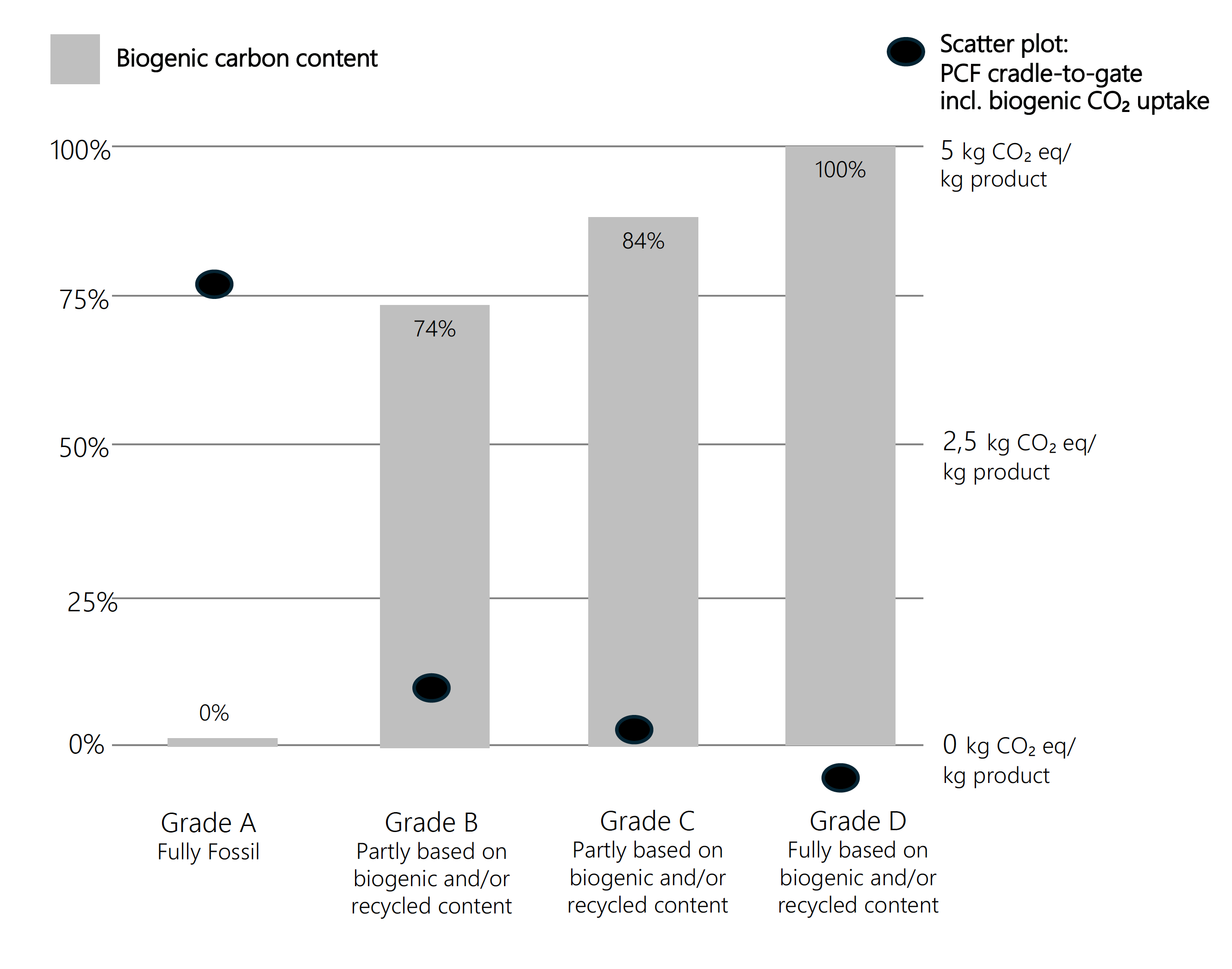
The bar chart pictured shows the increase in biogenic carbon content and the reduction of PCF values (represented as dots in a scatter plot) for the same base fluid across four different grades.
Synthetic lubricants are far more than a performance upgrade – they are a lever for sustainability. By combining engineered design, environmental benefits, and a roadmap for integration of renewable resources, Perstorp is accelerating the transition to a lower-carbon future.
To find out more about Perstorp’s Synthetic-EF base fluids, visit https://www.perstorp.com/en/products/engineered_fluids/synthetic_base_fluids_for_lubricants