

What’s Your Good News?
On my evening walk, a note written on the sidewalk with chunky chalk caught my attention—it read: “What’s your good news?” Passersby had scribbled several answers, from a light-hearted “I am going on a trip!” to a more sobering “My mom beat cancer!” This casual exchange of personal tidings made me realize that while reporting on the base oils market, I had mostly focused on negative news over the last few months. With the war between the United States and Iran largely unresolved in early August and many issues still afflicting the base oils industry as a consequence of the conflict, it had been difficult to find positive things to say about the situation.
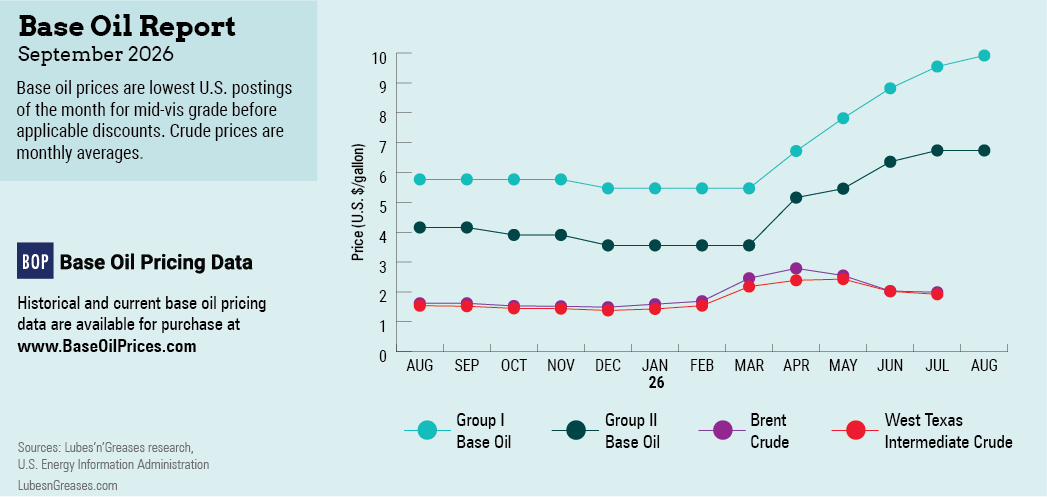
Of course, wars can be very profitable for some companies, but they are also profoundly harmful to the countries involved because they can cause massive loss of human life, devastating economic consequences and destruction of essential infrastructure. In the case of the base oils and lubricants industry, the ongoing hostilities and damage of base oil plants on the Persian Gulf and the closing of the Strait of Hormuz were expected to result in short- and long-term supply disruptions, price turmoil and demand erosion, with no region being spared.The API Group I and Group II segments showed a very tight supply and demand ratio as well, and these fundamentals, coupled with soaring crude oil futures, had driven U.S. base oil suppliers to increase posted prices almost on a weekly basis since early March. The prospect of a reopening of the strait and a resumption in crude oil flows from the Middle East in late June led to a sharp fall in crude oil prices, and a pause in base oil price adjustments. Furthermore, a number of blenders had been unable to absorb the steep base oil values, and demand in some segments had started to soften.
As July came to an end, market attention momentarily turned to events taking place closer to home than the Middle East conflict, as a tropical storm threatened to disrupt refinery operations along the U.S. Gulf Coast and a North American Group II/Group III producer announced that production would be permanently halted by the end of 2027. Needless to say, the U.S.-Iran war was still on everyone’s radar, but for a moment, other issues took center stage.
Tropical Storm Bertha first made landfall in southern Louisiana on July 22, and while it did cause a malfunction at Phillips 66’s Sweeny refinery in Texas, it fortunately did not affect production at other refineries along the U.S. Gulf Coast. Market participants typically maintain extra inventories in case of production disruptions from June until November–a plan that has been slightly complicated by the tight supply situation affecting most base oil categories.
Another positive aspect was that base oil demand in North America remained robust, despite elevated prices and supply uncertainties. The Group III segment has been particularly affected by a critical supply crunch because of the war in Iran and the closing of Hormuz. That is why some market participants found it slightly unsettling when HF Sinclair announced that it was retiring its Group II and Group III plant in Mississauga, Canada, by the end of 2027 as part of a company transformation. The Petro-Canada base oils plant in Mississauga has the capacity to produce 11,600 barrels per day of Group II base oils and 4,000 bbl/day of Group III base oils, according to Lubes’n’Greases’ Base Stock Plant Data.
In a press release, HF Sinclair also announced plans to complete a separation of its Lubricants & Specialties segment, creating a new independent, publicly traded company.
Any time capacity is taken off-line permanently, buyers are understandably alarmed that it may cause supply shortages and price increases. The good news is that HF Sinclair has ensured that after production in Mississauga ceases, customers will continue to be supplied by two producers, Chevron for Group II base oils and SK Enmove for Group III cuts, while the company will continue to have access to Group I and specialty products from HF Sinclair’s Tulsa, Oklahoma, refinery.
Chevron plans to bring new Group III+ capacity on line in Pascagoula, Mississippi, in Q4 2026, but commercial product was not anticipated to be available until Q1 2027. Aside from its partnership with HF Sinclair, Chevron has also signed a distribution agreement with Renkert Oil.
The Group III segment was likely to see tight supply as long as the war in Iran remained unresolved and the Strait of Hormuz did not reopen to all vessel traffic. In late July, the distributor of ADNOC base oils in the U.S., for example, was compelled to declare force majeure on contract commitments as it was unable to ship products out of Abu Dhabi.
Given global supply shortages and sharp crude oil price swings in response to geopolitical developments, in early August, Motiva, ExxonMobil, SK Enmove and Avista Oil announced posted price increases spanning 24 cents per gallon to $1.00/gal, with Group II+ and Group III showing the largest hikes of 48 cents/gal, 50 cents/gal and $1.00/gal.
Group I and Group II supplies also remained tight in the Americas, despite the perception that the market was better supplied than in the previous three months. A majority of U.S. producers maintained allocations and strict sales controls and had very limited spot supply to offer. Additional volumes were expected to move from Asia to partly quench the thirst for base oils in traditional U.S. export markets such as Latin America, but transactions were complicated by challenging logistics and steep freight rates.
The good news was that at the time of writing, the exchange of military attacks between the U.S. and Iran had been paused as both countries embarked once again on negotiations to de-escalate tensions and hopefully lead to a reopening of the Strait of Hormuz. While the situation in the Middle East was not expected to improve overnight, any signs of a potential resolution were seen as encouraging.
On that note, what’s YOUR good news?
Gabriela Wheeler is base oil editor for Lubes’n’Greases. Contact her at Gabriela@LubesnGreases.com