

The development of a global supply chain base oils marked a notable change to the base oil industry in the United States. No longer were blenders dependent on locally produced base oils but could now look to other regions to supply their respective needs. As expected, this began on a small scale with Canada and South America providing initial supplies of API Group I and Group II paraffinic and Group V naphthenic base oils.
The closure of Sunoco’s refinery in Yabucoa, Puerto Rico in 2001 eliminated Group II imports, although the start-up of the Petro-Canada Group II+ and Group III operations in 1997 saw an increase of imports from Canada. The next substantial change occurred around 2003 when SK (now SK Enmove) began imports of Group III into the U.S. Gulf Coast from South Korea. This continued to grow as demand for Group III base oils increased and was complimented by new production in South Korea by S-Oil. Europe, meanwhile, provided smaller levels of Group III imports from producers like Neste, Shell and ExxonMobil, the latter two with their high viscosity index, wax isomerized base oils. Europe was also a complimentary source of naphthenic base oils during this period.
The Middle East became an important source of Group III base oils in 2011 with the commercialization of the Shell gas-to-liquids facility in Ras Laffan, Qatar. This replaced the wax-isomerized base oils from Shell in Europe and was quickly followed by Group III imports from new merchant marketers in Bahrain (2012) and the United Arab Emirates (2017). By 2025, the Middle East had become the largest source of base oil imports into the U.S. at 47%, followed by Asia-Pacific at 28%. This was primarily Group III and Group III+ quality while the Canada import share of 21% was mostly Group II and Group III.
U.S. base oil imports reached their highest level of 17.8 million barrels in 2022 then underwent a slight reduction over the next few years as U.S. base oil refiners began to exchange some Group II production for Group III through feedstock and process management. In 2025, imports dropped slightly to 15.4 million barrels, but the US remains a significant opportunity for global merchant marketers who need to place production in high-technology markets.
Figure 1. U.S. Base Oil Imports – 1995 to 2026
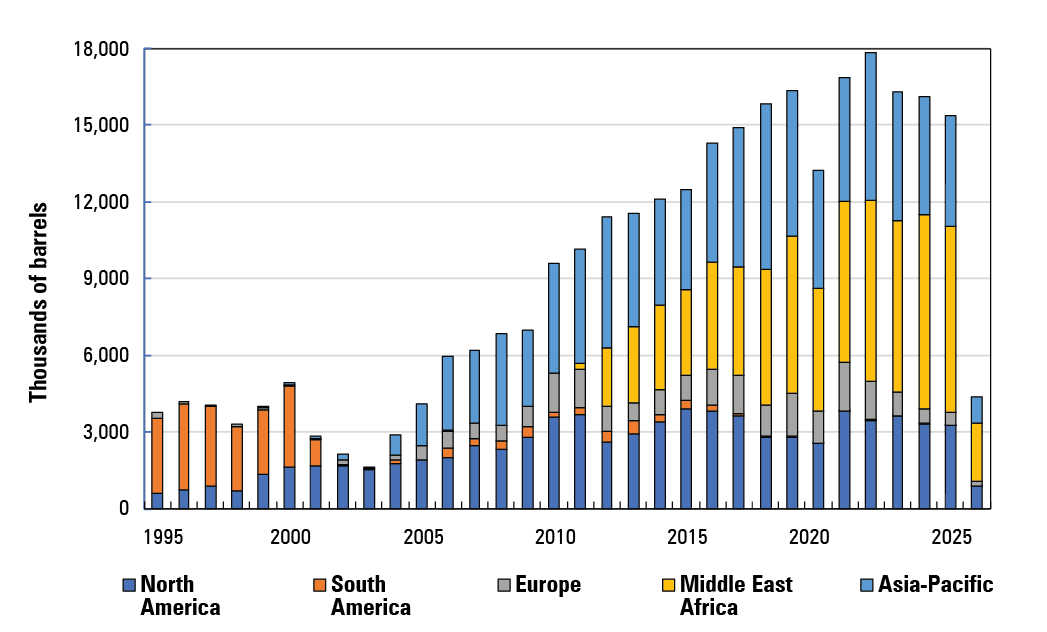
Source: U.S. Energy Information Administration
To better appreciate Group III and Group III+ base oils, it is important to understand formulation sciences. Most engine oils require a blend of at least two base oils to balance viscometrics while ensuring first-time on-specification production of finished lubes. For passenger car motor oils, the 4 centiStoke viscosity grade represents the primary blend stock for low-SAE grades.
This is then balanced with a heavier 6 cSt or 8 cSt viscosity grade to achieve the required target blended base oil viscosity and viscosity index for each SAE grade. The target viscosity will vary by SAE grade, product performance and additive technology. (See Figure 2.)
In North America, market general industry performance standards include API SQ and ILSAC GF-7, whereas original equipment manufacturer standards such as General Motors dexos Generation 3 have additional or more difficult requirements.
For a market general SAE 5W-XX grade PCMO, the target base oil viscosity is approximately 4.9 cSt at 100˚C and 115 VI. In this example, the base oil viscosity equates to Group II+ quality with a typical VI range of 110 to 119, although the Group II+ designation is not recognized by API 1509 and the group definitions. Nevertheless, it is a good indication of the required quality to formulate this SAE grade and performance and is marketed accordingly.
Figure 2. Blended Base Oil Requirements for PCMO
Performance | Industry Performance (API, ILSAC, ACEA) | Industry + OEM Performance (GM, MB, VW, BMW, Volvo, etc.) | ||||||
SAE Grade | 0W-16 | 0W-20 | 5W-20 | 5W-30 | 0W-16 | 0W-20 | 5W-20 | 5W-30 |
Kinematic Viscosity @ 100˚C, cSt | 4.6 | 4.6 | 4.9 | 4.9 | 4.7 | 4.6 | 5.1 | 5.0 |
Viscosity Index | 120-125 | 125 | 115 | 115 | ≥130 | ≥130 | ≥120 | ≥120 |
API Base Oil Group | III | III | II+ | II+ | III+ | III+ | III | III |
When a blender wishes to achieve the same SAE 5W-XX grade but with a higher performance level like dexos, they need a slightly higher kinematic viscosity and at a VI of at least 120. This is required to balance the additional chemical additives required for the higher performance standard and equates to Group III quality.
For the lower SAE 0W-XX grades, the base oil viscometrics shift towards lower kinematic viscosity and a higher VI. For market general products, the base oil quality is normally associated with Group III while a higher quality Group III+ base oil blend is needed for industry-plus OEM performance. In today’s market, Group III+ quality is defined as having a VI of at least 130 for the 4 cSt grade. This again is a “marketing” definition and is not recognized by API as an official designation.
During the development of the U.S. base oil industry and the introduction of hydroprocessing, refineries focused on Group II and II+ qualities to meet target market performance needs and to maximize yields and profitability. Higher-VI Group III was not a market concern, and the industry became reliant on imports to meet most of its needs. As the market demand for Group III+ quality has emerged, it has become apparent that there are only a few supply sources globally with the combination of processing severity and access to high-VI feedstocks needed to achieve this quality.
Very-high-VI Group III+ base oils are associated with waxy crudes or vacuum gas oils and are sourced in either Southeast Asia (for example Tapis crude) or the Middle East (Murban crude). Arab Light crude is used globally by many refiners to produce Group II and Group III qualities but does not have the desired level of waxy feed components to achieve Group III+ levels, unless severe processing is considered. Such processing can raise the VI to Group III+ levels but at the expense of reduced base oil yields and productivity, and potentially profitability. One other source of Group III+ is through gas-to-liquids technology, which is used at the Shell-QatarEnergy Pearl joint venture in Ras Laffan, Qatar.
Figure 3. SAE Grade Profile of North American PCMO
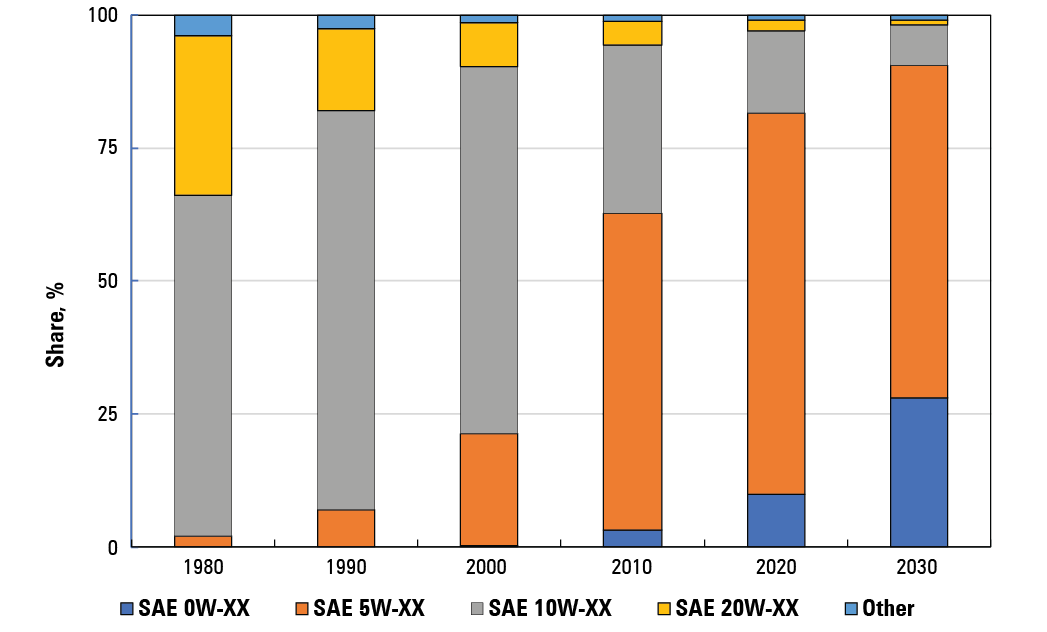
Source: KEPC
The vulnerability of the supply chain for Group III and in particular Group III+ base oils has been made clear by the recent events in the Middle East. The restricted flow of petroleum products through the Strait of Hormuz has limited the availability of Group III and Group III+ base oils from the region. Moreover, the problems could persist after normal shipping resumes as missile strikes have damaged the Pearl refinery, reducing Group III+ production in the medium term. It is estimated that nearly 30% of U.S. base oil imports come from the Shell-Qatar facility, while 47% of total U.S. base oil imports — meaning all API grades — are sourced from the Middle East.
Refiners around the world use Arab Light crude to produce both fuels and base oils, including Group III. Much of it is shipped through Hormuz — another reason that its closing has created a global supply shortage for high-VI base oils. In the U.S., posted prices for 4 cSt Group III rose nearly 45% from the start of the Middle East conflict to late June, and upward pricing pressure could continue as the market continues to adjust to limited availability and the ongoing instability in the Middle East region.
Domestic refiners will continue to balance production of Group II and Group III barrels wherever possible, but this will only have a limited impact on short-term shortages. Longer-term projects have been announced, but these will not address the existing shortage and the region’s growing thirst for Group III and Group III+ — forecasted to rise nearly 20% over the next decade. (See Figure 3.)
For Group I and Group II, the impact of the Middle East events should be limited in part due to the greater number of supply sources around the world and the production overcapacity for these grades.
Figure 3. North America Group III and Group III+ Demand
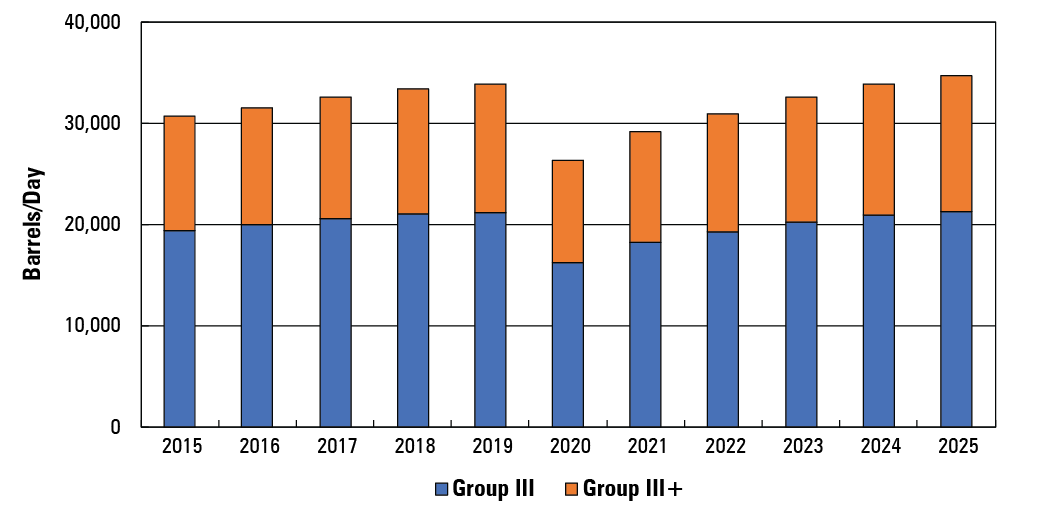
Source: KEPC
The war between Iran and the United States and Israel is just one example of geopolitics disrupting base oil and lubricant markets. The conflict in the Ukraine and Russia has impacted petroleum production and movements in that region, while government policies such as tariffs, trade wars and sanctions can also cause significant impacts at the domestic and international level. It is therefore important to consider geopolitics as a sensitivity when looking at market forecasting.
H. Ernest “Ernie” Henderson is president of K&E Petroleum Consulting LLC, of Oklahoma City, Oklahoma, U.S. He has nearly five decades in the industry, including stints with Exxon, Imperial Oil and Petro-Canada, in research, marketing, logistics and technical services. K&E’s expertise ranges from base stock management and strategic planning to supply chain optimization, formulation cost control, raw material
sourcing and patent litigation.