

When the first strikes on Iran were reported, few people in the base oil industry expected the conflict to fundamentally reshape the market. Most assumed it would resemble previous flare-ups in the region: crude prices would spike, then nerves would settle and trade would resume.
The Iranian military responded with strikes on neighbors’ energy infrastructure and a blockade on shipping through the Strait of Hormuz, one of the world’s energy transit chokepoints.
This quickly exposed how dependent the lubricant industry had become on Middle Eastern supply, particularly for API Group III base oils, turning what had been an oversupplied market into one where simply finding product became more important than negotiating its price.
The industry entered the crisis expecting another brief regional conflict before conditions steadily deteriorated.
LUBES’N’GREASES WEBINARS
In June, we hosted the first in a series of webinars about the base oil crisis triggered by the war between the United States, Israel and Iran. The event featured:
Ray Masson
Managing Director at Pumacrown Ltd and contributing editor, Base Oils, Lubes’n’Greases
Aleksandr Borisov
Base Oil Trader at Petrobell DMCC
Jeremy Kriska
VP Business Development at Tulstar Products Inc
Gabriela Wheeler
Editor Base Oils, Moderator Lubes’n’Greases
The webinar was free to subscribers. View it here.
The next webinar in the series will be held this fall.
“We thought that things were looking up,” Gabriela Wheeler, Lubes’n’Greases base oils editor, said at an industry discussion panel at the end of June. “Again, things are a little bit fragile.”
That realization hit other panelists.
“Nobody expected such a scenario,” said Aleksandr Borisov, a base oil trader at Petrobell. “Everybody thought that it would stop soon. It will not affect that much.”
Instead, he said, the industry has entered “a new reality.”
Caught Off Guard
While crude oil initially captured the headlines, the real story was unfolding inside the base oil market, where disrupted logistics, disappearing cargoes and an unexpected dependence on Gulf production combined to create shortages that continue to ripple across every region.
Suppliers and buyers alike had been caught off guard by the scale of the disruption.
“I’ve heard comments from market sources saying, ‘I’ve never expected anything like this to happen in my lifetime,’” Wheeler said.
The industry’s biggest surprise was not that disruptions occurred, but how exposed the market was.
“You understood there could be disruptions,” Jeremy Kriska, vice president of business development for Tulstar Products, said, “but I don’t think everyone understood how much this region relied on Group IIIs from the Middle East.”
The region is home to around 20% of the world’s Group III capacity, and when the conflict took that offline, the consequences were immediate.
“We saw… a market that was a bit oversupplied immediately went to a difficult market to source.”
That transition happened so quickly that suppliers warned customers almost immediately that market conditions had fundamentally changed.
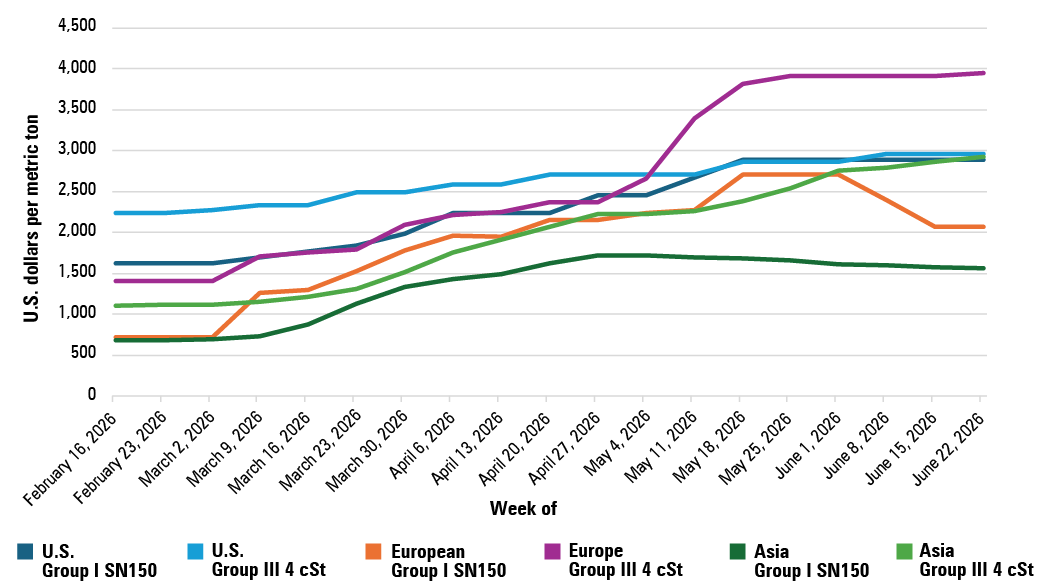
Figure 1. War-time Run-up in Base Oil Prices
Feedstock Dilemma
For Asia, the disruption was especially severe. The region relies heavily on Middle Eastern crude oil, with around 60% of imports originating there. More importantly, most Asian base oil refineries are configured specifically for Middle Eastern feedstocks.
“They cannot easily switch to other sources of crude,” Borisov said. “They’re not very flexible.”
That lack of flexibility meant refiners suddenly found themselves without feedstock while buyers competed for diminishing supplies.
“The prices hiked in Asia the most at the very beginning,” he said.
North American refiners were initially shielded from the first wave of disruption because they relied less heavily on Middle Eastern crude shipments.
“I think they were a little bit insulated from some of the first shocks,” Wheeler said.
Yet soaring prices created another problem almost immediately. Asia’s lubricant market proved far more price-sensitive than markets elsewhere. Blenders reported end users would not accommodate such high prices. They largely decreased consumption or stopped buying altogether.
The result was something few expected only weeks earlier: demand destruction. Consumption and demand for base oils almost vanished in Asia.
That collapse in demand, combined with additional exports from China and India, eventually helped stabilize Group I and Group II markets across Asia, even while Group III continued tightening globally.
Group Think
The crisis became, above all else, a Group III story. Unlike other viscosity groups, Group III is concentrated in a few regions. Closing off the Middle East — Bapco in Bahrain, Shell Pearl GTL in Qatar and Adnoc in the United Arab Emirates — left buyers with relatively few alternatives.
The shortage quickly overwhelmed traditional pricing mechanisms, and “spot prices somewhat became irrelevant.” Instead of debating premiums, buyers were simply trying to secure product.
Europe’s market experienced similar conditions to those in Asia, seeing record price levels almost immediately after the conflict began.
“All groups… moved very, very swiftly to new highs,” Ray Masson, director of trading firm Pumacrown, said, describing them as “the highest prices that we’ve ever actually experienced in base oils.”
Masson’s assessment of the European Group III market was concise: “Group III is now short.”
Although domestic production from Spain has helped, it has been unable to replace the missing Gulf volumes. Additional cargoes from Indonesia provided limited relief.
“We’re still facing huge shortages of Group III material in Europe right now,” Masson said.
North America
The industry’s priorities had fundamentally shifted, leaving Wheeler to ask whether buyers were now more concerned with availability than with price. In North America, demand stayed resilient despite unprecedented price increases.
“We haven’t quite seen the demand destruction here in the U.S.,” Kriska said. “It’s finding supply that’s more of the concern.”
That change altered the relationship between buyers and sellers. Buyers were less likely to haggle than to express appreciation simply for obtaining material.
“It’s not an argument about the price,” he said. “It’s more of a thank you for your help when it comes to sourcing.”
Europe reached much the same scenario, and availability and price became inseparable because shrinking supply continues pushing values higher.
“Price is a secondary element,” Masson said. “It really doesn’t come into the equation anymore because with no availability, prices really don’t come into it.”
He recalled one supplier refusing spot enquiries because “his tanks were dry.”
“If they can get their hands on product,” he added, “they will pay anything, basically, for it right now.”
While Asia initially experienced the most severe disruption, Borisov also described how the market unexpectedly adapted.
India and China, typically major importers, became important suppliers after cargoes originally destined for the Gulf were redirected.
India, unable to consume every diverted shipment internally, began re-exporting material throughout Asia. China followed a similar path.
Those additional barrels restored availability for most Group I and Group II grades across Asia, although Borisov stressed that high prices continued suppressing demand.
Crude Assumption
The crisis also challenged one of the industry’s longest-standing assumptions: that crude oil prices dictate base oil prices. Buyers increasingly questioned why base oil prices remained elevated even as crude oil and diesel values retreated.
“Crude oil prices and distillates are going down,” Wheeler said. “Base oils should be going down as well, but are they?”
According to Borisov, that relationship weakened significantly after the COVID-19 pandemic. Until 2019, there was a correlation between base oil and crude oil prices.
“After [the] pandemic, [the] correlation between base oil and crude oil is not that linear.”
Instead, supply and demand now dominate pricing, particularly for Group III.
Kriska said North American prices stayed high despite lower crude prices and expected Group III values to remain under pressure.
“We don’t see much price stabilization or decrease at least through the end of the year,” he said.
A similar divergence could play out in Europe, with Group I and Group II softening gradually if crude remains lower but Group III to staying where it is.
Rerefined Off the Sidelines
The crisis has also reshaped attitudes toward rerefined base oils. Historically viewed cautiously by some lubricant manufacturers, rerefined products became increasingly attractive simply because alternatives are disappearing.
“They have become more accepted because there are very little choice,” Masson said.
Some companies, he noted, secured long-term agreements with rerefined producers after finding themselves with few other options.
Even so, supply remains limited because much of the available production has already been contracted.
“A lot of blenders are writing to their customers saying that they’re unable to manage supplies of finished products,” Masson said, “and that they will not be doing so for the foreseeable future until things change… from the Gulf.”
Kriska described a similar trend in North America.
“They’re definitely a winner from this situation,” he said of rerefined producers. “Blenders’ acceptance levels [have] increased a lot.”
But even that market is tightening.
“A lot of the volumes that are produced here are also being contracted up by the majors now,” Kriska said. “Even rerefined is a bit difficult to source at the moment.”
Asia, however, remains more conservative. Rerefined Group III products have gained little traction there despite the disruption.
“They do not really want to use Group III rerefined,” Borisov said.
The discussion ultimately returned to the same conclusion with which it began: the industry’s biggest challenge is no longer simply high prices, but an uncertain supply outlook.
The conflict has exposed how concentrated global Group III production has become, how quickly availability can eclipse price and how interconnected regional supply chains really are. While Group I and Group II markets may gradually rebalance, Group III remains constrained until Gulf supplies recover.
The industry is operating in “a new reality”— one in which buyers are increasingly judged not by the prices they negotiate, but by whether they can secure product at all.