
The Light at the End of the Tunnel
Will the fragile ceasefire between the United States and Iran hold? Will crude oil and base oil shipments from the Middle East resume? Will crude oil prices remain at pre-war levels? These were some of the questions base oil market players were considering during the first few days of July after a memorandum of understanding signed between U.S. President Donald Trump and Iranian President Masoud Pezeshkian on June 17 led to a pause in hostilities and Iran’s agreement to allow vessel traffic through the Strait of Hormuz. Even so, a similar deal had been breached previously, so market participants were understandably skeptical.
By the first week of July, however, a gradual increase in transits through Hormuz was reported, and a number of Middle East producers were understood to have resumed production of crude oil and refined products, including base oils. All eyes were on the Persian Gulf producers of API Group III base oils since this segment showed the most critical shortages as a result of the war in Iran, and global prices for these grades had skyrocketed. According to sources, ADNOC in Abu Dhabi had ramped up base oil production as soon as the ceasefire was announced. The producer had reportedly been running its plant at reduced rates for its downstream production of lubricants.
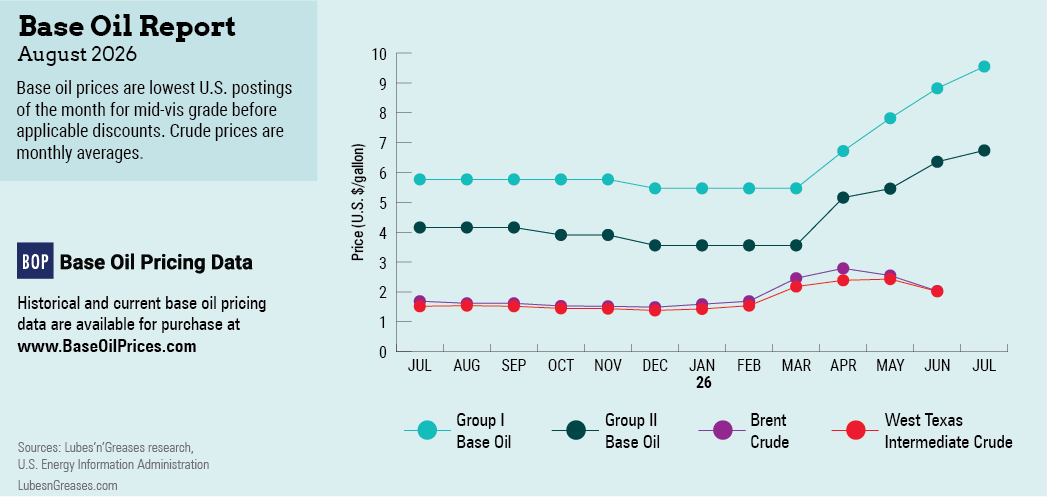
The Group I and Group II segments showed a very tight supply and demand ratio as well, and these fundamentals, coupled with soaring crude oil futures, had driven U.S. base oil suppliers to increase posted prices almost on a weekly basis since early March. The prospect of a reopening of the strait and a resumption in crude oil flows from the Middle East in late June led to a sharp fall in crude oil prices, and a pause in base oil price adjustments. Furthermore, a number of blenders had been unable to absorb the steep base oil values, and demand in some segments had started to soften.
U.S. base oil postings climbed between 33% and 73%, depending on the grade, since March, but participants acknowledged that in some cases, prices were not as much an issue as being able to secure supply. There was also concern that participants had entered hurricane season without extra barrels to cover potential supply disruptions.
Crude oil futures started a steady descent following the MOU between the U.S. and Iran. Further pressure came from reports that seven OPEC+ members were planning to boost oil production from August. After reaching almost U.S.$107 per barrel in late April, West Texas Intermediate futures fell back to pre-war levels near $69/bbl in early July.
While the lower crude prices exerted downward pressure on base oil values, the main factor influencing pricing remained the tight supply and demand balance, particularly in the case of Group III base oils as the critical shortages were not expected to be corrected in the short term. Aside from reduced production levels in the Middle East, as one train at the Shell Qatar Pearl GTL unit in Qatar was likely to be offline for several months, complex logistics and steep insurance rates were anticipated to become roadblocks in the resumption of shipments.
While Asian producers were able to increase refinery run rates after receiving crude oil shipments from origins outside of the Middle East, Asian and North American Group III supplies were not sufficient to fill the vacuum left by the absence of Persian Gulf products, which meet almost 43% of U.S. demand.
Since the beginning of the conflict, Middle East Group III suppliers had been able to meet most U.S. contract requirements from existing stocks after implementing strict allocation programs and reduced allotments, but by July, these stocks had been largely depleted. Even if everything went as planned and vessels were able to transit the strait safely, the first shipment of ADNOC material was not expected to reach the U.S. until the end of August.
Group III shortages caused much anxiety among blenders as these grades are difficult to replace. Some options such as polyalphaolefins were also limited and prices had skyrocketed, sources noted. Manufacturers who supply lubricants to automotive OEMs were particularly affected by the dearth of Group III base oils as they must meet strict formulation parameters. Several automakers had warned dealerships and service centers about shortages involving specific lubricants and other materials.
Many buyers have turned to rerefined base stocks to meet their requirements, but rerefined capacity is still relatively small in the U.S. Additional virgin base oil Group III capacity was not expected to come on-stream until later this year. Chevron’s new Group III+ base oil capacity in Pascagoula, Mississippi, will become available in the fourth quarter of 2026. ExxonMobil also expects to bring a major Group III base oil expansion on stream at its Baytown, Texas, complex, but not until 2028. No further details were forthcoming from either producer.
Meanwhile, naphthenic base oil prices were largely steady, despite sharp crude oil price fluctuations since mid-June. Several increases had emerged after the start of the Iran war, but no further adjustments surfaced, with producers noting that they had attained reasonable margins and would continue to monitor conditions in crude markets, hoping that an end to the conflict in the Middle East would help stabilize oil futures. Since conditions were still fragile, they felt that any small incident could tilt prices in either direction and adjustments may prove to be premature. The base oil supply crunch seen on the paraffinic side appeared to be less pronounced on the naphthenics side.
Geopolitical developments over the month of July will be critical to base oil market fundamentals, with participants hoping the ceasefire leads to a permanent cessation in hostilities and a gradual return to pre-war conditions.
Gabriela Wheeler is base oil editor for Lubes’n’Greases. Contact her at Gabriela@LubesnGreases.com