

Extreme pressure (EP) additives are critical components in modern metalworking fluids, designed to protect tools and workpieces under the most demanding conditions. Without EP additives, tool wear would increase significantly, surface finishes would degrade, and productivity would suffer.
Common EP additives include chlorinated paraffins (CLPs) and sulfur-based compounds (sulfur carriers). Phosphorus-based compounds are also often referred to as EP additives but mainly work as antiwear additives.
Chlorinated paraffins (CLPs) are poorly biodegradable; short-chain (SCCPs, C10–C13) and medium-chain (MCCPs, C14–C17) CLPs are acutely and chronically very toxic to aquatic organisms, bioaccumulative, and persistent in the environment.
Since SCCPs are also potentially carcinogenic and toxic to reproduction, their use in metalworking fluids has been banned in many countries. Current efforts also aim to heavily restrict the use of MCCPs. In the longer term, such measures are also expected for long-chain chlorinated paraffins chain (LCCPs, C18–C20).
As an alternative to chlorinated paraffins, sulfurized hydrocarbons and sulfurized esters are used as EP additives. They form metal-sulfide boundary films that prevent galling and cold welding between tool and workpiece. Due to their higher polarity, sulfurized esters also reduce friction under low mechanical or thermal load.
In terms of human and environmental toxicity, sulfur carriers are significantly more favorable than chlorinated paraffins.
LANXESS Scopeblue Additin® sulfur carriers are more than 50% derived from renewable raw materials and are suitable for use in lubricants that meet the requirements of the EU Ecolabel and the US Vessel Incidental Discharge Act.
They can be easily emulsified and are suitable components for soluble oils and semisynthetic metalworking fluids.
Two tribological tests were carried out to assess the suitability of sulfur carriers with improved sustainability in emulsified metalworking fluids.
All sulfur carriers in the following tests can be certified as:
• Based on renewable raw materials for more than 50%.
• Having low impact on the environment.
• Not labeled as hazardous to humans or to the environment.
• Meeting the requirements of the LuSC list for environmentally acceptable lubricants.
A Pin & Vee test evaluates how well a lubricant prevents wear, seizure, and cold welding under high load and low speed conditions.
It consists of two V-shaped blocks that are pressed against a rotating cylindrical pin, immersed in the lubricant. During the test, the vee blocks apply an increasing load to the pin until failure occurs, indicated by a sudden rise in friction, temperature, and pin damage.
All tests were conducted with emulsions of soluble oil concentrates containing 40% mineral oil and 10% EP additive. The soluble oils were diluted by 2% in deionized water (see table).
When comparing the different sulfur carriers using the Pin & Vee test (figure 1), the highest load of > 4,500 lbs was achieved by the formulation containing 10% Additin® RC 2411.
Properties of the EP-additives tested by Pin & Vee and four-ball tests
| EP additive | Chemical structure | Sulfur resp. chlorine content | Kin. Viscosity at 40°C | Content of sustainable raw material |
|---|---|---|---|---|
MCCP | Medium chain chlorinated paraffin, C14–C17 | 50% Cl | 180 mm²/s | 0% |
Additin® RC 2317 | Sulfurized methyl ester | 17% S (8% active S) | 55 mm²/s | > 70% |
Additin® RC 2411 | Sulfurized vegetable triglyceride | 9.5% S (<1% active S) | 230 mm²/s | > 80% |
Additin® RC 2418 | Sulfurized vegetable triglyceride | 18% S (9% active S) | 220 mm²/s | > 80% |
Figure 1: Pin & Vee test results of 3 different sulfur carriers. The dashed lines show the applied loads; the solid lines show the resulting torques.
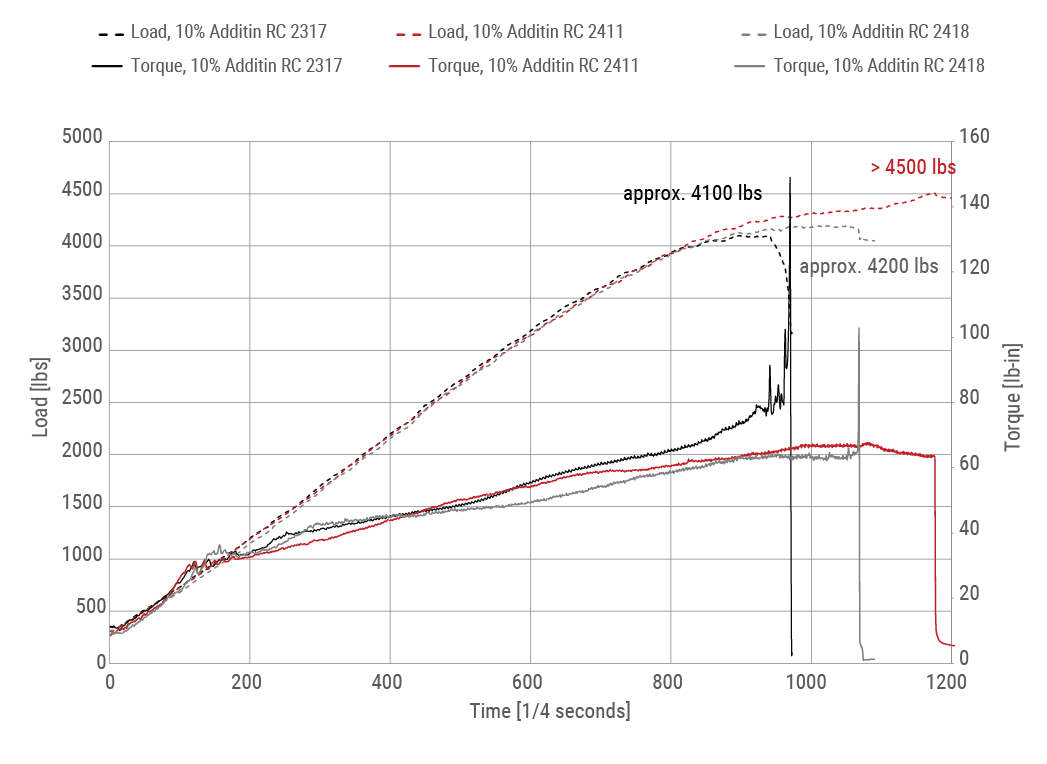
The result shows the excellent friction-reducing properties of this inactive sulfur carrier. The maximum achievable loads of the more active sulfur carriers Additin® RC 2317 and Additin® RC 2418 were also at a very high level, confirming the outstanding performance of these products.
A separate test compared the use of a Scopeblue Additin sulfur carrier with a diluted soluble oil formulation containing 10% of the MCCP and with the maximum achievable torque of the diluted soluble oil which does not contain any EP-additive. The active sulfurized ester Additin® RC 2317 showed a significantly better performance (figure 2). In addition to the Pin & Vee tests, Four-Ball tests were conducted to evaluate the ability of the EP-additives to prevent abrasive and adhesive wear under high-load and high-speed conditions.
Figure 2: Pin & Vee test results of soluble oil formulations containing no EP-additive respectively a medium chain chlorinated paraffin or an active sulfurized triglyceride.

Again, the EP-additives were tested with 10% treat rate as components in soluble oil formulations which were diluted to 10% with deionized water.
The ASTM D2783 Four-Ball EP test results (figure 3) show that sulfur carriers outperform medium‑chain chlorinated paraffins (MCCP) in preventing adhesive wear.
Figure 3: Four-Ball test results of soluble oil formulations comparing different EP-additives to the untreated base formulation.
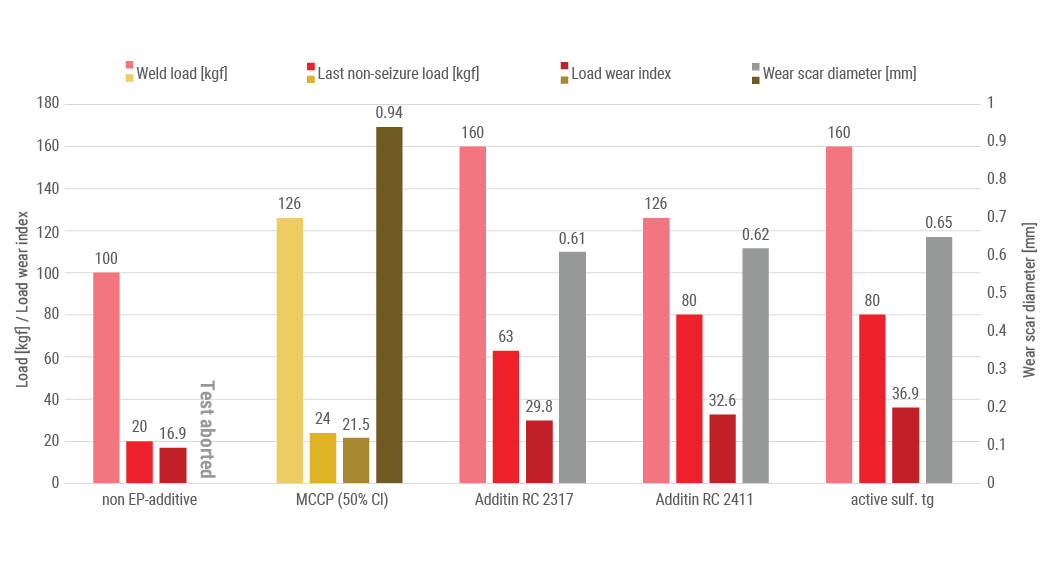
While the inactive sulfurized triglyceride Additin® RC 2411 reaches a weld load similar to MCCP, the more active Additin® RC 2317 and Additin® RC 2418 achieve clearly higher weld loads.
The last non‑seizure load and load‑wear index, indicating EP‑film stability and overall adhesive‑wear resistance, are also significantly higher for the sulfur carriers.
ASTM D4172 wear tests confirm the trend: without EP additives, the test could not be run due to severe vibration, whereas all sulfur carriers yielded similar wear levels, about 30% lower than that of MCCP.
The experimental data demonstrates that water‑miscible metalworking fluids can achieve high tribological performance when formulated with LANXESS Scopeblue Additin® sulfur carriers.
Pin & Vee results indicate that these sustainable sulfur carriers effectively reduce frictional energy losses and extend tool life in cutting and forming emulsions.
Enhanced Four‑Ball weld loads, last non‑seizure loads, and load‑wear indices, combined with reduced wear scar diameters, confirm the superior ability of these additives to stabilize boundary films and suppress adhesive and abrasive wear.
Overall, their performance clearly surpasses that of conventional additives like chlorinated paraffins.
To find out more about LANXESS’ Scopeblue Additin® EP Additives, visit the website at https://lanxess.com/en/products/brands/additin/scopeblue