
Industry Insider Predicts Continued Shift to Other Varieties
Lithium thickeners are by far the most common thickeners in the global grease market, but they have lost market share in recent years because of a spike in lithium costs, triggered by surging electric vehicle sales.
Lithium prices subsequently eased, but a Nynas AB official predicted recently that the grease industry will continue shifting to other thickeners — partly because competition for the mineral should continue to rise, but also for two additional reasons: a regulatory push to restrict its usage and the sustainability movement.
Speaking in April at an industry conference in Germany, Nynas Independent Senior Advisor Mehdi Fathi-Najafi also discussed varieties that could replace lithium greases, including those made with polyurea and different types of calcium thickeners.
Long-time Popularity
Greases are semi-solid lubricants made by dispersing thickening agents into base oil. Most of the thickeners that the industry uses are soaps — made by reacting carboxylic acids with alkaline hydroxides of earth metals — and to ensure product stability, the mixing is done in specialized reaction vessels.
Two types of lithium thickeners have mostly been used — conventional and lithium complex. Conventional lithium grease came first, Fathi-Najafi said, primarily developed and patented in the early 1940s. The manufacturing process combined lithium hydroxide and water in a cooking kettle with base oil and a fatty acid. Once the semi-solid was formed, chemical additives and more base oil were added before finishing steps of homogenization, de-aeration and filtration. Back in the ‘40s, production soon settled on lithium 12-hydroxystearate as thickening agent, and the resulting greases became widely popular.
Lithium complex soap thickeners were developed later that decade, although widespread use would not come until the 1980s. The process for lithium complex starts with lithium 12-hydroxystearate but adds a complexing agent, typically a dicarboxylic acid such as azelaic acid. This gives the grease a crystalline structure that is more thermally stable, significantly raising the dropping point, or the temperature at which the base oil and thickener begin to separate, allowing use in applications with hotter operating temperatures. Lithium complex greases are also more oxidatively stable than conventional lithium varieties and have greater load-carrying capabilities.
Greases made with conventional lithium and lithium complex thickeners came to dominate the global industry, eventually combining to account for 70% of worldwide production according to the NLGI Lubricating Grease Production Survey. Published annually by the United States-based National Lubricating Grease Institute, the survey is the world’s most comprehensive gauge of the market.
Fathi-Najafi said there are a number of reasons for the popularity of lithium greases.
“They were available at a reasonable price,” he said in Stuttgart at Uniti’s Mineral Oil Technology Congress. Original equipment manufacturers “approved them in major automotive and industrial applications. They performed well in applications ranging from medium to high speeds and covered a wide range of operating temperatures. Another factor is the fact that the grease industry is a conservative market.” Once products are in use, end users tend to avoid switching.
Lithium’s grease industry dominance began waning the past several years as electric vehicles and battery storage eroded one of the mineral’s advantages — cost. Most EVs run on lithium-ion batteries, so lithium demand from that industry skyrocketed as EV sales shot up the past decade.
Lithium suppliers had difficulty keeping up, so prices for the mineral skyrocketed, too, jumping 10-fold between late 2020 and late 2022. Lithium grease producers and users felt the pinch, and with EV sales forecast to continue growing, the conservative market started looking for opportunities to switch away from lithium. More recently the energy storage market has begun to rapidly develop, amplifying the growth in demand for lithium since it, too, is dominated by lithium-ion batteries.
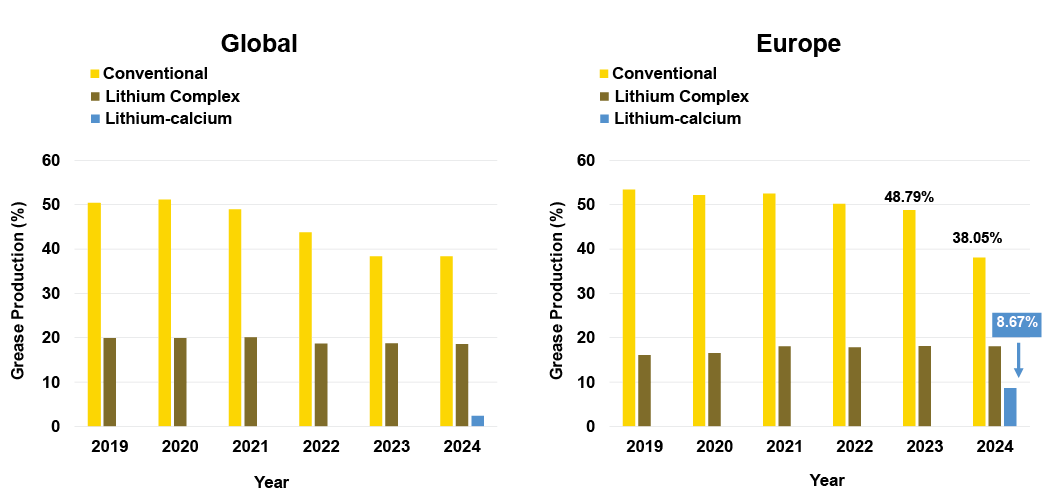
After peaking at just over 70% in 2020, the portion of global grease production containing conventional lithium or lithium complex thickeners declined each year according to the NLGI survey, to 57% in 2024. (See Figure 1.) Both varieties lost ground, even after lithium prices returned to earth. Massive investment in lithium production caused supply to expand sharply, and then the pace of growth in global EV sales moderated, leading to lithium surpluses. By 2023, prices fell to pre-2020 levels.
Figure 1. Portion of Global Grease Production Made with Lithium Thickeners
Source: National Lubricating Grease Institute Grease Production Surveys
Fathi-Najafi acknowledged that this has eased some of the immediate impetus to switch from lithium greases, but he predicted that price pressure will return.
“Oversupply has been the dominant theme since 2023,” he said. “But this year we’re seeing potential early signals of a recovery in the growth of demand for lithium. It still depends on EV momentum and Chinese market policy, but we have every reason to believe that EV sales will continue to rise.”
Chemical Safety Regulation
At the same time, he said, additional reasons are developing to shift away from lithium greases. One is regulation. Some regulators have raised concerns that lithium in grease can be toxic to human reproduction. The European Chemicals Agency is developing a proposal that would classify materials with more than a threshold level of lithium content as 1A/1B reproduction toxins under the United Nations’ Globally Harmonized System of Classification and Labeling of Chemicals.
According to European Union Classification, Labeling and Packaging regulations, that would require products to bear labels with explicit hazard warnings. The content threshold under consideration is 0.3% of free lithium hydroxide remaining after the manufacturing process.
“Finished grease containers may need to display warnings regarding reproductive toxicity, affecting the reputation and safe handling procedures of traditionally common lithium-based greases,” Fathi-Najafi said.
Some groups from the lubricants industry, including the Union of the European Lubricants Industry (UEIL) and the Technical Association of the European Lubricants Industry (ATIEL) have argued against such restrictions, citing lithium’s role in the grease industry and questioning the studies on which the draft proposal is based.
Similar restrictions are being considered or have been adopted in some other markets.
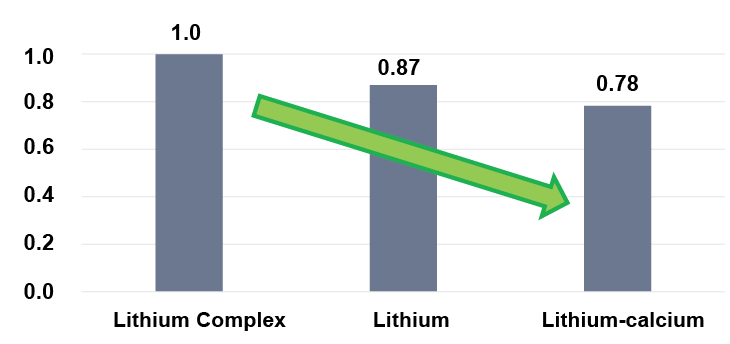
Fathi-Najafi thinks the sustainability movement will also reinforce the push to non-lithium types of grease. Grease companies have been developing standards to calculate carbon footprints for their products. A study by Fathi-Najafi and researchers from Greek grease producer Eldon’s found that lithium complex greases have larger cradle-to-gate product carbon footprints than conventional lithium greases, due to higher thickener content and the extra step in production. (See Figure 2.)
Figure 2. Comparing Product Carbon Footprints of Lithium Grease Thickeners
(kilograms of carbon dioxide equivalent per kilogram of grease)
Source: Mehdi Fathi-Najafi, Andreas Dodos, George Dodos
The footprint for lithium-calcium greases — a newer variety — was lower yet because the calcium reduces the amount of lithium used. Extraction of calcium hydroxide generates approximately 7%-14% as much CO2 as commercial methods for extracting lithium. Calcium extraction is also more sustainable by other parameters, Fathi-Najafi said, using 1%-2% as much fresh water and 2%-4% as much energy.
Other Thickeners
Fathi-Najafi suggested several alternatives that could replace lithium greases in certain applications. Varieties with calcium-containing thickeners have picked up some of the market share lost by lithium. Like the other greases made with calcium thickeners, those made with anhydrous calcium soaps demonstrate excellent water resistance and antiwear performance. Because they do not contain water, anhydrous calcium thickeners have higher dropping points than, for example, conventional calcium greases.
From 2020 to 2023, the portion of greases produced with anhydrous calcium thickeners jumped from 7% to 15%, according to NLGI’s survey, but it retreated to 10% in 2024 — a drop attributed to improved reporting in China and shift in that country toward higher-quality greases.
Production of calcium sulfonate greases has also been increasing — from 4% to 6% from 2020 to 2024. Fathi-Najafi said they, too, provide excellent water resistance and antiwear performance, along with corrosion resistance and high-temperature stability, making them popular for applications such as shipping, mining, pulp and paper manufacturing, steel manufacturing and automotive bearings.
Polyurea thickeners are metal-free non-soaps, formed through reactions between amines and isocyanates. Their nature allows excellent oxidation resistance and long service life, but they are relatively expensive. Fathi-Najafi discussed subcategories of this variety, based on the number of urea groups in their molecular structure. (See Figure 3.) In general, applications include motors and bearings, including high-speed bearings in precision devices. Share of global production for polyurea thickeners rose from 6% to 9% from 2020 to 2024. They are especially popular in Japan, where they account for approximately 30% of production.
Figure 3. Pros and Cons of Polyurea Greases
Polyurea Type | Structure | Pros | Cons | Applications |
Monourea | 1 urea group | Good pumpability,low noise | Lower high-tempstability | Small motors,appliances |
Diurea | 2 urea groups (most common) | Excellent oxidationstability and long life | Moderate waterresistance | Industrial motors,alternators, sealed-for-life bearings |
Triurea | 3 urea groups | Low oil bleed, highspeedcapability | Cost | High-speed bearings,precision devices |
Tetraurea | 4 urea groups | Best thermal &mechanical stability,very long life | Highest cost | Sealed-for-lifebearings, servomotors |
The grease industry has long had a range of options for thickeners. As more issues arise for lithium, Fathi-Najafi believes the market will continue turning toward alternatives.
Tim Sullivan is Executive Editor of Lubes’n’Greases. Contact him at Tim@LubesnGreases.com