
No Escape from Global Supply Crunch
By early April, the war waged against Iran by the United States and Israel raged on. Since the start of hostilities in February, the crucial Strait of Hormuz — the 21-mile-wide channel that separates Iran from the Arabian Peninsula — has been closed to tanker traffic, restricting oil shipments to the rest of the world and catapulting crude oil and diesel prices sky-high.
The U.S. is the world’s top oil producer, so a global supply crunch might not impact U.S. refiners as much as those that rely on Middle East crude. However, U.S. oil prices are not immune from the turmoil in the Middle East because crude oil is a globally traded commodity. This also applies to U.S. base oil prices, leaving no escape from the consequences of a worldwide oil supply crisis.
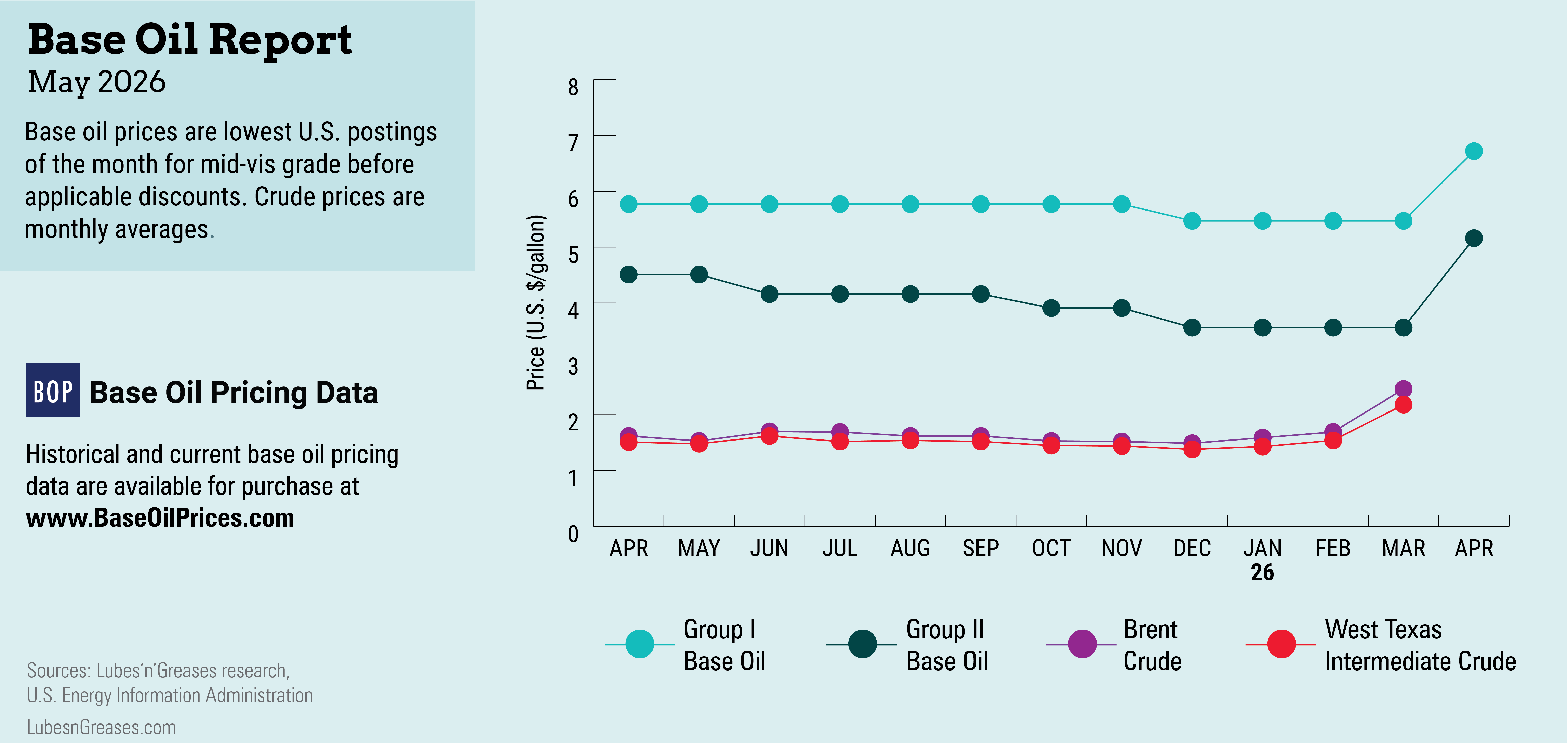
Both Brent and West Texas Intermediate oil futures surged to multi-year highs above U.S. $110 per barrel in the first few days of April, up from the high $60s/bbl in late February, as investors feared that a prolonged conflict would lead to severe global oil supply shortages. Gasoline and diesel prices also surged, with diesel increasing even more quickly than gasoline, reflecting a 47% hike since the start of the war.
The steep rise in crude oil and feedstock values, along with reduced availability of oil and refined products, drove U.S. paraffinic base oil producers to announce a flurry of posted price increases in March. Some suppliers implemented four or five consecutive rounds of increases, depending on the magnitude of the hikes. The markups ranged from a modest 10 cents per gallon to a hefty $1.50/gal, with API Group III grades experiencing the largest upsurge due to dramatically reduced global supplies.
On the naphthenic base oil side, most producers — including Ergon, Process Oils, Calumet and San Joaquin Refining — also implemented several rounds of price increases in March and early April. In addition to pressure from higher crude and feedstock prices, naphthenic base oil values received support from a tight supply-demand balance, partly due to domestic plant turnarounds between February and April.
Lubricant manufacturers also announced price increases to offset the sharp rise in production costs, as not only base oil prices had increased, but additive and transportation costs had risen as well.
For the most part, U.S. base oil suppliers suspended spot offers due to uncertainties regarding future supply levels and the need to ensure that contract commitments were met. While base oil consumers appeared to have sufficient stocks to continue running blending operations for several weeks, a protracted conflict could result in product shortages, particularly of Group III base stocks.
The Middle East is one of the top suppliers of Group III base oils, and some plants — as well as the associated refineries that supply their feedstocks — suffered production disruptions due to Iranian missile and drone attacks. Aside from these outages, Middle East Group III cargoes could not be shipped due to the closure of the Strait. Almost half of all U.S. Group III imports originate in Bahrain, the United Arab Emirates and Qatar, all of which have ports on the Persian Gulf, effectively closed to vessel traffic.
Iranian drone attacks forced the Shell-Qatar Petroleum gas-to-liquids plant in Ras Laffan to shut down, with damage to the facility expected to keep it out of commission for an extended period. Meanwhile, the Bapco base oil plant in Bahrain and the Adnoc plant in Abu Dhabi also suffered production disruptions.
Not only were Middle East base oil plants forced to shut down, but Asian refineries — another key source of Group III imports to the U.S. — had to trim base oil output as governments required refiners to prioritize competing fuel production. Asian refiners are highly dependent on Middle East crude. The Iranian chokehold on crude shipments through the Strait significantly reduced the flow of oil and refined products to Asia and Europe.
Members of the International Energy Agency began releasing strategic emergency oil reserves in a coordinated 172-million-barrel effort following the Middle East supply disruptions. However, many developing countries do not have such reserves, forcing refiners to trim production rates and halt exports. This situation significantly reduced global availability of base oils.
Even if the war were to end tomorrow, experts maintain that supply disruptions, surging prices, shipping disturbances, increased freight rates, and production cutbacks are likely to persist for several months. There is hardly a place on earth that would remain immune to these consequences.
Gabriela Wheeler is base oil editor for Lubes’n’Greases. Contact her at Gabriela@LubesnGreases.com