
There is a swirl of activity these days in the metalworking fluids market. Demand is growing at a splashy rate — at least by lubricant industry standards — but suppliers also face pressures from end users with rising performance expectations as well as regulators and the sustainability movement, which are pressuring to replace some raw materials.
The result is a lot of work to develop new ingredients — from base stocks to additives to chemical intermediates used to make both. Numerous companies are involved in this work, but the efforts of two were on display at January’s International Colloquium on Tribology in Ostfildern, Germany. An official from Sasol Chemicals discussed its introduction of Guerbet alcohols used as intermediates to make base stocks and additives, while an Advancion Sciences official discussed recently launched aminoamyl alcohols being promoted for staining prevention, pH stabilizing and other functions.
The lubricant industry is not known for rapid growth rates. Overall global demand has been basically flat for a couple decades, and any segment growing more than a few percentage points per year grabs attention.
Metalworking fluids are among the current standouts, according to Houston-based Sasol Chemicals, with demand forecast to grow at a cumulative annual rate of more than 5% for the next decade. At the International Colloquiumm on Tribology in Ostifildern, Germany, in January, Sasol Research Associate Paola Pastorelli said that growth is driven by several factors related to getting more out of metalworking operations. Metalworking companies are striving to increase productivity and are operating machinery at increasing levels of intensity. Tolerances for workpieces are tightening in response to customer demands, meaning fluids need to enable more precise machining.
Demand for neat fluids — those made with unemulsified base oils — is growing at a faster clip, taking market share from aqueous products that blend water and oil. Again, Pastrorelli cited several factors: continuing industrialization and expansion of manufacturing capacity; growth in precision machining and minimum quantity lubrication, which put a premium on boundary lubrication and fluid film strength; innovations in materials and alloys, which require higher fluid performance.
At the same time, formulators are under pressure from regulation and the sustainability movement, which are pushing formulators away from ingredients that are harmful to human health and toward others that are more sustainable. According to Pastorelli, that creates an environment that favors using fewer ingredients.
“This environment favors use of multifunctional components that deliver performance with reduced formulation intensity,” she said.
Guerbet Alcohols for Lubricity and More
Pastorelli discussed Sasol’s Isofol alcohols, which the company is now offering as intermediate materials to the lubricants industry and using to make esters for use as base oils and multifunctional lubricant additives. Derived in petrochemical refineries, Isofols are highly branched, primary, saturated 2-alkyl-1-alkanols, also known as Guerbet alcohols. The category is not new; the process of making Guerbet alcohols was invented more than 120 years ago, and Sasol has long produced them in Bransbuettel, Germany, for the cosmetics and pharmaceuticals industry. Only for the past few years, however, has the company been making them for lubricants, after opening a second production site in Lake Charles, Louisiana.
Sasol says the unique branch structure of these Guerbet alcohols imparts excellent lubricity to esters made with them. The company also claims better oxidative stability, lower viscosity and better biodegradability than, for example, dimer alcohols, which are derived from oxo-alcohols and have been used for lubes.
Pastorelli shared bench test data documenting performance of Isofols along with Marlowet base stocks and additives made with them. Results from tapping torque tests showed change in results from adding 4% or 10% of two grades of Isofol to baseline metalworking formulas. Scores improved significantly for aluminum cutting but less so for stainless steel cutting and stainless steel forming. Results for aluminum forming actually worsened slightly.
Sasol claims that Isofol also helps improve extreme pressure performance by helping sulfur-based EP additives to activate at lower temperatures, achieving wear prevention results in Stribeck/traction bench tests that are similar to formulations with chlorinated paraffins — but without using the latter chemicals, which have come in for increased scrutiny and restriction due to health concerns.
Sasol leans on its Gueret alcohol to make esters that it also supplies to the market. Esters are a broad range of organic compounds made by reacting alcohols with carboxylic acids. Sasol uses Isofol alcohols to make Marlowet esters that it pitches as base stocks for metalworking fluids and as co-base stocks and additives in metalworking fluids and industrial lubricants.
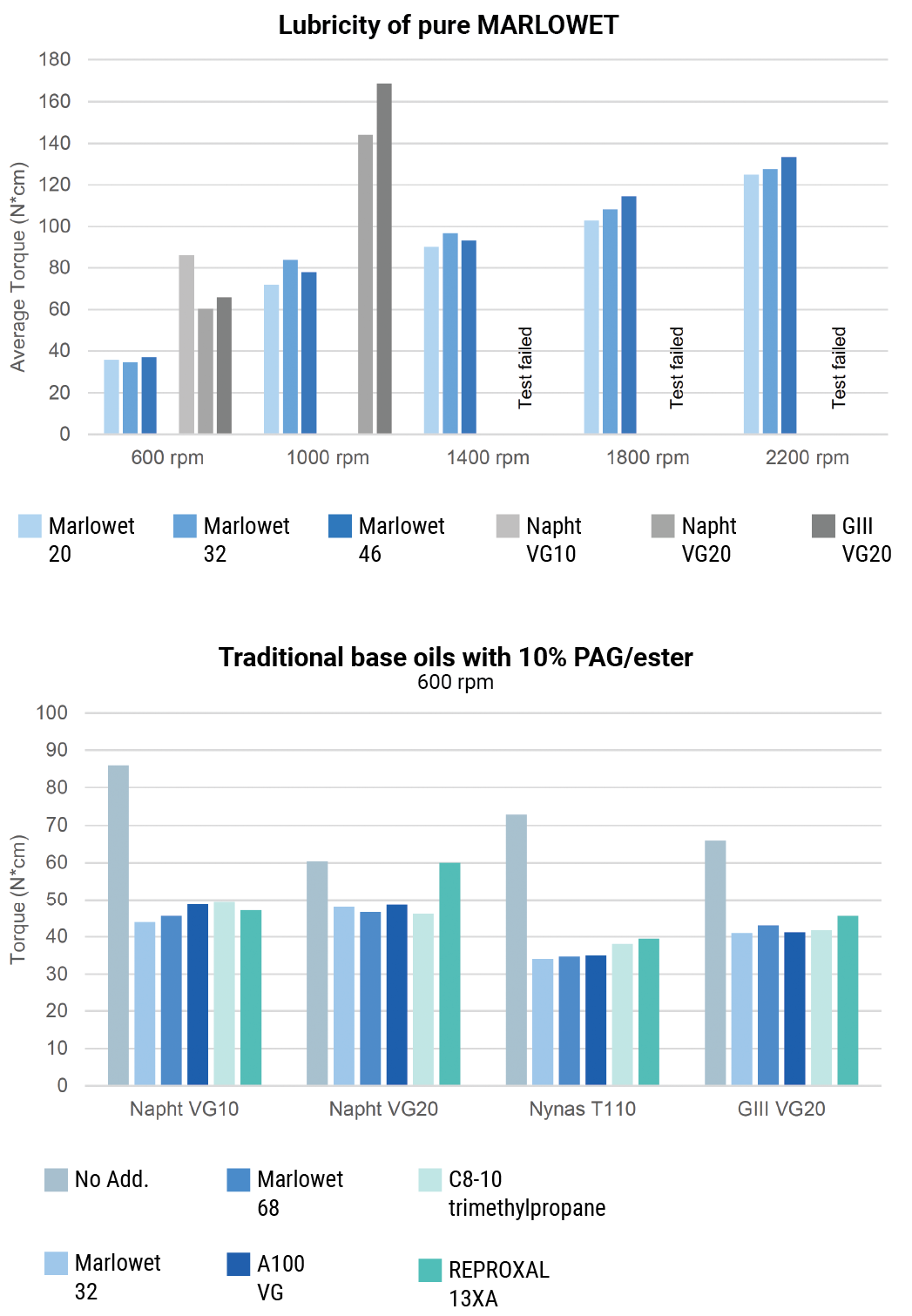
Sasol’s researchers again ran tapping torque tests to gauge lubricity performance, first for fluids made with just Marlowet esters base stocks and second for fluids made with naphthenic or API Group III base stocks and 10% polyalkylene glycols or esters, including Marlowet and other Sasol esters and PAGs. The bench tests were run on stainless steel and aluminum. The tests on fluids containing 10% PAG/ester were run only at 600 revolutions per minute, but those with Marlowet base stocks ran at speeds ranging from 600 rpm to 2,200 rpm.
Different viscosity grades of Marlowet showed clear improvement at all speeds in average torque exerted, an indicator of efficiency. (See Figure 1.) Fluids with 10% PAG/ester reduced torque by 20%-50% compared to formulations without additives, but the variety of those chemicals used did not make a clear difference. Marlowet provided a similar benefit to trimethylpropane, Reproxal and a third material.
Figure 1. Raising Lubricity Performance
Efficiency evaluated by tapping torque test on stainless steel.
Source: Sasol
Benefits for aluminum were markedly less. Formulations with Marlowet base stocks significantly reduced torque compared to light-viscosity fluids containing naphthenic oil but performed similar and sometimes worse than heavier samples made with naphthenic or Group III base oils. Formulations with 10% PAG/ester still reduced torque compared to the unadditized fluid (this time at 1,800 rpm), but only by 10%-25%. Again Marlowet performed about the same as the other PAG/esters.
Researchers investigated seals compatibility of Isofol and Marlowet using standardized test ASTM D471 and found both improved compatibility with ethylene propylene diene monomer and nitrile butadiene rubber compared to mineral base oils.
New Type of Alcohols
Denis Buffiere, a metalworking fluids customer application specialist with Advancion, discussed the company’s development of aminoamyl alcohols, which it launched in late 2024 as multifunctional additives to serve as surfactants, neutralizers and other functions in a range of applications. Advancion, which is based in Buffalo Grove, Illinois, U.S., and was formerly known as Angus Chemical, said it would initially make the chemicals at its Sterlington, Louisiana, United States, factory but planned to add capacity later at its plant in Ibbenbueren, Germany.
The company claims to be the sole producer of aminoamyl alcohols, primary amino alcohols that it offers into industries such as lubricants, paints and coatings, and cosmetics and personal care segments. In the lubricants industry, Advancion markets the chemicals under the Corrguard brand name, largely for use in metalworking fluids as corrosion and staining control agents, pH stabilizers and neutralizers.
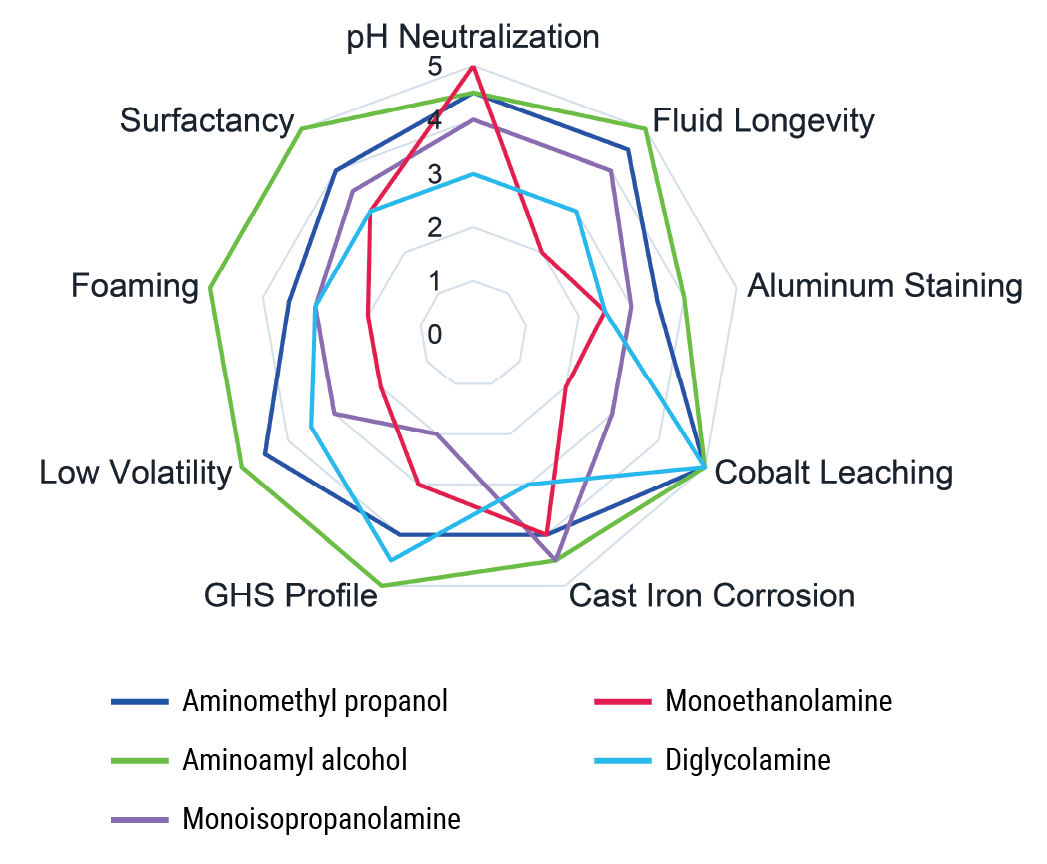
Advancion pitches its aminoamyl alcohols as a step up — at least for some parameters — from chemistries more commonly used in the industry, including 2-amino-2-methyl propanol, monoisopropanolamine, diglycolamine and monoethanolamine. (See Figure 3.) Aminoamyl alcohols performed better in preventing aluminum staining, Buffiere said, but similar to all for preventing staining of cast iron.
Figure 3. Comparing Performance of Multifunctional Additives
Source: Advancion
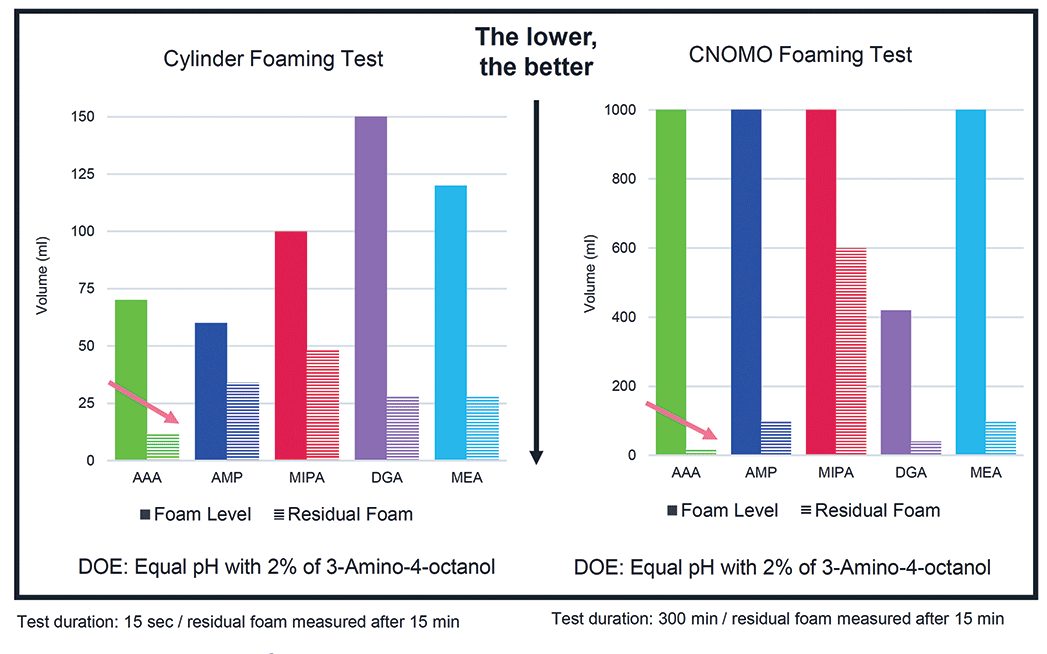
Researchers used two methods to compare foam dissipation performance — the Cylinder Foamng Test and the CNOMO Foaming Test. (See Figure 2.) Aminoamyl alcohol achieved the lowest level of residual foam at the end of both procedures. They also required less surfactant than AMP to maintain surface tension, matched AMP for hardwater emulsion stability, were less volatile and helped fluids last longer than the other alcohols.
Figure 2. Foam Dissipation Performance
Source: Advancion
Industry end users always look for real world results to confirm bench test performance. Sasol and Advancion will be working to gather such information, as will other suppliers developing new ingredients for metalworking fluids.
Tim Sullivan is Executive Editor of Lubes’n’Greases. Contact him at Tim@LubesnGreases.com