
In the past decade, the lubricant industry has felt pressure and seen opportunities in the transition from fossil-fueled energy and the explosion of artificial intelligence. Trevor Gauntlett looks at where the opportunities for business growth are amidst these megatrends.
There are more opportunities to be had from the global energy transition than just the electric vehicles and wind turbines that are so often the focus of industry articles and conference presentations. Coolants for EV batteries and fast chargers, the electrification of industry, battery energy storage and immersion fluids for data centers are emerging areas for synthetic base stock suppliers. Meanwhile, the exponential growth of artificial intelligence is driving demand for clean energy, as well as solutions to keep server farms cool.
Plate Expectations
One of the earliest applications of pure or lightly treated base fluids in the contemporary development of electrified transport was to address range anxiety and slow charging — two factors that restricted early EV adoption.
Batteries and power electronics in an EV are usually attached to a so-called cold plate, which radiates or conducts heat into a cooling medium. But restricted heat flux and a semi-permanent temperature gradient affected both the efficiency and lifetime of batteries.
Immersion cooling of the battery cells and power electronics was predicted to be the game changer. This required a non-corrosive dielectric fluid with low viscosity, high thermal conductivity, high heat capacity, long-term stability and good material compatibility. Five years on, however, much of the market is still cold plate or air cooled and automotive original equipment manufacturers are tending toward a single fluid to cool the electronics and lubricate the motor, bearings and transmission.
Hydrocarbons, such as low-viscosity polyalphaolefins and API Group III-type fluids, emerged as the fluids of choice for EVs. Phase change materials (usually melting) and esters provided some advantages, particularly when potential fires were considered.
Fast Chargers
The battery in an EV is not the whole story, however. High-power direct current fast chargers across Europe routinely operate in the 300-400-kilowatt range.
“At these power levels, thermal losses during fast charging sessions lasting 10 minutes or more would cause significant temperature increases in the charging cable if heat were not removed efficiently,” Marcel Paris, product management automotive at Fuchs, based in Mannheim, Germany, told Lubes’n’Greases.
The move toward liquid and immersion cooled charging cables has also improved the user experience.
“The newest generation of fast charging cables features significantly smaller diameters and improved flexibility while delivering the same or higher power levels,” adds Paris’ colleague Damian Weinzierl, Fuchs’ head of new mobility.
Earlier cable designs relied on large copper cross sections and passive or external cooling approaches, resulting in heavy, inflexible cables.
“By removing heat more effectively, immersion cooled cable concepts allow a substantial reduction in conductor size,” Paris explained. “At the same time, the use of electrically insulating, biodegradable thermal fluids ensures that potential leakage scenarios are managed responsibly, minimizing environmental impact.”
Cable theft used to be an issue due to the larger amounts of copper in the old cables, leading to a requirement that the immersion cooling fluids be biodegradable if this crime returns.
The Big Chill
As government target dates for full EV implementation began to look increasingly unlikely, suppliers of EV thermal management fluids developed their offer toward the emerging and very-large data center markets.
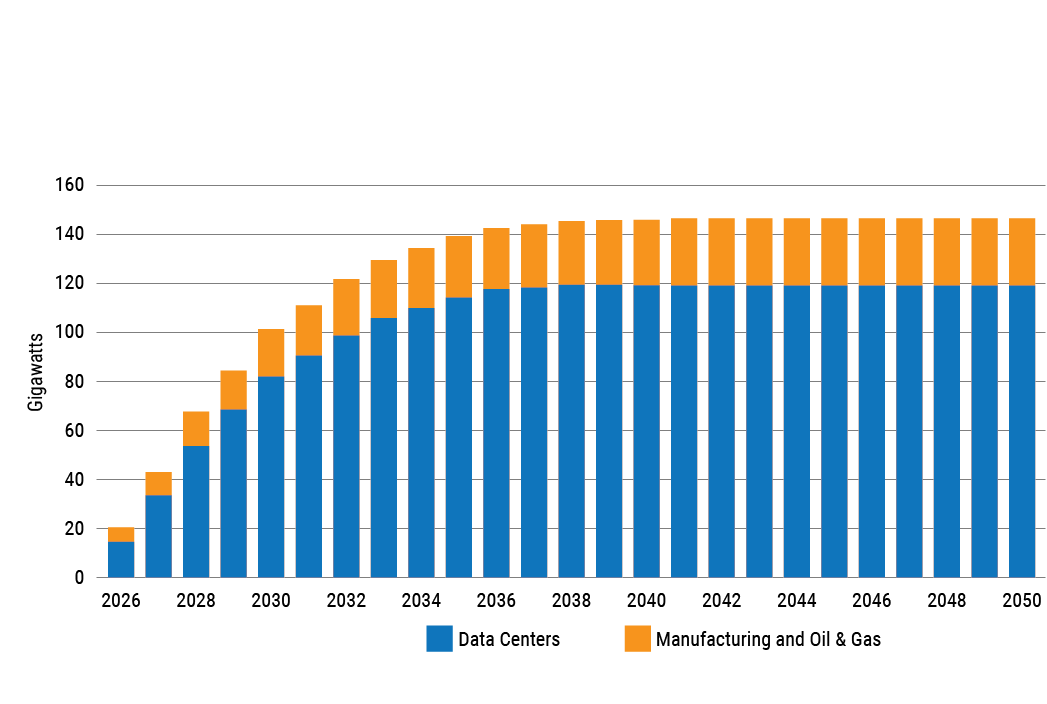
Mostly driven by AI, the International Energy Agency (IEA) expects global electricity consumption for data centers to double by 2030, reaching around 945 terawatt hours, equivalent to the electricity consumption of Japan in 2022. In the United States, energy demand for data centers is roughly three times as big as demand for manufacturing and oil and gas facilities in 2026, according to S&P Global, but is expected to be about six times as large in a decade, despite significant growth in demand for manufacturing and oil and gas. (See Figure 1.) Immersion cooling of data centers could have a compounded annual growth rate of 24.2% out to 2032, as immersion cooling is expected to also gain market share with new builds.
Figure 1. U.S. Large Industrial Energy Loads by Type
The technical demands for thermal management of data centers are close to those for EV batteries. Significant differences are that, rather than a battery cell, a chip is cooled and that servers are orders of magnitude larger than batteries.
“Data centers contain many more materials with which compatibility must be demonstrated, compared to an EV,” said Bill Downey, senior advisor to the president of Novvi LLC. These include elastomers, plastics and adhesives. However, once that compatibility threshold is surmounted, “automotive and data center OEMs are all looking for a sub-3-centistoke fluid [kinematic viscosity at 100°C],” Downey said.
The temperature range and the rates of temperature change should be less at a data center than in an EV battery. But market growth and the increasing thermal demands of data centers are accelerating.
“Four to five years back, the thermal load for an average rack in a data center stood somewhere between 6-8 kilowatts per rack. Today that average is 13-15 kW per rack,” Pooja Sharma, senior project manager at Kline & Co’s energy practice, said in a recent Lubes’n’Greases podcast. She also thinks the rate of growth of power density could be quicker in future.
Not all data centers are the same, and the demands for cooling differ significantly with application, as the hardware is different. Where liquid cooling is used, “cryptocurrency miners are very focused on cost per unit volume,” said Downey.
Contrast those conditions with those of “hyperscalers,” whose data centers underpin the likes of Amazon, Google, IBM, Meta, Microsoft, Oracle and service providers in the cloud. These companies are traded, have sustainability commitments to their shareholders and neighbors.
“They are more focused on long-term returns,” says Downey.
Figure 2. Global Energy Storage Annual New Build
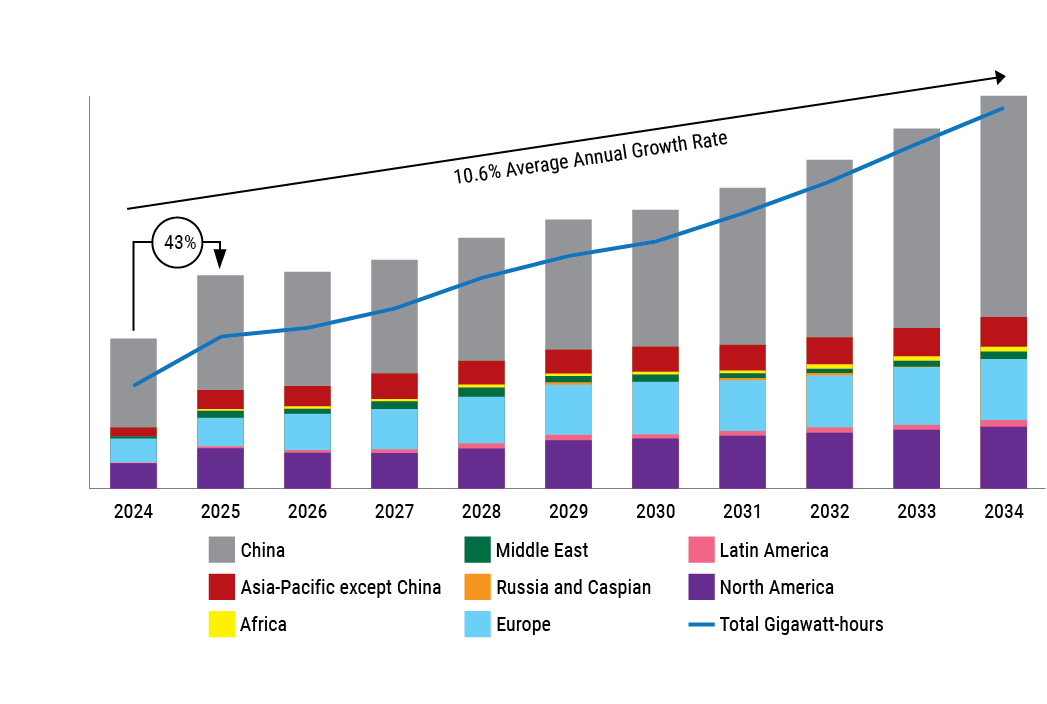
Source: Wood Mackensie
“Hyperscalers optimize globally for energy efficiency and operational risk,” according to Elisa Swanson-Parback, business development director at Perstorp Group, a subsidiary of Petronas Chemicals.
“Reliability, uptime, maintainability and long service life are key,” Swanson-Parback said. “A convincing liquid cooling solution must deliver across several integrated dimensions: safety, reliability, thermal and hydraulic performance, materials compatibility and long-term stability.”
One of the biggest differences in the server market is a fundamental operating issue. The tanks are invariably open to air. Suddenly, volatility becomes a significant issue for operator safety, as well as technical performance.
Additionally, “in markets like Japan, flash point is also an important feature where select fluids create a benefit,” noted Downey.
There’s more to the market than servers, however. In early February, Fuchs announced the deployment of a thermal management fluid into a Mongolian data center to stabilize the temperature of the backup batteries.
“Immersion cooling works perfectly for BESS [battery energy storage systems] and especially in regions with a high annual temperature range, like Inner Mongolia,” said Weinzierl. “The Chinese government encourages minimal emissions, and immersion cooling provides an additional aportion of thermal management lowering the PUE of the whole data center significantly,”.
Power usage effectiveness compares the total energy consumed by the facility to the energy used by its IT equipment.
Another place where immersion cooling may work is in BESS for large buildings. “In commercial and industrial environments, proximity to people raises the risk,” said Kevin West of K. West Advisory, based in Reading, U.K.
Compared with high-performance EV battery systems operating at elevated C-rates [NN], grid-scale BESS typically operate at comparatively low C-rates, so thermal loads are more manageable. As such, most large-scale BESS installations would not require immersion cooling. However, in commercial and industrial settings where higher power density, faster discharge capability or enhanced safety margins are required, immersion architectures could offer additional benefits, West explained.
Some players are seeking to monetize the heat generated from data centers, with district heating proposed as a model. In a pilot scheme, British startup Deep Geen claimed to use “biodegradable mineral oil” as an immersion fluid to transfer heat from the servers to the water of a public swimming pool, saving on the data center’s cooling costs while reducing the heating costs for the pool. There are larger district heating schemes in Europe, but none is explicitly using an immersion fluid to transfer the heat.
Grid expansion: the biggest volumes
Two major developments that get less attention are electrical transmission grid capacity and stability. One exception has been Thomas Norrby of Nynas AB, based in Nynashamn, Sweden. “Investment into the electrical grid consists of two roughly equal parts – replacement of ageing infrastructure and new net growth. The total size of the market in 2025 was about 1.6 million mtpa.”
“The electricity grid has evolved from a centralized system powered by a few stable plants into a decentralized and fragmented network of renewable sources such as wind and solar. This shift introduces fluctuating power generation that places greater demands on transformer performance, while the more dispersed and complex value chain (e.g. wind and solar farms) requires stronger alignment and education as well as continuous coordination across borders and stakeholders to ensure maximum efficiency,” according to Anna Eriksson, Nynas’s marketing manager of naphthenic specialty products.
“Naphthenic transformer oils maintain a global market share of about 70%. Several factors contribute to this dominance: very good high-voltage dielectric properties, very good low temperature startability, low viscosity (kinematic viscosity 7-10 centiStoke at 40 C) and low VI, which facilitates the natural convection cooling mode, which by far is the dominant technology for small and mid-size transformers. High availability and affordability are also key factors.”
“Transformer oils come in two fundamentally different categories.” Inhibited oils have a synthetic antioxidant (called BHT in lubricants applications) added and are generally used in the large transformers at each end of high voltage lines. Uninhibited oils are carefully refined to leave enough sulfur-containing molecules acting as natural antioxidants. They are deployed in the small “fill and forget” local distribution units. “Uninhibited oils last as long at the transformer itself,” Norrby added.
Figure 3. Gobal Installations in Energy Storage
Annuall installations for energy storage surpassed 100 GW for the first time in 2025. Wind and solar installations crossed that milestone in 2009 and 2017, respectively.
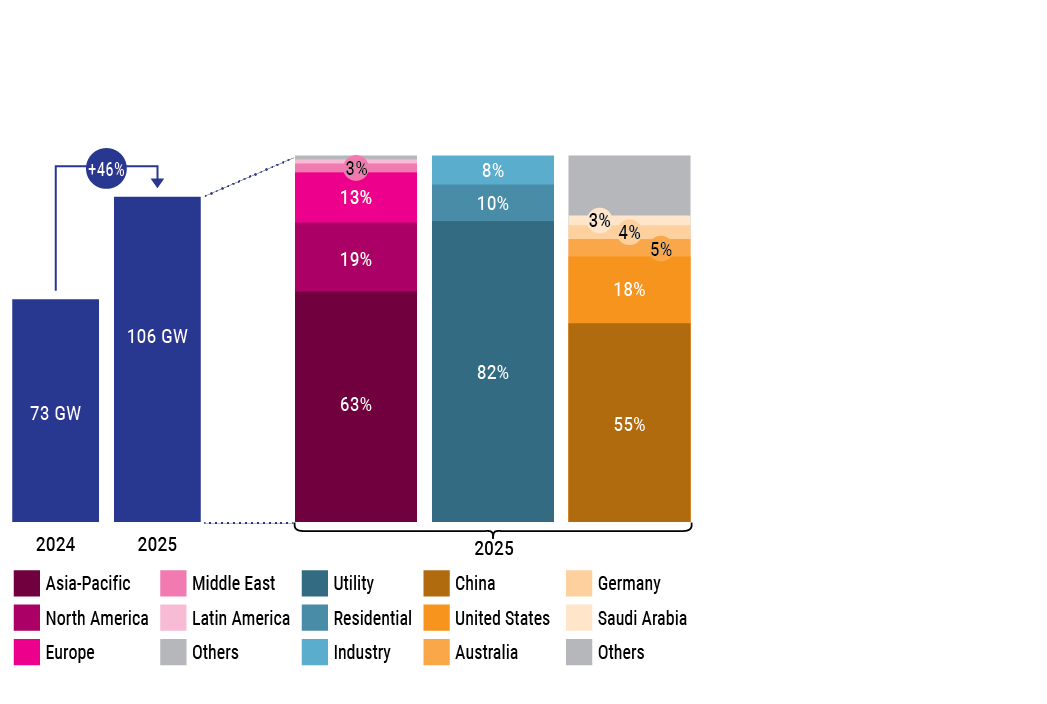
Source: Wood Mackensie
There is also potential to enhance existing assets. “A lower viscosity transformer oil, optionally combined with increasing the capacity of air-cooling fans for the radiators, would allow more power flowing through the windings for the same temperature rise (above the ambient, which is the metric),” says Norrby. This “would allow for a significant power uprating [of] 10-20% or more depending on design limits, merely by improving cooling efficiency.”
Some smaller grid and generation applications also utilize natural or synthetic esters, but hydrocarbons will probably continue to dominate. “The collection and transmission of the power generated is complex and requires a staggering amount of power transformers of all sizes,” said Norrby.
“Fun fact: one single long-distance, high-voltage direct line will have 96 high-performance transformers, 48 at each terminus. Each of these require a super grade transformer oil. So, electrification keeps the lubricants industry very busy indeed.”
“Cooling fluid properties do matter, but they’re never the whole story,” says Swanson-Parbäck. “Real energy efficiency comes from how the fluid chemistry works with system design, materials, and operating conditions. And the same goes for innovation.”
No single player can unlock the full potential of advanced cooling. It takes partnerships across the ecosystem to create the interplay that drives true performance, she noted.
Trevor Gauntlett has more than 25 years’ experience in blue chip chemicals and oil companies, including 18 years as the technical expert on Shell’s Lubricants Additives procurement team. He can be contacted at trevor@gauntlettconsulting.co.uk