
A Stitch in Time … Saves Supply
The nightmarish weather forecast that raised alarm among industry participants on January 22 sounded familiar. A dangerous winter storm approached, and it was expected to bring sub-zero temperatures, heaps of ice and snow, and possibly cause widespread power outages to large swaths of the United States and Canada, strikingly resembling Winter Storm Uri which brought huge base oil production losses back in February 2021. One major difference, however, was that this time, refiners were better prepared.
Given the recent history of freezing temperatures in areas where refineries are located and as weather patterns become more extreme, most facilities have been “winterized” and have improved plans and procedures to protect employees and structures during such hazardous weather events. However, an extended power outage could cause output disruptions even though many units are equipped with backup generators, industry sources noted. Prolonged power outages were one of the main reasons for the production losses at refineries and chemical facilities in Texas five years ago.
A number of oil platforms and processing units were on high alert before the recent storm, and some halted operations temporarily. Freeze-offs curtailed roughly five million barrels of crude oil production over the weekend, and crude exports were halted because of port closures along the U.S. Gulf Coast. However, ports reopened shortly after, and most refineries reported little impact on operations and logistics.
Refineries along the U.S. Gulf Coast were particularly affected, curtailing production overall by roughly 50%, according to sources familiar with refinery operations. Refineries on the Gulf Coast are not built for cold weather and simply do not run well at below-freezing temperatures. Producers wanted to avoid hard shutdowns, which are very difficult to recover from, and had implemented contingency plans ahead of the storm, with minimal impact to base oil production observed. However, there were some small issues reported at a few finished lubricant blending plants which are more vulnerable to extreme weather conditions.
Participants had kept an eye on Paulsboro’s API Group I plant in Paulsboro, New Jersey, because of its location in the path of the storm. The company indicated that the lubricant business remained largely unaffected, but as the refinery worked through the impacts of the weather event the company would suspend quoting export barrels to ensure it would meet all domestic obligations.
Calumet operates two plants in Louisiana, a state that was also impacted by the storm. However, a company source noted that both the paraffinic and naphthenic plants were able to safely navigate the severe weather without any disruptions.
Rerefiner Avista Oil also reported that its plant in Georgia was running well despite the adverse weather.
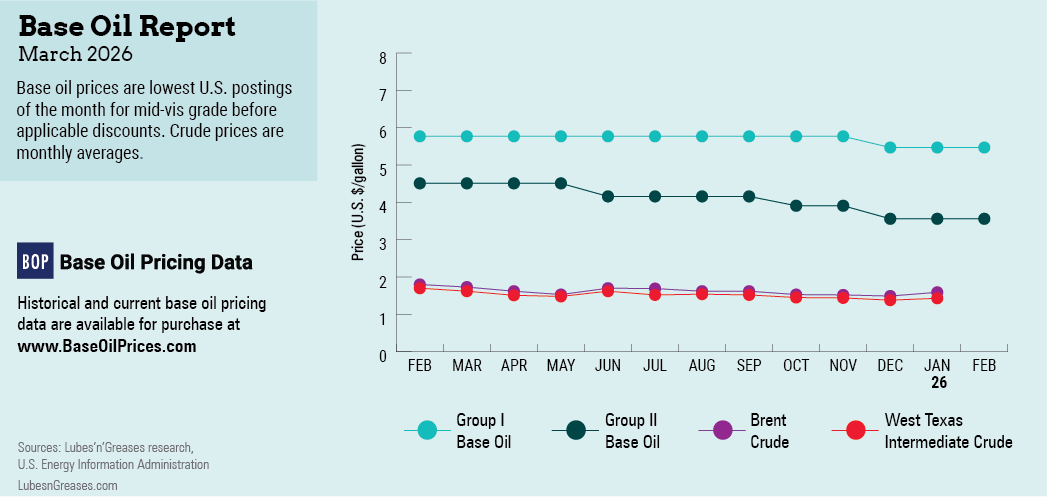
The winter storm did push crude oil prices higher, with futures rising by about 3% as U.S. oil producers lost up to 2 million barrels per day or roughly 15% of national production over the weekend. The storm also strained energy infrastructure and power grids and was expected to bring a significant drawdown in crude oil, gasoline and diesel inventories.
Base oil prices were generally reported as stable, although the heavy cuts remained exposed to downward pressure due to lackluster requirement levels and more plentiful availability compared to the light grades.
While the Group II segment was generally perceived as oversupplied, the situation seemed slightly more manageable than at the same time last year, when inventories were much larger. This was partly attributed to the fact that suppliers were able to ship large volumes of base oils into different export destinations during the fourth quarter of 2025, although some countries such as India took fewer cargoes than in the previous years. However, the Group II segment also reached the end of the year with a tighter supply and demand ratio because of the turnaround of a Group II plant in the last quarter. Prices for Group III grades were also steady given a fairly balanced supply and demand ratio.
Within the Group I segment, bright stock remained a sought-after grade, and some spot transactions took place at steeper prices, with small increases of 1 to 2 cents per gallon mentioned, because of a tightening of this cut amid emerging export opportunities.
The focus of export business remained Brazil, as Brazilian producer Petrobras’ key base oils plant was heard to have suffered an unexpected and extended shutdown in October. Several U.S. Group II cargoes had also been available in Brazil, and those blenders who were able to replace Group I cuts with Group II base oils opted for doing so as prices were competitive.
U.S suppliers also set their sights on export business to Mexico, where buying interest had started to improve, but the conclusion of deals appeared to be rather elusive since buyers’ price expectations did not meet offer levels. The availability of rerefined grades and Asian material also meant that suppliers had to deal with additional competition.
Freezing temperatures still blanketed much of the U.S. at the time of writing, raising concerns that refiners may have to favor diesel production versus base oils output if the weather conditions did not improve, as running generators had led to a spike in diesel consumption. Base oil buyers worried about tightening supplies and had contacted producers to ensure they would be receiving their cargoes as scheduled. Steeper crude oil values and a tighter base oil supply and demand balance may exert upward pressure on prices at a time when buying interest typically increases ahead of the spring lubricant production cycle, although a supply overhang may still weigh on prices in some pockets of the market.
Gabriela Wheeler is base oil editor for Lubes’n’Greases. Contact her at Gabriela@LubesnGreases.com