
Operators of lubricant manufacturing facilities, working as they do within the constraints of an active plant, often maintain an extensive wish list of features that would reflect their vision of an ideal facility.
A decision to build a new plant opens opportunities to realize those aspirations. Not all ideas are easily implemented due to factors like investment requirements, innovation and practicality, but features that have a sound rationale — that are likely to contribute to productivity, efficiency or product quality — may work their way into designs.
But wishes coming true don’t guarantee things working out as hoped. Significant challenges can remain, particularly in commissioning and starting up a greenfield or even a brownfield plant. The greater the number of novel features and enhancements, the higher the complexity involved in bringing the facility online. As the well-known saying goes, “there is no gain without pain.”
This article discusses the challenges involved in commissioning and starting up a lubricants plant, offering a practical guide or cheat sheet for the start-up process. For context, it’s helpful to review the entire Project Life Cycle (see Figure 1), since a successful start-up really begins during the planning phase — starting with concept design.
Figure 1. Project Life Cycle
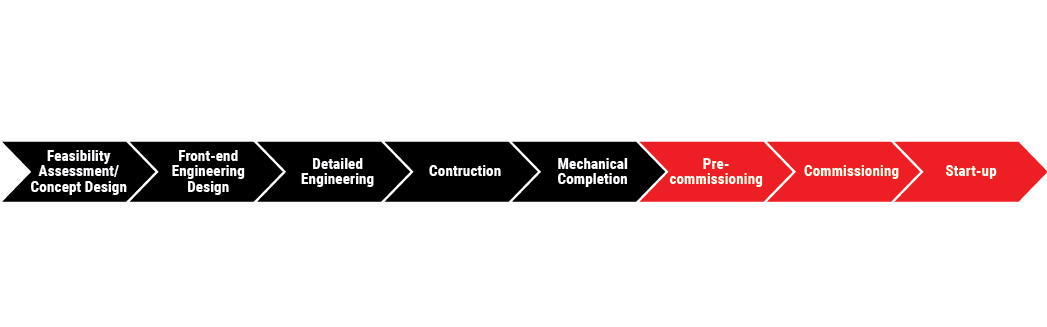
Source : Ganesan Ganapathi
The necessity for a specific project is identified early in the project life cycle by operations teams, management and business owners. Drivers for project initiation include factors such as capacity requirements, capability gaps, anticipated growth and business decisions. These needs undergo systematic filtering, strategic consideration and feasibility analysis before being consolidated into a clearly defined project.
Despite this structured formation process, projects require further specification regarding scope and concept — work that is carried out during the front-end engineering design stage. Each project milestone requires stage gate approval to ensure sponsors and stakeholders remain aligned with the project’s evolving definition and development.
To facilitate informed investment decisions, detailed engineering is conducted to thoroughly develop design specifications. This should yield accurate cost and schedule estimates, forming the basis for final management approval and enabling readiness for physical execution.
Subsequently, project execution encompasses construction, procurement and related activities necessary to bring the project to fruition. Eventually, though, the plant is built, and it is time to use it. Almost.
First the company must verify that everything is in order and that it has the plant that it designed and paid for. This is a multi-stage process that begins with pre-commissioning, when individual components and units are prepared and tested for operational readiness. Inspections may be conducted both on-site and at vendor facilities to mitigate risks that could negatively impact timely and cost-effective project delivery.
Commissioning then involves methodical completion of tasks to verify that the facility meets operational requirements and is suitable for turnover to the operations team. During this phase, key activities such as hands-on training for the future operations staff occur. Often the operations team is directly involved in commissioning procedures.
Finally, the facility enters the operations phase, beginning with a gradual ramp-up prior to reaching full designed capacity, thereby ensuring a smooth transition to steady-state operation. Following are recommended dos and don’ts for these and earlier stages.
Design Stage
1. Do incorporate commissioning into the design stage. Careful planning at this point allows you to refine design features, enhance new elements, and set clear operating conditions — ultimately minimizing unexpected issues later on.
2. Don’t design lengthy pipeline routes. Aim for modular, well-designed facilities with optimal pipe lengths. This approach streamlines testing and flushing during commissioning and provides greater control over the speed of the process.
3. Do standardize piping and instrumentation diagrams and three-dimensional models early with commissioning input. Involve operations teams in hazard and operability reviews to flag blind spots like dead legs. Dead legs are inactive or low-flow piping sections that can lead to problems such as premature corrosion due to collection of sediments, bacterial growth or water settling.
Construction
4. Do target lubricant specific threats — cleanliness, particles and water across construction phases. Do prioritize mitigating key issues — cleanliness, foreign bodies or particles and water — right from construction stages through rigorous protocols. Do develop a “cleanliness passport,” tracking relevant codes from construction through startup. ISO 4406 is an international standard used to quantify particulate contamination levels in lubricants and hydraulic fluids.
5. Do perform ongoing, systematic monitoring of construction activities from the perspective of commissioning. Independent oversight by both operations and commissioning teams helps to proactively identify any deviations or omissions relative to design specifications, enabling timely reporting and reducing the likelihood of future rework.
6. Don’t resort to open storage of critical equipment. Doing so risks exposure to atmospheric degradation that could lead to malfunction of equipment apart from risk to cleanliness and contamination.
7. Don’t overlook procedural safeguards that prevent contamination buildup during construction handovers.
Pre-commissioning Stage
8. Do use oil as the pressure-testing medium (or air leak tests where suitable) instead of water to avoid introducing moisture risks. Don’t use water for such testing because getting rid of it later will much effort, leading to delays in commissioning and start up. It is recommended instead to use light base oil as a pressure-testing medium.
9. Do circulate raw material tanks sequentially with designated quantities of light base oil, tank by tank. This progressively cleans the system, boosting commissioning effectiveness — any extra time invested pays off in long-term reliability. Reuse the circulated base oil for low-spec products after cleanup and quality checks.
10. Don’t skip on vendor pre-qualification factory acceptance or site acceptance test protocols. Unproven skids multiply onsite rework by a factor of three or even more.
11. Don’t ignore tuning of distributed control system and programmable logic controller loops during planning. Untuned controls cause erratic blending and result in off-spec output in initial runs. Typical loop tests are performed while pre-commissioning, but this kind of loop tuning ensures desired “response to stimuli” is indeed achievable and properly tested.
Commissioning and Start-up Stages
12. Do begin by blending and filling with low-service-level products (for example mineral oils), then ramp up complexity gradually (for example from API SC or API CC to higher specs, then to synthetics). This matures the system step-by-step.
13. Do anticipate need for flushing and downgrades, but apply 5R waste management principles (Refuse, Reduce, Reuse, Repurpose, Recycle) to plan and expedite them efficiently. Minimizing waste reduces pressure on the commissioning team and speeds progress.
14. Don’t rush high complexity blends early or ignore waste streams, as doing so amplifies delays and operational risks.
15. Don’t bypass intermediate quality control holds after each product trial, for doing so causes cumulative contamination to snowball.
While commissioning and starting up a lubricants plant may seem more straightforward compared to other petroleum or chemical processing facilities — mainly due to the high flash points of finished lubes — these projects carry do significant risks related to product cleanliness and water contamination. Practical commissioning tips can help address these issues, alongside thorough, proactive planning. Including the operations team from the earliest stages of the project helps ensure an efficient and timely startup.
Commissioning brownfield projects calls for similar preventive measures to avoid negative impacts on ongoing operations. Managing SIMOPS (simultaneous operations) safety is essential for these scenarios, which differ notably from greenfield projects. A structured work permit system, along with additional safety interlocks such as mechanical and electrical lockout/tagout, are implemented to support safe and effective commissioning and startup processes.
Ganesan Ganapathi has more than 40 years of experience as a supply chain and manufacturing professional with leading oil companies such as BP, Shell, Total and Bharat Petroleum. He also has noteworthy contributions in strategic and master planning, ranging from concept through commissioning and ramp up. He can be contacted via LinkedIn.