
For the past eight years, the world’s regulator of international shipping has worked to develop a plan for the industry to make its contribution in the fight to combat global warming. That work has brought the United Nations’ International Maritime Organization to the verge — possibly — of adopting laws aimed at eliminating or offsetting greenhouse gas emissions from ocean-going vessels by 2050.
If such a plan is adopted, proponents say it will prod the industry to make monumental shifts from the fossil fuels it has historically used to alternatives that generate far less amounts of greenhouse gas emissions. According to one industry insider, some of those alternatives would require changes in marine lubricant formulation, while others may not.
“The requirements for lubricants will depend on the mix of fuels that end up being used,” Justin Van Tries, market liaison and product manager for marine and power engine oils with TotalEnergies, said in May at the Society of Tribologists and Lubrication Engineers’ annual meeting in New Orleans.
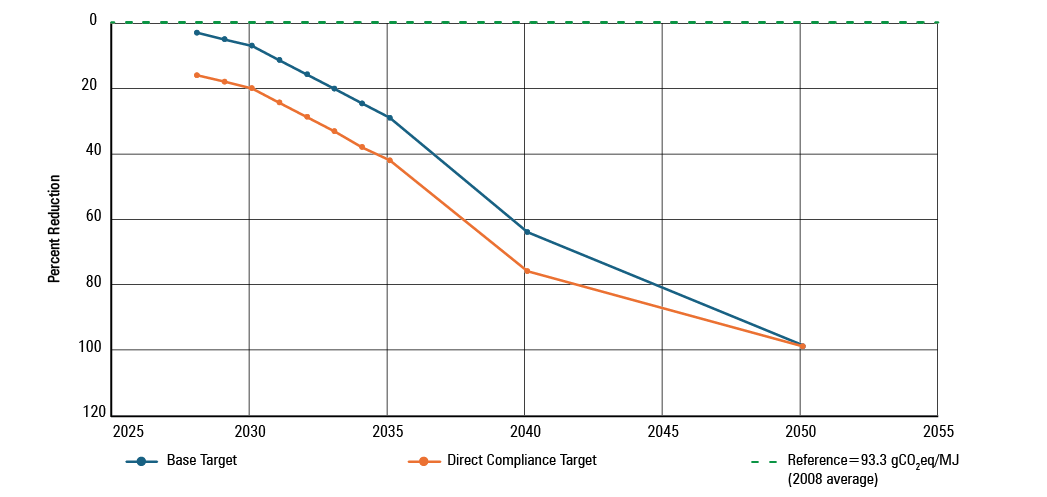
The IMO is an agency that aims to ensure the security of shipping and to prevent pollution by ocean-going vessels. Since 2018 much of its attention has focused on aligning the industry with the Paris Agreement, the 2015 worldwide resolution to prevent global temperatures from rising more than 1.5 degrees C˚ by the middle of this century. In 2018 the organization adopted its initial strategy on reduction of greenhouse gas emissions from ships, and in 2023 its 175 member nations unanimously approved the Greenhouse Gas Strategy, which set targets of cutting ocean-going ship emissions of those gases by 20% from 2008 levels by 2030 and by 40% by 2040. (See Fig. 1.) The ultimate goal is by around 2050 to reach net-zero emissions, meaning any remaining emissions would be offset by carbon credits.
From there the organization’s Marine Environment Protection Committee began drafting a regulatory program to meet those goals. By last year it had developed Net Zero Framework, which would not explicitly prohibit or mandate the use of particular fuels but would encourage the use of cleaner fuels by assessing fees based on a ship’s greenhouse gas fuel intensity, a metric for well-to-wake emissions, calculated from the amount and types of fuels consumed. The framework set two limits on GFI and established a market for carbon dioxide credits priced in two tiers. Vessels exceeding the more difficult direct compliance limit would have to purchase the cheaper credits, priced at U.S. $100 per ton of CO2 equivalent. Those exceeding the easier base target would need to buy the more expensive offsets, which would cost $380/ton.
Figure 1. Targeted Emissions Reductions*
Source: TotalEnergies
*Note: Emissions based on well-to-wake greenhouse gas fuel intensity metric; units are grams of CO2 equivalent per megajoule
“The NZF penalizes vessels with GFI higher than targets and incentivizes use of low-GHG fuels and other technologies to reduce the GFI,” Van Tries said.
Funds collected from penalties will create a fund that supports early adopters of zero- or near-zero emissions fuels and infrastructure development, along with supporting small and developing nations hurt by climate change. The regulation was to begin in 2028.
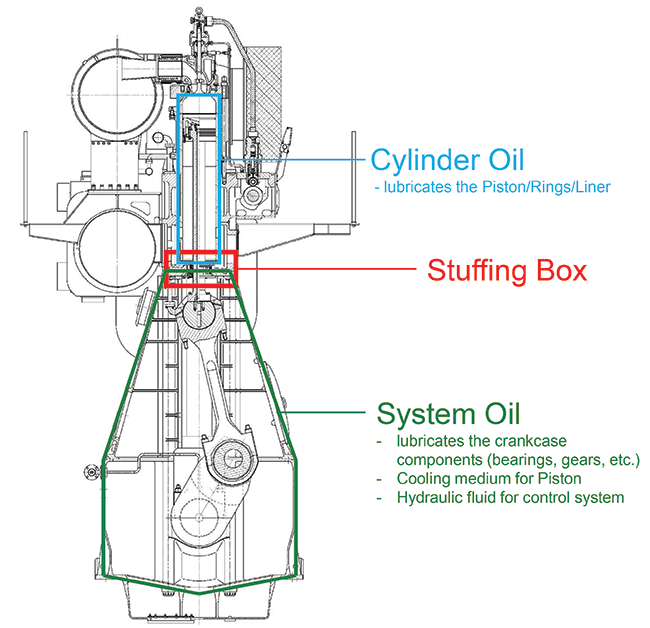
Figure 2. Two-stroke Crosshead Engines: Two Lubrication Systems
Source: TotalEnergies
Waylaid by Opposition
In April of 2025, the Marine Environment Protection Committee voted to endorse the framework and referred it to the IMO for adoption at an extraordinary meeting in October of that year. The framework was not approved, however, and was instead held up by opposition from the United States and oil-producing nations. The U.S. called for a permanent scrapping, arguing that the framework would undermine existing fleets and global trade by promoting expensive fuels lacking in availability. It also opposed the fees that the framework would charge. Oil-producing nations — including Saudi Arabia, Russia, Iraq, Kuwait, the United Arab Emirates, Bahrain, Somalia, Algeria and Argentina — contended that the framework was not supported by many member states and argued for greater consensus.
The meeting adjourned without a vote as member nations agreed to a one-year pause in hopes of bridging differences. The matter is scheduled for a vote at another extraordinary meeting in early December, but differences on key points remain after multiple meetings this year. Observers say it is unclear what will become of the framework.
Comparing Alternative Fuels
Van Tries talked about four of the fuels cited most as zero- or near-zero emissions replacements for fossil fuels: liquefied natural gas, biofuels, methane and ammonia. (See Fig. 3.) LNG currently makes the smallest reduction in greenhouse gas emissions, he said, just 23%, but industry is developing alternative versions to the gas extracted from wells, fields and rock formations.
One alternative is biogas or renewable natural gas is produced by the decomposition of biomass such as waste plant matter and other agricultural residues, municipal waste and animal manure. Industry is also developing methods to make synthetic natural gas or e-methane, which is produced by combining green hydrogen with captured CO2 in a methanation process that involves high temperatures and pressure. Proponents foresee a transition from LNG through biogas to synthetic natural to reduce greenhouse gas emissions to near-zero by 2050. This requires the collection of CO2 from biogenic sources or the atmosphere. Critics say such processes would remain too expensive to be practical. Van Tries said LNG has the advantage of already having an established supply.
Figure 3. Impacts of Future Marine Fuels on Greenhouse Gas Emissions, Lubricants
| Fuel | Greenhouse Gas Reduction | Fuel Pros | Fuel Cons | Lubricant Implications |
|---|---|---|---|---|
Liquefied natural gas |
|
|
|
|
Biofuel |
|
|
|
|
Methanol |
|
|
|
|
Ammonia |
|
|
|
|
Like natural gas, methanol’s greenhouse gas emissions depend on its source. Methanol made from coal (brown methanol) actually generates more mine-to-wake emissions than fossil fuels, while gray methanol, made from natural gas, generates a comparable amount. Blue methanol, made from natural gas with carbon capture and storage CO2 achieves significant reductions, and green methanol, made from biogenic waste and green hydrogen, is near-zero. But blue and green methanol have high costs and low availability, Van Tries added. On the plus side, engine technology is ready and there is low competition from other uses.
Ammonia generates no CO2 either in production or use, but it does generate nitrous particles that are also greenhouse gases, and the amount ranges widely depending on the source of raw materials. Ammonia is highly toxic, Van Tries said, and a safety regulatory framework for it is still under development.
The engines burning these fuels are the largest in transportation, crosshead two-stroke engines as tall as four-story buildings, armed with from five to 14 cylinders with diameters of up to 96 centimeters. Pistons have stroke distances of 1.5-3.5 meters and move at 70-160 revolutions per minute, generating between 2.5 and 84 megawatts of power.
Today’s engines are built to accommodate the fact that availability of fuels, as well as pricing, can vary between different parts of the world and that ship operators may want to switch fuels — sometimes in mid-transit — while still optimizing operations.
“Many modern engines are built to operate with two fuels,” Van Tries said, “utilizing two-fuel systems on the engines. Some models can operate in two different combustion cycles — diesel and otto. Mixed mode can accommodate different percentages of each fuel type. This is key to the use of alternative fuels such as natural gas, methanol, ammonia, ethane, ethanol, etc. Recent developments even allow for altering the compression ratio while running to allow for maximum efficiency of the fuel and cycle in use.”
The size and design of crosshead two-stroke engines allows the piston, cylinder liner and rings to be separated from the crankcase, enabling optimal lubrication of each. (See Fig. 2.) The crankcase has a system oil that lubricates its gears, bearings and other components while also cooling the lower section of the piston and serving as a hydraulic fluid for the control system. The pistons, rings and liners, meanwhile, are lubricated by a cylinder oil. Separating the two area is the stuffing box, which seals them off, preventing fuel from migrating to the crankcase and helping to avoid explosions there.
Cylinder oil is a total loss lubricant that is consumed as the fuel burns. Injected directly onto the cylinder and into the ring pack, it performs several functions, Van Tries said, lubricating to reduce friction and cylinder wear, serving as a heat transfer medium, neutralizing acids formed during combustion and keeping components clean. Traditionally they were formulated to have high base numbers to handle high-sulfur residual fuels, but today’s engines require lower basicity and higher levels of detergency, thermal resistance and oxidation control.
Impacts on Lubricants
Among the clean fuels discussed by Van Tries, biofuels are most readily accommodated by existing cylinder oils since they are near drop-in replacements for fossil fuels.
“Biofuels burn similar to fuel oil,” he said. “They present no significant lubrication challenges due to the fuel. The cleanliness of the ring pack is the focus.”
LNG does affect cylinder oil requirements, but those needs have largely been identified.
“Natural gas is known fuel,” Van Tries said. “It’s lubrication challenges were unique due to the engine design and operation.” First, in the Otto cycle, there is significant flame interaction between the lubricant and the liner. Second, ash content, which traditionally has been high in cylinder oils, leads to problematic calcium deposits on diesel fuel injectors. “So development of low-ash, low [base number] cylinder oil is necessary.”
For methanol and ammonia, the picture is less complete because of lack of real world experience in field trials. “First-production ammonia-fueled engines have completed shop testing but have no operational usage,” Van Tries said. “Methanol has been in operation but usage is limited.” The good news is that no issues have been identified to date between either of these fuels and approved cylinder or system oils.
Van Tries chalked this up to engine design, noting that cylinder oils have a limited life and that fresh oil is continually injected to the liner and ring pack. In addition, injection and combustion of both fuels is a diesel cycle that limits fuel interaction with the liner.
Still, industry is waiting to see long-term impacts of these fuels, particularly on system oil. Van Tries noted that ammonia presents multiple general challenges. It is corrosive to copper and is absorbed into lubricants, which can degrade oil and disrupt the performance of antiwear additives.
The shipping industry’s use of low-emission fuels will be impacted by a range of factors — from costs to regulations that are still being developed, fuel availability and infrastructure construction. The outcome of those factors will affect what, if any, adjustments are required for marine lubricants.
Tim Sullivan is executive editor for Lubes’n’Greases. Contact him at Tim@LubesnGreases.com.