In a welcome development for API Group III buyers, Penthol, the distributor of ADNOC base oils in the United States, announced it would lift force majeure on Dec. 1. An ADNOC cargo was delivered to the U.S. Gulf in early November, and a second parcel was reportedly en route to Europe and the U.S. The fresh shipments were anticipated to bring some relief to Group III consumers and signaled optimism that additional shipments would be concluded, although the logistics still faced grave risks, resulting in sky-high freight rates and insurance premiums.
Motiva communicated posted price adjustments this week as well, with some base oils showing decreases and others increases, reflecting current market fundamentals. Indeed, the supply and demand ratio in the Group I and Group II segments has started to ease, with suppliers also keen on reducing inventories ahead of year-end tax assessments. These factors exerted downward pressure on pricing. On the other hand, fairly firm feedstock costs and ongoing shortages in the Group II+ and Group III categories placed upward pressure on prices, with Motiva’s increases mirroring these conditions. Market activity was slightly subdued ahead of the Thanksgiving holiday on Nov. 26 in the U.S.
Crude oil remained volatile on an apparent flare-up of hostilities between the U.S. and Iran, with Iran claiming strikes on American targets in the Middle East and increasing its attacks on vessels in and around the Strait of Hormuz as the country said it would tighten control over the waterway until its demands were met. The U.S. was seemingly preparing for major military action given that no peace agreement has been achieved, despite ongoing diplomatic efforts.
Crude futures displayed a choppy trading session on Tuesday, with values slipping in early trade as increased supply expectations offset concerns about vessel attacks near Hormuz. Futures then rebounded as the shipping risks outweighed the optimistic supply outlook. West Texas Intermediate futures settled up by $2 per barrel to near $82, but values were still lower than last week’s settlement at around $86/bbl. Increased Middle East flows and the restart of a Libyan pipeline were expected to continue placing pressure on prices. JPMorgan predicted oil futures would fall to the high $70s/bbl in the first half of 2027 due to an estimated supply surplus, partly due to higher Middle East production outside of Iran next year, as well as additional supply from the Americas, particularly the U.S., CNBC reported.
Group I and Group II
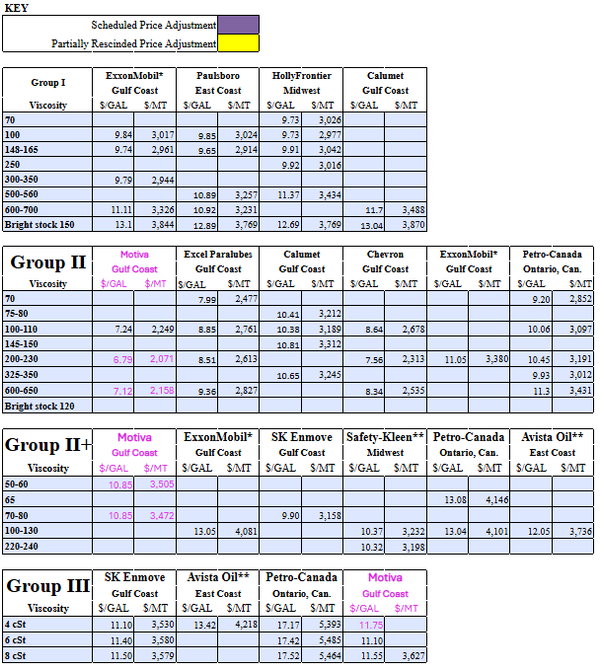
Motiva communicated a posted price decrease of 20 cents per gallon for its Group II 220N grade and 45 cents/gal on its 600N base oil, which went into effect on Nov. 23. The adjustments were driven by “continued market dynamics,” the company explained. Prices for the Group II 100N cut were unchanged.
As has been the case over the last couple of months, Group I and Group II producers appeared to be on a mission to find a home for the extra stocks they held during the Atlantic hurricane season and for other supply emergencies as the market has been so tumultuous throughout the year. Most suppliers preferred to end the year with lean inventories to avoid tax repercussions on unused stocks, and this has led to lower prices. Slipping crude oil and feedstock values were also exerting downward pressure on base oils.
These factors coincided with a slowdown in demand, as consumption levels were heard to have declined precisely for the same reason that suppliers were releasing inventories — buyers also try to finish the year with just enough raw materials to keep operations running, while credit and cash flow constraints for some players also curbed orders. Blenders have faced ongoing difficulties in recouping their higher production costs given resistance to lubricant price increases in the second half of the year. November and December are traditionally difficult months for lubricant increases to be pushed through, particularly when crude oil and feedstock prices are also sliding.
In contrast to six months ago, when the market had been extremely tight because of crude oil supply disruptions and a need for some refiners to produce more fuels versus base oils, availability of a majority of Group I and Group II grades has lengthened. However, the light grades appeared to be tighter than their heavy-viscosity counterparts, partly because of seasonal factors as heavy-viscosity cuts see less demand in the colder months. Group II 100N appeared to be the least available grade for spot business, but 200N was also snug.
Even with supply levels easing, producers remained focused on fulfilling contract commitments and stayed cautious regarding spot availability due to ongoing market uncertainty. Given that the conflict in Iran has disrupted base oil supply on a global scale, buyers were looking to lock in more contract volumes for next year and move toward near-sourcing — a shift that also gives producers a safety net by reducing their need to move spot cargoes.
Group I spot supplies have also been tight following a maintenance shutdown at Paulsboro Refining’s Group I unit in New Jersey. The producer restarted base oil production on Oct. 26, and while it was expected to continue covering contract commitments, exports were not anticipated to resume until December and only after the company has been able to rebuild inventories.
In the Group II segment, it was heard Chevron is planning to bring Group III production online at its plant in Pascagoula, Mississippi, before the end of the year, and this may impact its Group II production levels.
U.S. export prices have also weakened, in part because U.S. suppliers had to compete with Asian offers, but also to promote sales in traditional markets such as Mexico since buyers expected prices to be on a downward trend as they typically do towards the end of the year, and they pressured suppliers. Some negotiations were anticipated to take place on the sidelines of the ICIS Base Oils and Lubricants conference in Jersey City, Dec. 3-4.
In Brazil, Group I supplies have improved as a key producer was running its plant at normal rates and was able to meet contractual obligations. The producer lowered its Group I prices for November because of growing supply levels against sluggish demand. Group II prices were mostly steady because these cuts were less plentiful, although the light grade and Group I bright stock were losing territory because of more ample supplies.
As the market headed into the last month of the year and the holiday period, demand for U.S. base oils in Latin America and Europe declined, with buying interest in other regions such as India — which is sometimes flooded with U.S. base oils in the last quarter as suppliers try to reduce inventories at home — also described as lackluster. An increase in production levels at Indian base oil plants was also seen as the culprit for the reduced buying appetite, although one plant was heard to be undergoing a turnaround.
Group II+/Group III
Motiva announced a 25 cents/gal increase on its Group II+ 2 and 3 cSt grades, and 50 cents/gal on the company’s Group III 4 cSt, effective Nov. 23. The producer’s Group III 6 and 8 cSt grades were unchanged. The increases came on the back of extremely constrained conditions for most of these grades and prospects of ongoing supply tightness.
News that the official distributor of Abu Dhabi producer ADNOC in the U.S., Penthol USA, would be lifting its force majeure on ADNOC supplies on Dec. 1 brought some relief to the Group III segment as global availability has been extremely tight since the start of the Iran war. The force majeure had been implemented on July 15, but the supplier has since been able to lift two ADNOC shipments, with the latest one expected to arrive in the U.S. at the end of December or early January. The cargo was heard to have sailed from Fujairah, in the United Arab Emirates. Penthol told customers that sales controls remained in place and that the company expected some shipment delays until safety stocks could be replenished. The supplier also noted that it remained confident about the situation, but that shipments were a costly undertaking because of the heftier transportation and insurance costs, while also admitting that ongoing risks were “part of the new normal.”
Despite the lifting of these cargoes, shipments from the Persian Gulf have not resumed a normal schedule yet, as the threat of Iranian strikes on vessels persisted, with this week showing a surge in attacks on tankers. Furthermore, the Group III plants in Bahrain, Qatar and Abu Dhabi were not expected to fully resume until the U.S.-Iran reach a peace deal and the Strait of Hormuz is opened to all vessel traffic, with some of the facilities also having to undergo repairs because of missile strikes earlier in the conflict.
Group III prices remained exposed to upward pressure, especially 4 cSt, due to limited supplies and healthy demand. Some downward pressure has built on the 6 and 8 cSt grades given improved availability and because these grades are less widely required in downstream applications. Participants expected conditions to remain fairly tight given a number of upcoming turnarounds next year and the delayed start-up of Group III production in Saudi Arabia. A turnaround at S-Oil’s Group II/III plant in Onsan, South Korea, in May, which was expected to last 45 to 60 days, could exacerbate the tight supply conditions further.
HF Sinclair/Petro-Canada was also expected to decommission its Group II/II+/III base oils plant in Mississauga, Canada, some time next year. Although the company has signed an agreement with SK Enmove and Chevron to secure supply for its current customers once the plant is retired, there might be a temporary tightening of domestic supplies in North America. A Canadian labor union was also challenging the company’s decision to close the plant as more than a hundred employees would be losing their jobs.
Demand for rerefined base oils was robust given the tight conditions of virgin oils over the last several months. Rerefiners cited limited extra availability beyond contract volumes and at least one rerefiner said it was fully committed until next February. Sources also reported increases on the light Group II cuts that can be used as a substitute for Group III 4cSt.
Asian base oils continued to flow into the U.S. at a steady pace, but while Asian Group II+/III supplies make up a significant portion of the total U.S. consumption, they are still not able to fill the gap left by Middle East supplies. Asian producers were also focusing on meeting contractual obligations and most sales controls and allocations remained in place.
Naphthenic Base Oils
Naphthenic base oils were under downward pressure due to softer crude oil prices, with values for the heavy grades, which were well-supplied, seeing some downward adjustments. The supply and demand balance of the light grades, particularly the pale 60, was still strained and prices were therefore reportedly firming, with demand from the transformer oil segment described as healthy, although no market-wide increase announcements were heard.
A scheduled turnaround in February 2027 at a naphthenic producer’s plant may lead to a further tightening of supplies as the refiner was expected to start building inventories to cover commitments during the outage.
Sources reiterated that contract discussions were ongoing, with some changes to the way prices are determined likely to take place for 2027 agreements. Numerous buyers would prefer to see contracts indexed against Brent, while producers were hoping to implement changes that would more closely reflect the continuous strained supply conditions of the light grades.
Crude Oil
Crude oil futures edged higher on Tuesday as reports of further tanker attacks outweighed concerns about potential oversupply in 2027, given that the latest diplomatic efforts to resolve the U.S.-Iran war have not shown much progress and Middle East crude flows were expected to continue seeing disruptions.
- West Texas Intermediate January 2027 futures settled on the Nymex at $82.05 per barrel on Nov .24, down from $86.01 per barrel on Nov. 17.
- Brent January 2027 futures were trading on the ICE at $90.10/bbl on Nov. 25, down from $92.88/bbl on Nov. 18.
- Louisiana Light Sweet crude wholesale spot prices were hovering at $83.17/bbl on Nov. 23. Spot prices had settled at $91.14 on Nov. 16, according to the U.S. Energy Information Administration.
Diesel
Low-sulfur diesel, Nov. 23 (Nov. 16), EIA
New York Harbor: $3.81/gal ($4.11/gal)
Gulf Coast: $3.66/gal ($3.96/gal)
Los Angeles: $3.89/gal ($4.14/gal)
Gabriela Wheeler can be reached directly at gabriela@LubesnGreases.com
LNG Publishing Co. Inc./Lubes’n’Greases shall not be liable for commercial decisions based on the contents of this report.
Posted Paraffinic Base Oil Prices Nov. 25, 2026 (Prices are FOB basis, in U.S. dollars/gallon and U.S. dollars/metric ton).
Archived base oil price reports can be found through this link: https://www.lubesngreases.com/category/base-stocks/other/base-oil-pricing-report/
Historic and current base oil pricing data are available for purchase in Excel format.
*ExxonMobil prices obtained indirectly.
**Rerefiner