The consensus on API Group III base oils was that conditions have not changed dramatically and there were still severe shortages afflicting this segment given the ongoing production and shipment disruptions in the Persian Gulf, despite the arrival in the United States of a couple of Middle East cargoes. Reports were slightly more mixed in the Group I and Group II segments, with some participants observing an easing of supplies and others seeing tight conditions. Additional spot offers have emerged in the export market, but buying interest from U.S.’ traditional receivers such as Mexico and India was lackluster given current pricing, competitive Asian offers and steep freight rates.
As has been the case over the last nine months, market players kept a concerned eye on geopolitical developments in the Middle East. Base oil shipments from Bahrain, Qatar and Abu Dhabi were not expected to fully resume until the U.S.-Iran reach a peace deal and the Strait of Hormuz is opened to all vessel traffic. As it stands, October and November witnessed a surge in maritime attacks in the vicinity of Hormuz and the Gulf of Oman, with Iran maintaining its de facto chokehold on the crucial waterway and Iran-backed Houthi rebels targeting energy and infrastructure in Saudi Arabia and blocking passage in the Bab al-Mandab Strait.
Crude oil futures have slipped from their peaks two weeks ago as analysts remained optimistic that a resolution to the U.S-Iran conflict would be attained soon, leading to a full resumption of energy supplies from the Middle East. West Texas Intermediate (WTI) futures closed near $86 per barrel, compared to $102/bbl two weeks ago, while Brent was trading near $92/bbl, from $115/bbl in early November. There appeared to be some progress in Russia-Ukraine peace negotiations, which also exerted downward pressure on crude prices on expectations that a peace deal could lead to potential increases in Russian crude and diesel supplies. Russian and Ukrainian officials met in Abu Dhabi on Tuesday for the first time since February as the U.S. pressed on with diplomatic efforts to help end the war.
Group I and Group II
There appeared to be increased availability of most Group I and Group II cuts as suppliers have released the emergency stocks kept during hurricane season to avoid taxes on bulging year-end inventories. At the same time, demand has slowed down for some cuts because buyers also prefer to end the year with lean inventories, and some credit and cash flow constraints were also dampening consumption. Blenders’ margins have been squeezed because they have faced difficulties in transferring the high production costs from soaring base oil prices and other inputs to downstream segments.
In the Group I category, a recent maintenance shutdown at a Group I unit has contributed to a tightening of spot supplies. Paulsboro Refining (PBF Energy) completed a turnaround at its Group I plant in New Jersey at the end of October. The producer restarted base oil production as planned on Oct. 26, and while it was expected to continue covering contract commitments this month, the producer was not anticipated to resume exports until December after building inventories throughout November, a company source said.
In the Group II segment, Chevron was heard to be planning to bring Group III production online at its plant in Pascagoula, Mississippi, before the end of the year and this may impact its Group II production levels.
Other producers mentioned having ample supplies of the heavy grades to offer for spot business, but the light grades remained on the tight side. This, along with refinery economics that encouraged base oil managers to maintain base oil margins against diesel values, supported prices of the light grades. The Group II 100N was the least available cut partly because buyers were using it to replace Group III light grades in certain applications.
There were mixed views about the state of the base oils market and where prices may be heading. Some sources mentioned logistical issues and delays, but no shortage of products overall. In general, producers were concerned about fulfilling contractual obligations and were cautious about volumes offered up for spot business. A trend to secure more base oils through contracts next year was also evident in ongoing negotiations, with buyers eager to avoid the risk of relying too heavily on spot purchases and increasing their portion of volumes acquired under contract.
While domestic spot prices were generally stable, export prices have come under pressure as there were still competitive offers from Asia, particularly for Group II grades from South Korea. Demand for U.S. base oil barrels in Latin America, Europe and Africa has declined and suppliers have had to adjust prices down to capture business given Asian competition. However, increased production costs over the last several months were also limiting the amount of discounts that suppliers were able to offer, and the recent arrival of large import cargoes at several destinations was also tempering buying appetite for U.S. spot exports. A source fittingly described the export discussions as “more talk than action,” which was evidenced in the fact that not a large number of spot transactions managed to be concluded.
Group II suppliers were also looking for export opportunities to India, which has traditionally been a receiver of U.S. base oils every last quarter of the year, when producers focus on reducing inventories. However, a tight supply and demand balance for most of the year in the U.S. and the current steep freight rates were dampening business, although some discussions were heard to be taking place. There was also mention of a 15,000-metric ton cargo being discussed for shipment from the U.S. Gulf Coast to West Africa in the second half of November.
In Brazil, a key producer has been able to meet its contractual obligations following a restart in July after completion of maintenance. The producer was reported to have lowered its Group I prices for November. With spot base oil prices in the U.S. showing a downward trend, buyers preferred to delay purchases in hopes of achieving lower prices.
In Mexico, spot prices have also been exposed to downward pressure due to competitive Asian offers, with some buyers opting to take agreed contractual volumes from their U.S. suppliers and securing any additional product needs from Asia. Consumption in Mexico remained sluggish because of economic uncertainties affecting lubricant markets, a weakening Mexican Peso against the U.S. Dollar, and expectations of ongoing downward pressure on U.S. spot export prices.
Group II+/Group III
Despite temporary relief for some consumers as a couple of Middle East Group III cargoes have reached U.S. shores, there continued to be concerns about the unremitting supply shortages caused by the production and shipment disruptions in the Persian Gulf. In the U.S., Group III prices remained exposed to upward pressure, especially the 4 cSt grade due to limited availability against robust demand. Upcoming turnarounds next year and the delayed start-up of Group III production in Saudi Arabia were anticipated to keep pressure on global supply levels and pricing.
There have been reports of imports of Group III grades from India and China reaching the U.S. over the last few months, but these base oils do not carry the required OEM approvals, so they offered limited relief.
The extremely tight conditions were partly the drivers for SK Enmove’s posted price increase that went into effect on Nov. 1. The supplier increased its Group II+ and Group III postings by 30 cents per gallon. This increase follows several posted price adjustments by various producers that were implemented in September and October.
Suppliers of Group III base oils produced in the Persian Gulf were heard to have managed to arrange additional shipments, including a 30,000-ton cargo, following the successful lifting of a couple of parcels in September that reached the U.S. in late October and early November. The additional cargoes were expected to arrive at the end of the year or early next year. Psychologically, buyers felt less panicked about supplies and less inclined to pay higher prices, but the recent shipments did not mean that supply has returned to pre-war levels. Even if the conflict is resolved tomorrow, experts warned that it may take several months for the flow of crude oil and refined products to recover. In shipping circles, an 18,000-ton cargo was quoted for prompt shipment from Fujairah, United Arab Emirates, to Rotterdam and the U.S. Gulf Coast.
Blenders have also increasingly turned to rerefined base oils given the lack of supplies of virgin base oils. Rerefiners continued to report limited extra availability beyond contract commitments amid vastly improved margins as Group III prices have skyrocketed this year.
Asian suppliers continued to meet their regular shipment schedule and fulfill their contractual obligations, and were still concerned about Middle East crude supply disruptions. They offered some spot supplies whenever possible, but availability remained limited. A few refiners were able to run their refineries with crude from origins outside the Middle East, but this has affected their yields. Additionally, a global dearth of fuels such as diesel were forcing some refiners to prioritize fuel production.
Naphthenic Base Oils
A fairly tight supply and demand balance, especially of the light grades, continued to support generally stable naphthenic base oils prices, although some downward adjustments were heard for the heavy grades given lackluster consumption levels and falling crude oil values. Despite the crude decreases realized over the last two weeks, Brent prices continued to hover at relatively steep levels and placed pressure on base oil values.
Extremely tight diesel inventories in the U.S. also impacted refining and pricing decisions, although diesel prices have softened over the last two weeks following crude oil decreases, and this has turned the focus on maintaining base oil margins.
Crude Oil
The fall in crude oil futures stalled on Wednesday, with prices recovering on reports of renewed attacks in the Strait of Hormuz and a statement by Iranian’s security chief that no nuclear material would leave the country.
- West Texas Intermediate December 2026 futures settled on the Nymex at $86.04 per barrel on Nov. 10, down from $96.09 per barrel on Nov. 3.
- Brent January 2027 futures were trading on the ICE at $92.75/bbl on Nov. 11, down from $102.80/bbl on Nov. 4.
- Louisiana Light Sweet crude wholesale spot prices were hovering at $92.40/bbl on Nov. 9. Spot prices had settled at $102.56 on Nov. 2, according to the U.S. Energy Information Administration.
Diesel
Low-sulfur diesel, Nov. 9 (Nov. 2), EIA
New York Harbor: $4.25 per gallon ($4.68/gal)
Gulf Coast: $4.15/gal ($4.40/gal)
Los Angeles: $4.39/gal ($4.69/gal)
Gabriela Wheeler can be reached directly at gabriela@LubesnGreases.com
LNG Publishing Co. Inc./Lubes’n’Greases shall not be liable for commercial decisions based on the contents of this report.
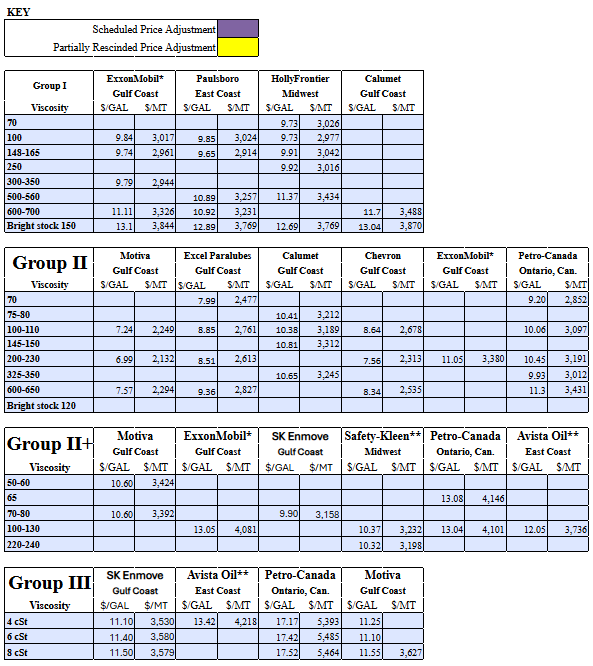
Posted Paraffinic Base Oil Prices Nov. 11, 2026
(Prices are FOB basis, in U.S. dollars per gallon and U.S. dollars per metric ton).
Archived base oil price reports can be found through this link: https://www.lubesngreases.com/category/base-stocks/other/base-oil-pricing-report/
Historic and current base oil pricing data are available for purchase in Excel format.
*ExxonMobil prices obtained indirectly.
**Rerefiner