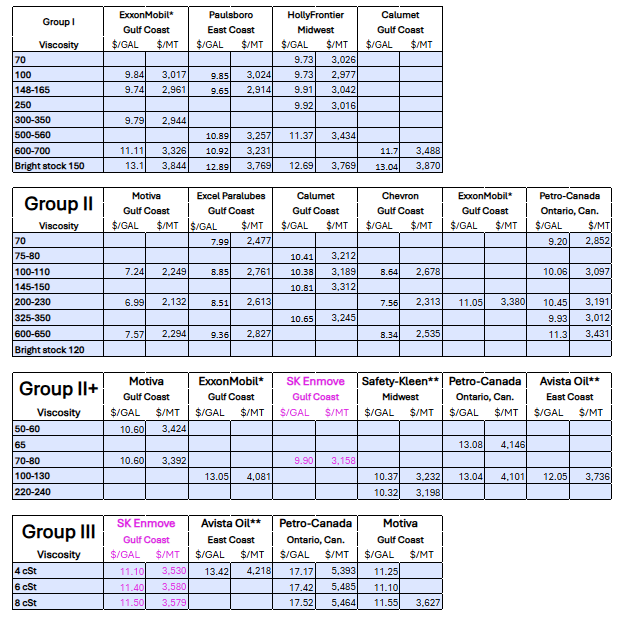
Steep crude oil and feedstock prices and increases in the cost of energy, transportation and other inputs continued to exert upward pressure on base oil values. Crude oil futures have come down from peaks observed a week ago, but they were still hovering at elevated levels, and this, combined with ongoing supply shortages, drove producer SK Enmove to communicate a posted price increase during the week.
Many of the current fundamentals affecting base oil prices are linked to the United States-Israel-Iran war, as crude oil and base oil supply and shipment disruptions in the Middle East catapulted prices to historic highs. The conflict was still simmering, and Iran maintained its tight grip on the Strait of Hormuz, but Qatar and Pakistan were mediating diplomatic talks to prevent further military escalation.
The war was also a central issue for U.S. voters in the midterm elections on November 3 as it has pushed up energy prices across the nation, leading to voters’ concerns about the increased cost of living. The Democratic sweep of both the Senate and the House of Representatives represented a major shift in congressional power, giving Democrats greater influence over federal spending and on U.S. policy towards Iran, Russia and Ukraine.
But observers worried that the significant Republican losses could make president Donald Trump more inclined to order a large-scale attack against Iran, targeting not only Iran’s nuclear facilities, but also its civilian infrastructure. On Saturday, Mojtaba Khamenei, Iran’s supreme leader, warned that Iran’s response would be “immediate” and “without any geographical limitations” if the U.S. launched a widespread attack–hinting that the country could strike targets beyond the Middle East.
Crude oil futures fell on Tuesday for a second consecutive session, on hopes that the U.S. and Iran would reach a diplomatic agreement soon. West Texas Intermediate (WTI) futures closed near $96 per barrel, from $101/bbl a week ago, while Brent traded near $103/bbl, from $115/bbl the previous week. Losses were capped by American Petroleum Institute (API) data revealing a significant decline in U.S. inventories last week. OPEC+ producers also decided to maintain December output targets, reigniting concerns about potential oil supply shortages, as no adjustments to the group’s policies were expected until next year.
Group I and Group II
After facing tight supplies for most of the year, the Group I and Group II base oil segments have begun to ease slightly. This shift occurred as producers along the U.S. Gulf Coast started releasing extra inventory held back during the hurricane season, which has driven down spot prices for most grades. However, light-viscosity base stocks have resisted this downward trend and remained stable due to tighter supply compared to the heavier cuts. Bright stock was somewhat of an exception as prices were stable due to snug availability.
Meanwhile, geopolitical tensions and market uncertainties stemming from the ongoing conflict in Iran have led some suppliers to take a cautious approach, choosing to preserve their stock levels rather than aggressively liquidating them on the spot market.
Additionally, skyrocketing crude oil and feedstock prices, coupled with a dramatic spike in competing fuel values, continued to push base oil costs upward as producers fought to defend their profit margins. Although most manufacturing facilities were operating at maximum capacity, spot market availability remained restricted because several suppliers were still struggling to meet their contractual commitments.
Paulsboro Refining (PBF Energy) just completed a turnaround at its Group I plant in New Jersey. The producer restarted base oil production as planned on October 26, and while it was expected to continue covering contract commitments this month, the producer was not anticipated to resume exports until December after building inventories throughout November, a company source said.
A second producer also indicated that depending on supply and demand levels this month, it may be able to release spot supplies of the heavy grades, as these were more readily available. The producer also noted that bright stock remained in tight supply and prices were therefore maintained.
The improved supply levels coincided with a seasonal slowdown in demand for all grades as both buyers and sellers tend to reduce inventories to avoid tax repercussions at the end of the year. Blenders have also faced difficulties in offsetting climbing production costs and were dealing with credit limitations and cash flow constraints, dampening their interest in large base oil volumes and limiting them to contract negotiations.
Export prices were exposed to downward pressure as demand for U.S. base oil barrels in Latin America and Europe has declined and buyers remained on the sidelines as they hoped to be able to acquire cargoes at lower prices if they postponed their purchases. Export spot indications for Group I and Group II grades were heard to have moved down by 5 cents/gal to 10 cents/gal week on week.
In Brazil, a key producer appeared able to meet its contractual obligations and was reported to have lowered its Group I prices for November. This action was likely triggered by a need to compete with lower-priced imports from the U.S. and Asia. While some buyers were considering Asian offers, hefty freight rates and extended delivery times were discouraging them from securing additional cargoes. Buyers were delaying purchases as long as possible in hopes of attaining lower prices.
U.S. Group II suppliers were also eyeing opportunities in India, which has traditionally been a receiver of U.S. cargoes in the last quarter of the year, when suppliers make their hurricane inventories available at competitive prices. While volumes moving to India were anticipated to be lower than in previous years as the domestic U.S. market has been tight throughout the year, there were ongoing discussions. Indian buyers were also slightly reluctant to source deep-sea cargoes due to soaring freight rates and logistical issues.
U.S. producers have reduced prices for shipments into Mexico as they hoped to maintain supply relationships during contract negotiations and also lower their inventories ahead of December 31. But consumption in Mexico has been lackluster because of economic uncertainties affecting lubricant markets and expectations of ongoing downward pressure on U.S. spot export prices.
Group II+/Group III
Persistent supply shortages and production shutdowns in the Persian Gulf–which is the source of a significant portion of global Group III base oils—together with high crude oil prices continued to exert upward pressure on Group II+ and Group III prices. SK Enmove communicated a posted price increase of 30 cents per gallon on its Group II+ and Group III base oils, effective November 1. This increase follows several adjustments by various producers that were implemented in September and October.
In the U.S., Group III prices continued to hover at elevated levels due to limited availability, with the 4 cSt grade in particular seeing upward price adjustments of around 10 cents/gal given the grade’s wider use. The other Group III grades also experienced upward pressure, however. Upcoming turnarounds next year were anticipated to keep pressure on supply levels and pricing.
Suppliers of Group III base oils produced in the Persian Gulf were heard to be working on additional export cargoes, following the successful shipment of a couple of parcels in September. At least one vessel discharged a small quantity in Europe before making its way to the U.S., with arrival expected last week. Even so, the official U.S. distributor of Adnoc’s material, Penthol, was still maintaining its force majeure on contracts because it was difficult to predict whether a second cargo would be able to cross the Strait of Hormuz, but preparations for another shipment were ongoing, sources said. A second supplier was expected to deliver a Group III cargo shipped out of the Persian Gulf in mid-November.
An increased number of blenders were seeking rerefined base oils given the lack of supplies of virgin base oils. Rerefiners reported limited extra availability beyond contract commitments. A domestic rerefiner was heard to be sold out of Group III cuts until February, while other rerefiners were also not in a position to offer additional cargoes.
Asian suppliers continued to meet their regular shipment schedule and fulfill their contractual obligations. They offered some spot supplies whenever possible, but availability was thin. Asian refiners were keeping an eye on the Middle East crude supply situation as many operations have been impacted by the recent Saudi crude flow disruptions. A few refiners have purchased crude from origins outside the Middle East, but this was affecting their yields. Additionally, a global dearth of fuels such as diesel were forcing some refiners to prioritize fuel production.
Naphthenic Base Oils
Firm crude oil and diesel prices continued to place upward pressure on naphthenic base oil prices, with values reported as generally stable. While most refiners were running base oil plants at full rates, they also needed to consider whether to stream more feedstocks into diesel production as prices were soaring and there were ongoing supply shortages.
Robust demand for the light naphthenic grades from the transformer oil and metalworking fluids segments buoyed prices up, while consumption of the heavy grades has shown a seasonal decline, although requirements from the grease sector were still healthy.
Crude Oil
Crude oil futures slipped in early trade on Wednesday on hopes of a resolution to the Iran war, but the downward adjustment was capped by concerns about U.S. oil stocks as API data showed that crude oil inventories fell by 5.267 million barrels, surpassing the forecast decrease of 2.100 million barrels, indicating a stronger-than-anticipated demand for crude oil.
- West Texas Intermediate December 2026 futures settled on the Nymex at $96.09 per barrel on November 3, down from $99.90 per barrel on Oct. 27.
- Brent January 2027 futures were trading on the ICE at $102.80/bbl on Nov. 4, down from $114.91/bbl on Oct. 28.
- Louisiana Light Sweet crude wholesale spot prices were hovering at $102.56/bbl on Nov. 2. Spot prices had settled at $109.25 on Oct. 26, according to the U.S. Energy Information Administration.
Diesel
Low-sulfur diesel, Nov. 2 (Oct. 26), EIA
New York Harbor: $4.68 per gallon ($4.83/gal)
Gulf Coast: $4.40/gal ($4.89/gal)
Los Angeles: $4.69/gal ($5.19/gal)
Gabriela Wheeler can be reached directly at gabriela@LubesnGreases.com
LNG Publishing Co. Inc./Lubes’n’Greases shall not be liable for commercial decisions based on the contents of this report.
Posted Paraffinic Base Oil Prices November 4, 2026 (Prices are FOB basis, in U.S. dollars per gallon and U.S. dollars per metric ton).
Archived base oil price reports can be found through this link: https://www.lubesngreases.com/category/base-stocks/other/base-oil-pricing-report/
Historic and current base oil pricing data are available for purchase in Excel format.
*ExxonMobil prices obtained indirectly.
**Rerefiner