October is ending with crude prices still hovering at multi-year highs and supply disruptions in the Middle East impacting refining operations and base oil availability in most regions, particularly API Group III grades. While there had been hopes that the recent shipments conducted out of the Persian Gulf could be repeated, there were still uncertainties about the achievability of fresh loadings. The Iran conflict raged on, and vessels were still under the threat of attacks by Iranian forces near Hormuz and by their Houthi proxies in the Red Sea, as the Saudi-Houthi conflict gained momentum instead of winding down.
United States President Donald Trump seemed focused on the Nov. 3 midterm elections and vacillated between initiating a major military escalation against Iran or brokering a diplomatic deal. Both Qatar and Pakistan have sought to thwart an escalation in hostilities and were mediating between DC and Tehran.
There has not been an improvement in the number of vessels allowed to cross the strait—on the contrary, this month is ending with a significant increase in maritime attacks since the US-Iran war started, as more than 30 incidents were reported in the area, up from 14 in September.
Not only were vessels targeted by Houthi insurgents, but energy facilities were also attacked. Crude oil prices surged this week after Houthi rebels claimed they had fired missiles at Saudi Arabia’s largest oil refinery in Ras Tanura, fanning concerns over Middle East supply disruptions. OPEC+ producers were also expected to maintain December output targets, which added to the anxiety over potential oil shortages. West Texas Intermediate futures climbed to around $101 per barrel on Wednesday morning, from $99/bbl a week ago, and Brent traded above $115/bbl, from $110/bbl last week.
Group I and Group II
The tight supply conditions that have been seen for most of the year in the Group I and Group II segments appeared to ease somewhat as producers have started to release some of the extra inventories that were kept during the hurricane season along the U.S. Gulf Coast. This development was exerting downward pressure on spot prices of most Group I and Group II base stocks, although the light-viscosity grades were mostly holding their ground because of tighter availability than the heavy-vis cuts. Furthermore, with the Iran conflict still unresolved and many uncertainties still plaguing the market, some suppliers have turned cautious and preferred to maintain a certain level of inventories instead of lowering them at all costs.
At the same time, soaring crude oil and feedstock prices and a need to keep healthy base oil margins as competing fuel prices have skyrocketed placed upward pressure on base oil values.
While most plants were being run at top rates, not all suppliers were able to offer additional volumes and some were still struggling to fully meet contractual obligations, which limited their ability to offer spot cargoes.
One of the producers that was not expected to offer any spot supplies until late November was Paulsboro Refining (PBF Energy). The producer was expected to complete a turnaround at its Group I base oil plant in New Jersey last week and to bring its crude unit back online around October 22, with base oils being produced by October 26. While the producer was expected to cover contract commitments after the outage, sources said spot supplies were unlikely to be available for a few weeks.
Another producer indicated that while light and mid-viscosity grades face a tight supply-demand balance, market conditions for heavy-viscosity cuts and bright stock remained stable. This supplier may release spot volumes of these heavier grades provided market prices hit their targeted thresholds.
Bright stock remained in tight supply and prices were therefore more insulated from downward pressure, with values said to be stable.
At the same time, demand for all grades has started to decline due to seasonal factors as both buyers and sellers prefer to end the year with lean inventories to avoid tax repercussions. Blenders have also faced difficulties in offsetting climbing production costs and were dealing with credit limitations and cash flow constraints, dampening their interest to acquire large base oil volumes beyond those stipulated under contract. Consumption of Group II cuts and rerefined base oils was generally strong as these products were used to replace Group III base stocks in some applications.
Export prices remained exposed to downward pressure as demand for U.S. base oil barrels in Latin America and Europe has dwindled and there appeared to be sufficient stocks to meet immediate product needs.
In Brazil, a key producer was reported to have lowered its Group I prices for November, likely to compete with imports from the U.S. and Asia. While some buyers were considering Asian offers, hefty freight rates and extended delivery times were discouraging them from securing additional cargoes. Many consumers preferred to wait and see whether U.S. prices would come down further before venturing back to the trading table.
U.S. producers have also reduced prices into Mexico in an effort to attract fresh business and reduce inventories at home ahead of year-end. However, buyers were hesitant to secure more cargoes as their stocks were plentiful and they expected ongoing downward pressure on pricing in the next few weeks.
In shipping circles, a 3,000-ton lot was quoted for lifting in Onsan, South Korea, for Savannah, Georgia, in the second half of Nov. A 15,000-ton lot was mentioned for possible shipment from South Korea to Venezuela in the second half of Nov.
Group II+/Group III
The relentless market tightness and ongoing outages in the Persian Gulf were exerting pressure on Group II+ and Group III prices, although no posted price adjustments were communicated during the week. Several producers increased postings between September and October, driven by the current supply constraints and high crude oil prices.
While some buyers have resorted to purchasing Group II cuts to utilize in some applications in lieu of Group III base oils, most buyers have strict formulations that did not allow substitution. An increased number of blenders have also turned to rerefined base oils, with these products gaining acceptance and becoming tight as well, with producers reporting few extra barrels to offer. A domestic rerefiner was heard to be sold out of Group III cuts until February, and another appeared to have only enough supply to cover contractual commitments as most buyers were taking all the quantities they were entitled to under contract.
Some recent progress was reported in terms of base oil shipments from the Persian Gulf. In late September, an Adnoc cargo was heard to have managed to be shipped out of Abu Dhabi and was expected to arrive in the U.S. at the end of this month. The vessel discharged a small quantity in Europe before making its way to the U.S. The official U.S. distributor of Adnoc’s material, Penthol, was still maintaining its force majeure on contracts because it was difficult to predict whether a second cargo would be able to cross the Strait of Hormuz, and it could not be determined when shipments would be able to resume their regular schedules.
Aside from the Iranian blockade of the strait, base oil plants in the Persian Gulf have suffered damages earlier in the conflict and some repairs have been completed, while others were expected to take some time. Even if the units were fully repaired, production would be suspended or run at very reduced rates as marine shipments were unable to leave the facilities.
One of those plants is Bapco’s unit in Sitra. The company declared force majeure across all group operations after the Sitra Refinery complex sustained damage from an attack amid regional conflict in March. The event severely impacted regional output and forced a temporary suspension of contractual obligations for various products, including Group III base oils. According to the company’s website, during a Board of Directors meeting for the third quarter of 2026, Chairman His Highness Shaikh Nasser bin Hamad Al Khalifa formally reviewed the normalization of operations and the progress of the company’s business recovery. While Bapco has successfully prioritized and secured all local domestic supply needs throughout the crisis, bringing complex refining assets like the Group III base oil units back to reliable, pre-incident operating rates has been a progressive process integrated into their broader post-conflict recovery pipeline, the company explained. Market sources had mentioned that a cargo had loaded at the Bapco terminal, but it could not be ascertained whether the shipment has already crossed Hormuz.
In the meantime, Asian suppliers were striving to meet all of their contractual obligations and offered some spot supplies whenever possible, but this has not been easy as refineries have also been impacted by the recent Saudi crude flow disruptions and some refining yields have been affected by the use of crude oil from origins outside the Middle East. The 4 cSt cut was in high demand, while supplies have dwindled due to changes in refining yields and an uptick in consumption from blenders who were not able to use substitute grades.
Additionally, a global dearth of fuels such as diesel were forcing some refiners to prioritize fuel production, while crude oil supplies from the Middle East were also an issue. Earlier in the conflict, overall South Korean national refinery run rates dropped to 65-70% rates, according to local media reports. Even though primary crude processing was heavily suppressed, premium Group III units were being pushed as hard as possible under strict regulatory guidelines. Following the start of the blockade of the Strait of Hormuz, South Korea has made significant progress in changing its supply chain and has shifted heavily towards crude imports from the Americas, with volumes from the U.S. and Canada seeing substantial increases and likely to continue to replace Saudi barrels in the future.
Naphthenic Base Oils
Naphthenic base oil prices remained exposed to upward pressure from high crude oil and feedstock values, while refinery economics and a need to maintain diesel production as prices have skyrocketed and there have been global shortages also drove producers to keep base oil prices at stable-to-firm levels. Producers continued to watch crude oil price developments closely.
The light naphthenic grades were extremely tight and these conditions were expected to persevere into next year as many requirements from the transformer oil market were going unfulfilled for the time being. Demand for the heavy grades was more lackluster as consumption in the rubber and tire markets has shown a seasonal decline, but there was still healthy activity in the grease segment. While the heavy pale oils had also enticed buyers who sought to replace higher-priced paraffinic grades, prices for heavy-vis paraffinic cuts were slipping, so the incentive has also dwindled.
Crude Oil
Crude oil futures rose in early trading on Wednesday, October 28, on concerns that the U.S. may resume military strikes on Iran after next week’s midterm elections in the U.S. The reported attack on Saudi Arabia’s Ras Tanura refinery also reignited concerns about crude supply shortages.
- West Texas Intermediate December 2026 futures settled on the Nymex at $99.90 per barrel on October 27, up from $97.82 per barrel on Oct. 20.
- Brent December 2026 futures were trading on the ICE at $114.91/bbl on Oct. 28, up from $110.75/bbl on Oct. 21.
- Louisiana Light Sweet crude wholesale spot prices were hovering at $109.25/bbl on Oct. 26. Spot prices had settled at $116.01 on Oct. 19, according to the U.S. Energy Information Administration.
Diesel
Low-sulfur diesel, Oct. 26 (Oct. 19), EIA
New York Harbor: $4.83 per gallon ($5.17/gal)
Gulf Coast: $4.89/gal ($4.97/gal)
Los Angeles: $5.19/gal ($5.38/gal)
Gabriela Wheeler can be reached directly at gabriela@LubesnGreases.com
LNG Publishing Co. Inc./Lubes’n’Greases shall not be liable for commercial decisions based on the contents of this report.
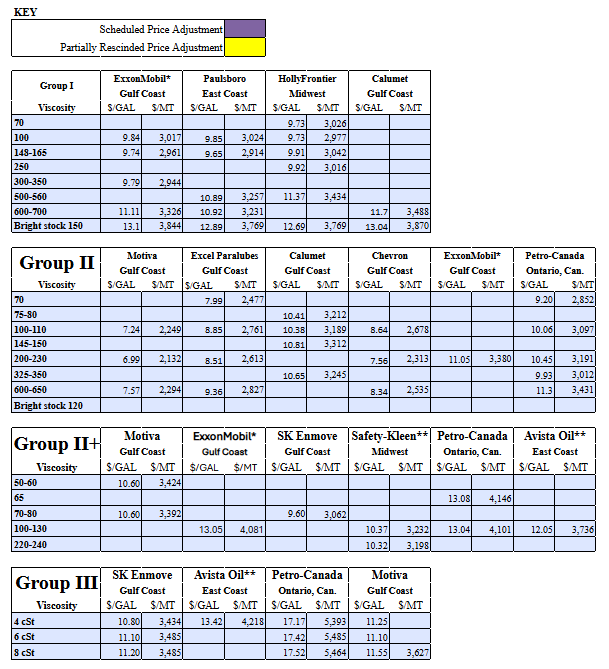
Posted Paraffinic Base Oil Prices October 28, 2026 (Prices are FOB basis, in U.S. dollars per gallon and U.S. dollars per metric ton).
Archived base oil price reports can be found through this link: https://www.lubesngreases.com/category/base-stocks/other/base-oil-pricing-report/
Historic and current base oil pricing data are available for purchase in Excel format.
*ExxonMobil prices obtained indirectly.
**Rerefiner