Steep crude oil and feedstock prices, coupled with tight supply fundamentals continued to place upward pressure on base oil prices, but the previously observed tightness seemed to be easing as more volumes were reaching the market. Producers appeared to be able to offer some spot cargoes as they tried to lower inventories that had been kept during hurricane season in an effort to avoid year-end tax liabilities. However, the light grades and all of the API Group III cuts still displayed shortages, even though at least two Group III cargoes were heard to have been lifted from the Persian Gulf and were making their way to the United States.
Whether these loadings could be repeated remained a big question mark, as Iranian attacks on tankers, dry bulk carriers and tugboats in the Strait of Hormuz seemed to have intensified. It was difficult to assess how many vessels had actually been hit as many operators chose not to report attacks, although authorities cited over a dozen vessels targeted within a single week. Recent incidents include the sinking of the Singapore-flagged container ship GFS Pride after a projectile or mine strike. A second Singaporean ship, GFS Giselle, was also hit but managed to reach safety.
The threat to oil shipments and the seemingly escalating supply risks drove crude oil futures higher on Wednesday, with West Texas Intermediate hovering near $99 per barrel and Brent rising to over $110/bbl, from $94/bbl and $106/bbl, respectively, last week. Industry leaders expected prices to remain elevated for some time as oil “buffers” that had tempered price spikes such as high commercial fuel stocks and ample national strategic inventories held by many governments have now been exhausted. U.S. crude and product inventories also fell the previous week.
Group I and Group II
Contrasting factors were influencing Group I and Group II base oil prices this week. On the one hand, prices were still exposed to upward pressure because of firm crude oil and feedstock values and a need for refiners to justify base oil production versus that of competing fuels like diesel, which has hit record high price levels and was not expected to decrease significantly any time soon.
On the other hand, there is the perception that the tight supply conditions seen over the last several months have started to ease as a number of producers have been able to offer spot supplies, or additional volumes to contract buyers as they release inventories held during the hurricane season. This was pressuring prices down. However, not all suppliers were in a position to offer extra quantities, and some cuts were simply not available.
Paulsboro Refining (PBF Energy), for instance, has embarked on a turnaround at its Group I base oil plant in New Jersey and market sources said the producer was not likely to offer spot supplies until possibly November as the company was making sure it would be able to meet all contractual requirements following the outage. The turnaround was proceeding as expected and the crude unit was anticipated to be brought back online around Oct. 22, with base oils being produced by Oct. 26, a company source said.
A second producer reported a tight supply and demand ratio on the light and mid-viscosity grades, and more balanced conditions for the heavy-vis cuts and bright stock, with the possibility of offering spot supplies of these grades if prices met expectations.
Demand showed differing trends as well, with some buyers seeking spot volumes as a few offers of the heavy grades at reduced prices have emerged, while others held off on acquiring more base oils because transferring steep prices down the supply chain has been difficult. Consumption of Group II cuts and rerefined base oils was generally strong as these products were used to replace Group III base stocks in some applications.
Export prices were exposed to downward pressure as demand for U.S. base oil barrels in Latin America and Europe has declined on seasonal factors and as Asian cargoes have been offered to various Latin American destinations at attractive prices, forcing U.S. suppliers to lower their price indications as well. However, skyrocketing freight and insurance rates were dampening fresh transactions involving Asian cargoes.
Brazil continued to command some attention since the country is a large receiver of U.S. base oil barrels, particularly as the local producer had shut down its plant for maintenance in the third quarter and this had resulted in snug availability of most grades. There was also some interest to move Group II cargoes to Brazil as supplies had increased in the U.S. However, the Brazilian producer has restarted operations and has been able to meet commitments, although some cuts were still on the tight side and there were few spot offers of light grades. Domestic prices for Group I were reported as largely stable.
U.S. producers have also lowered their offers into Mexico to compete with Asian suppliers as demand for U.S. products from the neighboring nation had weakened. Refiners were hoping to place some cargoes to avoid tax repercussions on existing stocks at the end of the year.
Sources this week noted that a shipping inquiry involving 2,000 metric tons of base oils looking to be shipped from Malaysia to Savannah, Georgia, that was mentioned last week was not likely to have been concluded as the Malaysian producer has just concluded a turnaround and did not have much extra product to offer. Perhaps the players involved were checking freight rates to see if future shipments were workable.
At the same time, there were reports of other Asian cargoes being considered for the Americas, with a 12,000-ton lot quoted for shipment from Daesan, South Korea, or Tianjin, China, to Houston at the end of October. A 2,000-2,500-ton cargo was also mentioned for possible shipment from East Asia to Tampa, Florida, this month.
Trading activity was generally muted as numerous participants were attending the Independent Lubricant Manufacturers Association meeting in Arizona earlier this week, with discussions centering on the current volatilty and disruptions in global markets that are affecting logistics, production and supply chains everywhere.
Group II+/Group III
While there were no fresh posted price increase announcements this week, Group II+ and Group III prices continued to be driven up by global supply shortages and steep crude oil prices. Since early September, most Group II+ and Group III producers, including ExxonMobil, SK Enmove, Motiva and Petro-Canada have implemented posted price increases.
The fact that a couple of shipments of base oils manufactured in the Persian Gulf have managed to make their escape through Hormuz did not necessarily mean that supply would be adequate to cover U.S. requirements soon. Far from it, while the loadings were positive developments, the presence of these molecules was expected to meet just a small portion of all unfulfilled demand. Additionally, A 30,000-ton cargo was quoted for shipment from Fujairah, United Arab Emirates, to the U.S. Gulf in October, but it could not be ascertained whether this transaction had been concluded.
Another encouraging sign was that according to reports, one of the processing trains at the Shell/Qatar Pearl gas-to-liquids plant in Qatar had been restarted last week. The plant has two trains and one of them remains shut down due to damages incurred during a drone and missile strike in March. That train will not be fully repaired until early 2027, sources familiar with the company’s operations said. Meanwhile, it was not clear whether the unit that has been restarted was producing base oils to start building inventories, or to move product within the region, as some shipments have been done by truck and at least one loading was also reported bound for the U.S. Sources said that even if plants in Abu Dhabi, Qatar and Bahrain were able to be fully restarted, vessels were still unable to safely cross Hormuz, with supply remaining trapped in the Persian Gulf. Experts said that supply chains have been deeply affected by the Iran conflict and that even after the war ends, many of the old ways of conducting business and sourcing feedstocks have been altered forever.
Meanwhile, Asian base oils continued to flow into the U.S. and the Americas, with producers striving to meet contract commitments, but still keeping strict sales controls and allocations. Asian refiners were concerned about crude supplies as further disruptions have occurred in Saudi Arabia, one of the largest crude oil producers in the Middle East and the main supplier to many refineries in Asia. Many units there were built to run on Arab crude, and while some have been able to source crude from other origins, their yields may have suffered. SK Enmove was understood to have flexibility in terms of the crude slates it utilizes to run its refinery in South Korea, but other Asian refiners’ output has been affected by the dearth in Middle East crude shipments and a need to prioritize fuels production, and have therefore restricted their base oil offers.
Naphthenic Base Oils
Just like their paraffinic counterparts, naphthenic base oil prices were also exposed to upward pressure due to steep crude oil and feedstock values, particularly Brent futures, which have a more direct impact on refinery economics. While no fresh price adjustments have been widely communicated, a source commented that “this could change quickly if crude keeps running up.”
The most recent price increase initiative was communicated by San Joaquin Refining in mid-September, and some producers have increased prices on a case-by-case basis, or according to contract stipulations if agreements were indexed against diesel prices, which have surged on global supply deficits.
The light naphthenic grades were still described as very tight, with demand from the transformer oil segment drawing substantial amounts of base oils, which was also placing upward pressure on prices. The heavy grades saw weaker demand from the rubber and tire segments, especially after the end of the summer driving season, and this was exerting downward pressure on pricing.
Crude Oil
Crude oil futures rose on Wednesday, Oct. 21 on fears of supply disruptions from escalating tensions in the Middle East and falling U.S. inventories. Maritime security risks seemed to have escalated with reported attacks on vessels in the Gulf of Oman, threatening crude loadings and transfers in the region.
- West Texas Intermediate December 2026 futures settled on the Nymex at $97.82/bbl on Oct. 20, up from $94.14 per barrel on Oct. 13.
- Brent December 2026 futures were trading on the ICE at $110.75/bbl on Oct. 21, up from $106.07/bbl on Oct. 14.
- Louisiana Light Sweet crude wholesale spot prices were hovering at $116.01/bbl on Oct. 19. Spot prices had settled at $100.01 on Oct. 8, according to the U.S. Energy Information Administration. (There was no trading on Oct. 12 due to the Columbus Day or Indigenous Peoples Day holiday in the U.S.)
Diesel
Low-sulfur diesel, Oct. 19 (Oct. 8), EIA
New York Harbor: $5.17 per gallon ($5.30/gal)
Gulf Coast: $4.97/gal ($4.83/gal)
Los Angeles: $5.38/gal ($5.15/gal)
Gabriela Wheeler can be reached directly at gabriela@LubesnGreases.com
LNG Publishing Co. Inc./Lubes’n’Greases shall not be liable for commercial decisions based on the contents of this report.
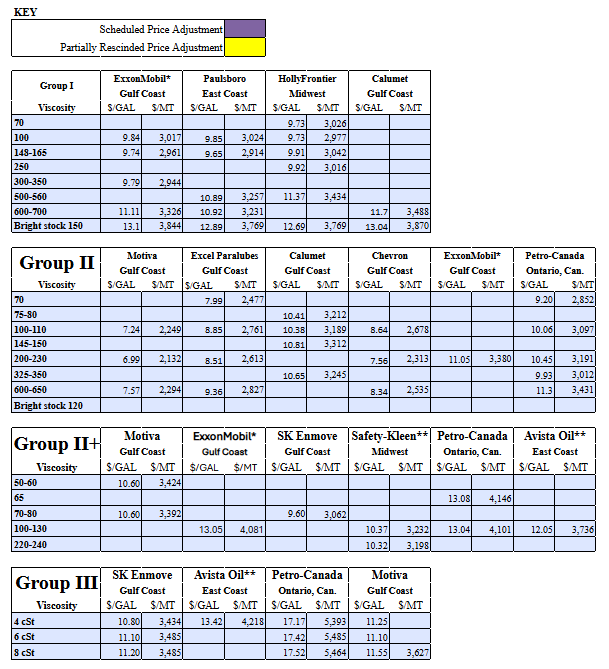
Posted Paraffinic Base Oil Prices October 21, 2026 (Prices are FOB basis, in U.S. dollars per gallon and U.S. dollars per metric ton).
Archived base oil price reports can be found through this link: https://www.lubesngreases.com/category/base-stocks/other/base-oil-pricing-report/
Historic and current base oil pricing data are available for purchase in Excel format.
*ExxonMobil prices obtained indirectly.
**Rerefiner