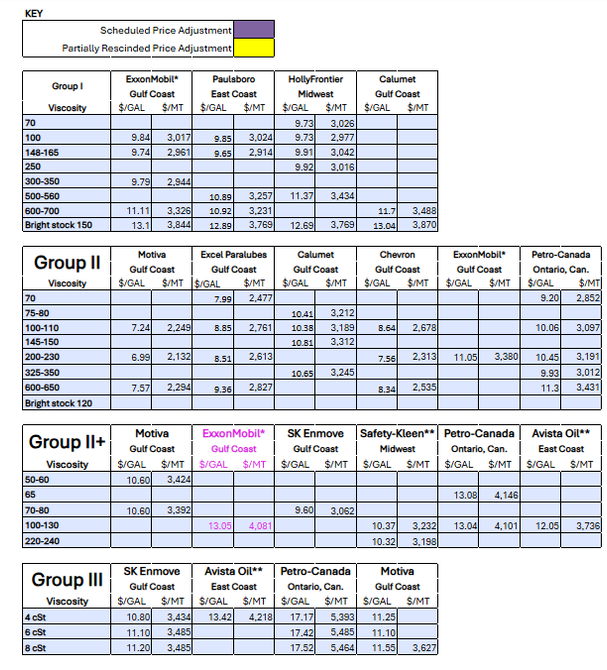
According to reports, ExxonMobil communicated a posted price increase on its API Group II+ grade due to a tight supply and demand balance. At the same time, availability of Group I and Group II base oils appeared to have improved compared to earlier in the year but was by no means close to normal levels.
The fact that more volumes were coming to market was partly attributed to producer’s efforts to lower inventories that had been built up during the hurricane season along the United States Gulf Coast. However, the light-viscosity grades remained quite tight, and there were still shortages reported in the Group III segment, despite a couple of cargoes being on their way to the U.S. after loading in the Persian Gulf and negotiating the dangerous crossing of the Strait of Hormuz.
Several vessels have been targeted by Iranian forces in the strait this week, while Iran-backed Houthi rebels have not only threatened facilities and ships in the Red Sea, but have also attacked Saudi Arabia’s main airport, killing several people and wounding hundreds of others.
Hostilities in the Middle East seemed to have escalated, with Saudi Arabia’s energy ministry reporting that a strike had caused a small fire at an Aramco building in Dhahra, following a Houthi warning for civilians to evacuate Saudi oil sites. In retaliation, the Saudi-led coalition hit Houthi energy terminals and fuel reserves in Yemen.
There was also international consternation as U.S. president Donald Trump announced a deal struck with Russian president Vladimir Putin to allow millions of tons of Russian diesel to enter the U.S. and global markets. The move represents an abrupt policy shift aimed at curbing high domestic fuel prices ahead of the upcoming U.S. midterm elections. To facilitate this agreement, the U.S. Treasury Department issued a temporary license suspending sanctions on Russian diesel exports through April 7, 2027. However, the diesel volumes that may be imported into the U.S. were relatively small and not likely to meet much of the daily demand in the country or impact prices significantly, sources commented.
Crude oil prices remained volatile, with futures moving up on Wednesday on fears of a widening war on the Arabian Peninsula after the Aramco headquarters were targeted. West Texas Intermediate and Brent futures climbed during the week, with WTI settling near $94 per barrel on Tuesday and Brent trading close to $106/bbl on Wednesday morning. Experts were watching developments over the next few weeks as they would ikely determine the trajectory of oil prices, including concerns over artificial intelligence stock valuations as earnings season begins, and the potential implications of the upcoming U.S. midterm elections for president Trump’s policy agenda.
In other industry news, Curaçao’s idled Isla refinery might be targeting a phased 2027 restart, backed by U.S. government interest amidst soaring refined product cracks, media outlets reported. Isla Refinery is a 335,000-barrels-per-day fuel refinery that had been operated by Venezuelan state-owned PdVSA since 1985, but was mothballed in 2012. The refinery was built by Royal Dutch Shell in 1915, with operations officially beginning in May 1918 to process crude oil from Venezuela’s nearby Lake Maracaibo basin. Shell operated the facility for nearly 70 years before selling it to the government of Curaçao for a symbolic price in 1985. Curaçao’s authorities require permission from Washington’s Office of Foreign Assets Control to process or do business with crude from neighboring Venezuela. A prior OFAC license expired and new approvals have not been granted yet. The refinery includes a base oil plant with capacity to produce 5,000 b/d of Group I paraffinic base oils and 3,700 b/d of naphthenic base stocks.
Group I and Group II
Group I and Group II base oil prices showed little change, although spot prices have come under downward pressure on increased availability as producers have started to offer volumes that had been kept in case of production disruptions during hurricane season to avoid tax repercussions on existing stocks. This coincided with weakening domestic demand at the end of the summer driving season. The cuts that appeared most readily available were the heavy-viscosity grades, and pressure on these cuts was therefore more significant.
At the same time, a need to preserve base oil margins at certain levels against soaring diesel prices was exerting pressure on refiners to maintain or raise prices. A string of increases by producers Motiva and Chevron emerged in late September and early October, but no further adjustments were reported this week.
Export prices were exposed to downward pressure as buying interest from Latin America and Europe has receded on seasonal factors and because of the presence of Asian cargoes that have been offered to various Latin American and U.S. destinations at competitive levels. This week, it was heard that a 20,000-ton cargo was under discussion for lifting in Port Klang, Malaysia, to Savannah, Georgia, Oct. 15-25, and a number of cargoes moving from India, China and South Korea had been quoted in the previous weeks.
One of the main destinations for U.S. cargoes in South America had been Brazil until earlier this year, but spot shipments were reduced when supplies tightened in the U.S. following the start of the Iran conflict and U.S. producers needed to ensure that they met contractual commitments. At the same time, the local producer in Brazil had shut down its plant for maintenance in the third quarter and this had resulted in snug availability of most grades. While the producer has restarted operations and has been able to meet commitments, some cuts were still on the tight side and there were no spot offers of light grades. Domestic prices for Group I light base oils in Brazil rose in October due to hikes by the local producer, while heavy grade SN500 and bright stock prices held steady. These higher costs have slowed down purchasing activity, leading buyers to purchase smaller volumes to minimize the financial risk of holding expensive stock.
U.S. export prices for base oils heading into Mexico dropped as suppliers faced growing inventories amid slowing Mexican demand. In response, sellers lowered rates to stimulate new orders. Additionally, a weaker Mexican peso relative to the U.S. dollar further reduced buyers’ enthusiasm in the region.
With Middle East crude shipments still under the threat of Houthi rebels’ attacks in the Red Sea, and a limited number of vessels being allowed to transit the Strait of Hormuz, refiners were still cautious about potential crude supply shortages that may affect base oil production in the coming months. Producers sought to prioritize output to meet contractual obligations, but some suppliers have also loosened the strict allocations imposed in the previous months.
Blenders were still facing buyer resistance to price increases for lubricants and finished products that they have been trying to implement to offset mounting production costs. Some manufacturers were dealing with cash flow and credit constraints and may be forced to reduce production as they face difficulties when trying to replenish base oils, additives and other inputs at the current steeper values.
Aside from international turmoil tightening global base oils supplies and exerting pressure on prices, current and upcoming turnarounds in various regions might exacerbate the snug spot availability.
In the U.S., Paulsboro Refining (PBF Energy) has started a five-week turnaround at its Group I base oil plant in New Jersey. The turnaround was proceeding as expected and the crude unit would be back online around Oct. 22, with base oils being produced by Oct. 26, a company source said. Market sources did not expect Paulsboro to offer spot supplies until some time in November as the company was making sure it would be able to meet all contractual requirements first.
Chevron was expected to reduce its Group II output in Pascagoula, Mississippi, as the company rolls out new Group III+ (NEXBASE 4 XP) production at the site in October/November 2026.
Petro-Canada has also scheduled a 30-day turnaround on its Group II unit in Mississauga, Canada, this quarter that may be tightening supplies further, but no update about a starting date were available. Earlier this year, HF Sinclair announced a permanent retirement of base oil refining at the Petro-Canada facility in Mississauga during 2027.
While turnarounds in other regions do not affect U.S. consumers directly, they do tend to tighten global base oil supplies, particularly at a time when any production disruptions could result in further shortfalls.
A Luberef Group I and Group II plant in Yanbu, Saudi Arabia, was scheduled to be shut down in October, but it appears the shutdown might only affect the Group II grades. Yanbu facilities have come under Houthi rebels’ attacks, with drone and missile hits reportedly having been deterred by Saudi forces in recent weeks. The plant had already been running at reduced rates since last month, according to sources.
There have also been turnarounds announced at a number of Chinese base oil plants and at the Petronas Group II/Group III plant in Melaka, Malaysia, which was completed in early October.
Group II+/Group III
The ongoing global Group II+ and Group III supply shortages and steep crude oil prices triggered posted price increases in recent weeks. According to reports, ExxonMobil communicated a 71 cents per gallon posted price increase on its Group II+ (EHC45) grade, with an effective date of Oct. 15, during the week. SK Enmove, Motiva and Petro-Canada have all implemented increases between early September and early October.
About a third of U.S. demand for these grades continued to be met through Asian base oils, with producers striving to meet contract commitments, but still keeping strict sales controls and allocations. While at least one producer has flexibility in terms of the crude slates it utilizes to run its refinery in South Korea, other refiners were concerned about the current disruptions in crude oil shipments from Saudi Arabia and have tightened their spot offers.
There was again a glimmer of hope in the Group III segment as reports pointed to a restart of one of the processing trains at the Shell/Qatar Pearl gas-to-liquids plant in Qatar this week. The plant has two trains and one of them remains shut down due to damages incurred during a drone and missile strike in March. That train will not be fully repaired until early 2027, sources familiar with the company’s operations said. Meanwhile, it was not clear whether the unit that has been restarted was producing base oils to start building inventories, or to move product within the region, as some shipments have been done by truck.
Nevertheless, participants said the resumption of output was a step in the right direction. The same was said of two base oils cargoes that were recently loaded in the Persian Gulf and were currently en route to the U.S., after managing a perilous crossing of the Strait of Hormuz. If more base oils produced in the Persian Gulf can somehow reach markets in the U.S., the current supply constraints would see some relief, although market observers said that it would take many months and a lot more product to achieve a semblance of normal supply. Even if plants in Abu Dhabi, Qatar and Bahrain were able to be fully restarted, vessels are still unable to safely cross Hormuz, with supply remaining trapped in the Persian Gulf.
Participants were holding on to hopes that more vessels would be loaded in October and November, as an increased number of crude oil tankers have managed to cross the strait in recent days. Vessels are crossing the Strait of Hormuz through high-risk, clandestine tactics and complex political or military arrangements, including sailing in “dark mode” as crews switch off their automatic identification system transponders, mobile phones and navigation lights for 10 to 14 days while passing through the strait. Some tankers were also heard to follow the Omani coastline or designated northern corridors near Iranian islands while using single radars, sandbagged decks, and manual observation, while some “shadow fleets” rely on fake flags, shell companies, and disabled tracking signals to bypass regional interdictions. Reuters also reported that Iran permits passage to vessels from nations it considers friendly or neutral (such as Omani, Japanese, or French-operated fleets) as long as they have no active U.S. or Israeli military links.
Naphthenic Base Oils
Steep feedstock and Brent crude oil prices continued to exert pressure on naphthenic base oil values, but aside from San Joaquin Refining’s initiative in mid-September, no other official announcements were communicated. The widening crack spread of diesel over crude oil was exerting pressure on refiners to produce more diesel versus base oils, and therefore, base oil prices were increased to justify output. Some suppliers were heard to have adjusted prices on a case-by-case basis.
Producers were monitoring both crude oil prices and supply/demand factors as the light grades were very tight, with demand from the transformer oil segment described as healthy, which was also placing upward pressure on prices. On the other hand, there was downward pressure on the heavy grades which were more plentiful.
Crude Oil
Crude oil futures moved up on Wednesday on escalating hostilities in Saudi Arabia and as Iran seemed to have found new tactics to target tankers attempting to leave the Persian Gulf. Diesel prices were hovering at record-high levels and the International Energy Agency (IEA) predicted that supply shortages would persist into 2027.
- West Texas Intermediate November 2026 futures settled on the Nymex at $94.14 per barrel on Oct. 13, up from $89.44 per barrel on Oct. 6.
- Brent December 2026 futures were trading on the ICE at $106.07/bbl on Oct. 14, up from $101.89/bbl on Oct. 7.
- Louisiana Light Sweet crude wholesale spot prices were hovering at $100.01/bbl on Oct. 8. Spot prices had settled at $98.38 on Oct. 5, according to the U.S. Energy Information Administration. (There was no trading on Oct. 12 due to a public holiday in the U.S.)
Diesel
Low-sulfur diesel wholesale, Oct. 12 (Oct. 5), EIA
New York Harbor: $5.30 per gallon ($4.63/gal)
Gulf Coast: $4.83/gal ($4.51/gal)
Los Angeles: $5.15/gal ($4.82/gal)
Gabriela Wheeler can be reached directly at gabriela@LubesnGreases.com
LNG Publishing Co. Inc./Lubes’n’Greases shall not be liable for commercial decisions based on the contents of this report.
Posted Paraffinic Base Oil Prices Oct. 14, 2026 (Prices are FOB basis, in U.S. dollars per gallon and U.S. dollars per metric ton).
Archived base oil price reports can be found through this link: https://www.lubesngreases.com/category/base-stocks/other/base-oil-pricing-report/
Historic and current base oil pricing data are available for purchase in Excel format.
*ExxonMobil prices obtained indirectly.
**Rerefiner