Base oil business activity was fairly subdued and prices were generally stable, but some players wondered whether this might be calm before the storm. Indeed, Tropical Storm Isaias was forming in the U.S. Gulf, and it threatened to hit large areas around the Gulf Coast as a dangerous hurricane. Meanwhile, there appeared to be less panic among buyers about product shortages as producers have started to release extra stocks that were kept during the peak hurricane months, although it appeared that the risk of severe weather has not completely disappeared. API Group III supplies were showing ongoing global shortages and consumers were still concerned about being able to obtain the much-needed molecules. However, the fact that at least one confirmed shipment had been able to load in the Persian Gulf and was on its way to the United States had provided a ray of hope that the situation might improve in the coming months.
The conflict between the U.S. and Iran did not seem to be close to a resolution, however. U.S. president Donald Trump said Washington had rejected an Iranian proposal to reopen the Strait of Hormuz to commercial shipping because its conditions were unacceptable. Fresh explosions were reported in the Strait of Hormuz, and an oil tanker was ostensibly hit by a ballistic missile over the weekend, with at least 11 tankers reported to have been attacked in and around the strait during the first week of October.
On Wednesday, a missile was fired by Houthi rebels near the international airport of Aden in Yemen minutes before the arrival of a passenger flight. Despite the ongoing hostilities and Houthis’ control over much of Yemen’s Red Sea coast and the Bab al-Mandab Strait–a crucial chokepoint for energy shipments– West Texas Intermediate and Brent futures fell on Tuesday, with WTI trading near $89 per barrel and Brent close to $101/bbl, still at high levels, but significantly down from peaks near $119-120/bbl in March, when the conflict began.
Group I and Group II
Group I and Group II base oil prices were generally stable, with spot business described as muted as producers suspended offers until there were more assurances that crude flows from the Middle East would not suffer further disruptions. In recent weeks, Houthi and Iraqi attacks on Saudi Arabian refining and port infrastructure had resulted in the closing of Saudi Aramco’s East-West pipeline, which is used to transport crude oil to ports on the Red Sea and bypass the Strait of Hormuz. The pipeline has been reopened, but shipments were still under the threat of Houthi attacks, while vessels attempting to cross Hormuz had been targeted by Iran. Many U.S. refiners are insulated from crude oil disruptions in the Middle East because they use domestic crudes, but several refineries in the U.S. depend on Arab crude shipments.
The ongoing conflict in the Middle East kept crude oil, feedstocks and diesel prices at elevated levels and placed upward pressure on base oil prices. Low diesel stocks and skyrocketing prices were forcing refiners to stream feedstocks into diesel production and may impact base oils output. Producers were also forced to keep base oil prices above a certain level to justify production.
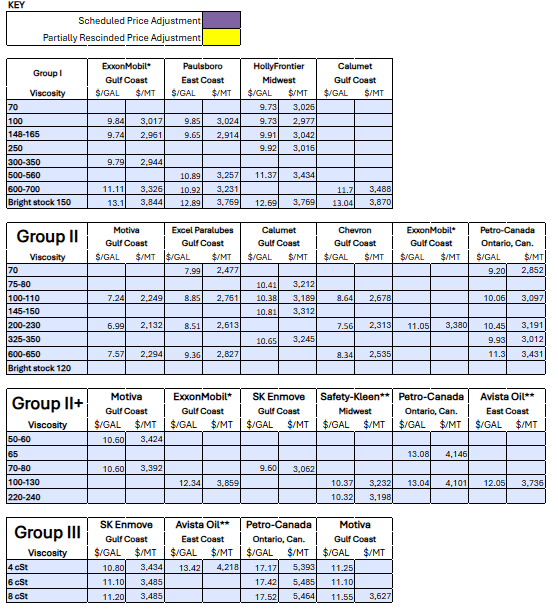
Chevron and Motiva announced posted price increases for Group II base oils between late September and early October. Motiva implemented a price increase of 35 cents/gal on its Group II 100-vis base oil and 25 cents/gal on its 220-vis, effective October 1. The price of the company’s Group II 600-vis was not adjusted. Chevron had communicated a 40 cents per gallon posted price increase on its Group II 100R grade, and a 35 cents/gal hike on its 220R and 600R cuts, which went into effect on Sept. 22.
Blenders have tried to pass the increased production costs down the supply chain, but buyers have grown increasingly resistant to further price hikes. Some manufacturers now face a painful cash-flow squeeze. A number of small blenders have faced difficulties absorbing the cost of expensive new inventory under increasingly restrictive credit limits and are being forced to scale back production or delay feedstock purchases. This has resulted in a mixed scenario in terms of base oil consumption.
Some refiners have offered fresh spot cargoes, and prices seemed to have been adjusted down from September as there has been increased availability because suppliers were releasing stocks kept during the hurricane season. However, if supply disruptions occur due to Tropical Storm Isaias, which this week was approaching the U.S. Gulf Coast where many base oil plants are located, the extra supplies may not be offered any longer.
Aside from international turmoil tightening global base oils supplies and exerting pressure on prices, current and upcoming turnarounds in various regions might exacerbate the snug spot availability.
In the U.S., Paulsboro Refining (PBF Energy) has started a five-week turnaround at its Group I base oil plant in New Jersey. A severe storm that hit the U.S. East Coast last week did not have an impact on the refinery because the facility is one hour inland from the coast, a company source explained, adding that the turnaround was proceeding as expected and the crude unit would be back online around October 22, with base oils being produced by October 26. Market sources said that they did not expect Paulsboro to offer spot supplies until late November as the company was making sure it would be able to meet all contractual requirements.
Chevron was expected to reduce its Group II output in Pascagoula, Mississippi, as the company rolls out new Group III+ (NEXBASE 4 XP) production at the site in October/November 2026. Chevron is expanding its access to Venezuelan crude oil, and more of that oil will make its way to the Pascagoula refinery as a result, an article in Mississippi’s WLOX News reported. Chevron announced in early September that, through its joint ventures, it would receive greater access to Venezuela’s crude oil supply. The refinery in Pascagoula has processed Venezuelan crude oil for decades, and the refinery’s coker unit gives the plant the ability to process the heavy crude coming from Venezuela. However, this heavy, sulfur-rich crude is not suitable for base oil production. Chevron utilizes a completely different set of high-quality paraffinic and lighter crude slates, including sweet crudes from theU.S. Gulf and inland shale plays like the Permian Basinin Texas and New Mexico, plus crude imports from Mexico, Brazil and also the Middle East to feed its world-scale premium base oil plant.
Petro-Canada has also scheduled a 30-day turnaround on its Group II unit in Mississauga, Canada, this quarter that may be tightening supplies further, but no update about a starting date were available. Earlier this year, HF Sinclair announced a permanent retirement of base oil refining at the Petro-Canada facility in Mississauga during 2027.
While turnarounds in other regions do not affect U.S. consumers directly, they do tend to tighten global base oil supplies, particularly at a time when any production blips could result in further shortfalls.
A Luberef Group I and Group II plant in Yanbu, Saudi Arabia, was scheduled to be shut down in October, but it appears the shutdown might only affect the Group II grades. Yanbu facilities have come under Houthi rebels’ attacks, with drone and missile hits reportedly having been deterred by Saudi forces in recent weeks. The plant had already been running at reduced rates since last month, according to sources.
There have also been turnarounds announced at a number of Chinese base oil plants and at the Petronas Group II/Group III plant in Melaka, Malaysia.
While the U.S. is a regular exporter of Group I and Group II base oils to several destinations in Latin America, volumes have declined this year because of the tight conditions in the domestic market and the soaring prices, which has made Asian base oils more competitive, particularly over the last couple of months as Asian supply had started to ease. However, Asian refiners have restricted their spot export volumes since late September because of crude oil supply concerns given Saudi crude shipping disruptions. Group II and Group III shipments have also made their way from Asia to the U.S. Gulf. In shipping circles, a 20,000-ton cargo was quoted for lifting in Port Klang, Malaysia, to Savannah, Georgia, between Oct. 15-25. A 5,000-ton cargo was discussed for shipment from Tianjin, China, to Houston, Texas, between Oct. 20-30. Approximately 9,000-11,000 tons were also being considered for shipment from South Korea to the U.S. Gulf Coast at the end of Oct. A 5,500-ton cargo was also mentioned for shipment from South Korea or China to Rio de Janeiro, Brazil, in the first half of October. A second, larger parcel of 9,000-11,000 tons was also on the table for shipment from South Korea to Brazil at the end of October/early November.
In Brazil, October domestic prices for Group I light base oils have been increased by the local producer, but the heavy grade SN500 and bright stock remained unchanged, according to sources. The higher pricing has dampened buying interest, as some consumers preferred to secure smaller quantities to avoid holding pricey inventories.
U.S. export prices into Mexico have been adjusted down as suppliers find themselves with more availability and demand in the neighboring nation had started to sag, so sellers tried to promote fresh orders. A weaker Mexican peso against the U.S. dollar also dampened buying interest.
Group II+/Group III
Ongoing supply constraints for Group III base oils continued to place upward pressure on prices. This strain on the market was expected to persist as long as the Iranian conflict remains unresolved, the Strait of Hormuz stays under Iranian control, and Iran-backed Houthi rebels threaten vessels in the Red Sea and Bab al-Mandab Strait. However, the situation saw a minor reprieve after at least one shipment successfully departed the Adnoc refinery in Abu Dhabi and was reported en route to the U.S. Adnoc’s official distributor in the U.S., Penthol, maintained its force majeure on contract commitments as there were still major uncertainties regarding future shipments from the plant in Abu Dhabi.
Furthermore, while any volumes that become available provide relief, this particular shipment—which was reportedly 40,000 tons–will only meet a small part of the huge monthly requirements for Group III base oils. North American consumption of Group III base oils totals roughly 2.2 million tons per year, which averages out to approximately 183,300 tons per month. Middle East imports account for approximately 40% of U.S. imports (primarily sourced from Qatar, the UAE, and Bahrain). Asia-Pacific base oils make up roughly 28% of imports, led heavily by South Korea, with newer shipments emerging from India and other origins. Canadian imports represent about 21% of baseline imports, providing a mix of Group II and Group III grades. The remaining fraction (4% to 11%) is made up of smaller, sporadic shipments from Europe (like Germany or Sweden) and South America.
As long as vessels are unable to navigate the Strait of Hormuz safely and Iran maintains its grip on the crucial waterway, base oil production in Bahrain, Qatar and Abu Dhabi will remain mostly shut down or running at reduced rates as cargoes cannot be shipped out, with only a few shipments being moved by truck within the region. One of the trains at the Shell/Qatar Pearl gas-to-liquid (GTL) plant had suffered extensive damages during a missile and drone attack, but the company said that repairs were underway and there were expectations that the damaged line could restart next year.
The tight conditions and firm crude oil prices have prompted producers to increase posted prices in recent weeks. Motiva implemented an increase on the company’s Group II+ cuts of 75 cents/gal, while its Group III 4 cSt grade also edged up by 75 cents/gal. Group III 6 cSt and 8 cSt cuts moved up by 50 cents/gal, effective October 1. Motiva had previously also increased posted prices by $1.00/gal on Sept. 1.
Other initiatives included Petro-Canada’s 50 cent-per-gallon increase on its Group III base oils, effective Sept. 25; and SK Enmove’s 50 cent-per-gallon increase on its Group II+ and Group III grades on Sept. 8.
Meanwhile, Asian producers continued to meet contract commitments but kept strict sales controls and allocations. While at least one producer has flexibility in terms of the crude slates it utilizes to run its refinery in South Korea, other refiners were concerned about the current disruptions in crude oil shipments from Saudi Arabia and have tightened their spot offers.
Naphthenic Base Oils
There was no fresh price initiatives reported on the naphthenic base oils front, but producers kept a close eye on crude oil prices as the situation remained highly volatile and price spikes were exerting upward pressure on base oil prices.
In mid-September, San Joaquin Refining communicated a price increase of 50 cents per gallon on low-viscosity oils. The increases were driven by volatile market conditions and regional supply/demand imbalances. Other suppliers did not communicate initiatives but were heard to have adjusted prices on a case-by-case basis.
The light grades continued to be described as tight, with at least one producer reporting being consistently sold out of the pale oil 60 as demand from the transformer oil segment has been strong. Consumption of the heavy cuts was not as robust, and prices were therefore steady, but were exposed to downward pressure due to falling demand from the metalworking and grease segments. There were also ongoing reports of paraffinic base oil consumers seeking naphthenic substitutes as prices were more competitive, but this was mostly applicable to the lighter grades.
Crude Oil
Crude oil futures were generally stable on Wednesday morning as exports through the Strait of Hormuz have increased, but only due to a major U.S. military commitment and at a high cost to the lives of tanker crews, CNBC.com reported, as Iran appeared to have stepped up its attacks on tankers.
- West Texas Intermediate November 2026 futures settled on the Nymex at $89.44 per barrel on October 6, up from $89.38 per barrel on Sept. 29.
- Brent December 2026 futures were trading on the ICE at $101.89/bbl on Oct. 7, down from $103.05/bbl on Sept. 30.
- Louisiana Light Sweet crude wholesale spot prices were hovering at $98.38/bbl on Oct. 5. Spot prices had settled at $101.37 on Sept. 28, according to the U.S. Energy Information Administration.
Diesel
Low-sulfur diesel wholesale, Oct. 5 (Sept. 28), EIA
New York Harbor: $4.63 per gallon ($4.91/gal)
Gulf Coast: $4.51/gal ($4.79/gal)
Los Angeles: $4.82/gal ($4.57/gal)
Gabriela Wheeler can be reached directly at gabriela@LubesnGreases.com
LNG Publishing Co. Inc./Lubes’n’Greases shall not be liable for commercial decisions based on the contents of this report.
Posted Paraffinic Base Oil Prices October 7, 2026 (Prices are FOB basis, in U.S. dollars per gallon and U.S. dollars per metric ton).
Archived base oil price reports can be found through this link: https://www.lubesngreases.com/category/base-stocks/other/base-oil-pricing-report/
Historic and current base oil pricing data are available for purchase in Excel format.
*ExxonMobil prices obtained indirectly.
**Rerefiner