Firm crude oil and feedstock prices and a fairly tight supply and demand balance continued to exert upward pressure on base oil prices. Motiva announced a fresh posted price increase that will go into effect in October. Buyers’ anxiety about API Group I and Group II base oil shortages seemed to have subsided somewhat, but extremely tight supplies of Group III base oils were still causing much concern to blenders who were unable to find replacements for cuts produced at facilities in the Persian Gulf. These products were still largely unable to reach markets around the world, although at least one cargo was understood to have transited the Strait of Hormuz on its way to the United States.
Trading was somewhat subdued in the U.S. because of lingering uncertainties about crude oil and refined products shipments from Saudi Arabia. Some U.S. refineries run on Middle East crude and potential supply disruptions could force refiners to reduce runs and alter their refining yields. At the same time, there has been continuous concern about steep diesel prices and a need to produce more fuels to replenish stockpiles. This may affect refining decisions and impact base oil production.
Market participants were also keeping an eye on crude oil prices and geopolitical developments as the Iran conflict remained unresolved, but diplomatic negotiations appeared to be ongoing. West Texas Intermediate futures settled 3.5% lower on Tuesday as investors looked for signs of recovering crude exports from the Middle East, despite the lingering threat of Iran-backed Houthi rebel attacks on Saudi Arabian tankers, ports and facilities, and their de-facto control of the Bab al-Mandab Strait in the Red Sea.
Some participants have also been monitoring conditions on the U.S. East Coast, as a powerful storm caused extensive damage and power outages and at least one casualty over the weekend. The nor’easter brought back memories of Superstorm Sandy, which left behind extensive damage across the eastern U.S. in 2012. While this storm’s impact has been less catastrophic, it could be the first of several along the East Coast this fall because of an El Niño effect that is changing weather patterns all over the world.
Paulsboro Refinery (operated by PBF Energy) in New Jersey has apparently not suffered damages from the storm, according to a Reuters report. The facility frequently implements severe weather contingency plans to maintain and protect operations during major East Coast storm events. The Paulsboro Refinery, which houses an API Group I base oils plant, had shut down earlier this month for a five-week turnaround.
Group I and Group II
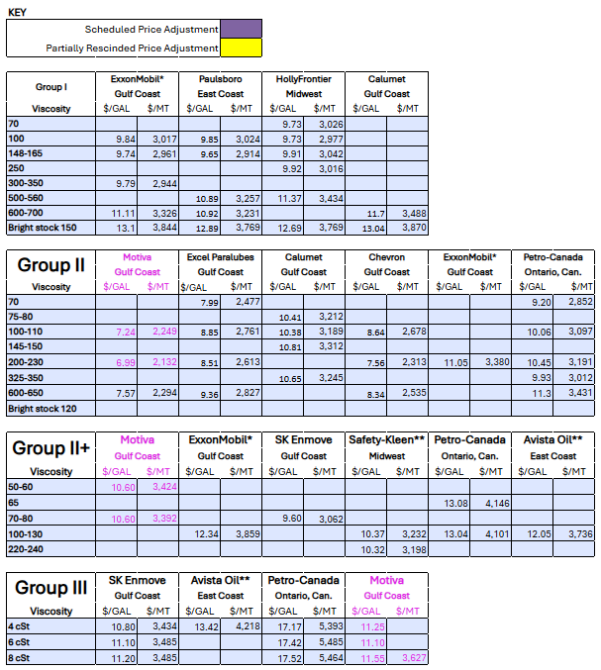
Motiva communicated a price increase on the company’s Group II, Group II+ and Group III grades, with the exception of the 600-vis. The Group II 100-vis base oil will move up by 35 cents/gal and the 220-vis by 25 cents/gal. The Group II+ cuts will increase by 75 cents/gal, and the Group III 4 cSt grade will also edge up by 75 cents/gal. The Group III 6 cSt and 8 cSt will be raised by 50 cents/gal, with all the adjustments going into effect on October 1.
Base oil prices continued to be exposed to upward pressure as refiners needed to maintain a certain price level to justify production versus that of competing diesel, as diesel prices were soaring. Firm crude oil values because of the ongoing war in Iran and Houthi rebel attacks on Saudi vessels and facilities also supported domestic posted prices.
Last week, Chevron communicated a 40 cents per gallon posted price increase on its Group II 100R grade, and a 35 cents/gal hike on its 220R and 600R cuts which went into effect on Sep. 22.
Availability of Group I and Group II base oils has grown, partly because some suppliers have started to release inventories held during hurricane season along the U.S. Gulf Coast. While the season is not officially over until Nov. 30, most storms occur in August and September and weather forecasts did not predict severe weather over the next few weeks. Some producers have also relaxed their sales controls and allocations and have offered additional volumes to customers.
Demand showed diverging trends, with some consumers looking to secure base oils as they anticipated supplies to remain limited, particularly as a number of turnarounds were expected to tighten supplies before the end of the year. Some buyers were more cautious and preferred to delay purchases in expectation of geopolitical developments that may change the price trajectory of crude oil, diesel and base oils.
As mentioned above, Paulsboro was expected to have started a turnaround at its Group I plant in New Jersey for five weeks in mid-September. The producer was anticipated to have built inventories to cover contractual obligations during the outage, but might be unable to offer spot supplies until close to the end of the year.
Petro-Canada has also scheduled a 30-day turnaround on its Group II unit in Mississauga, Canada, this quarter that may be tightening supplies further, but no update about a starting date were available. Earlier this year, HF Sinclair announced a permanent retirement of base oil refining at the Petro-Canada facility in Mississauga during 2027.
Chevron was expected to reduce its Group II output in Pascagoula, Mississippi, as the company rolls out new Group III production at the site in October 2026.
In other regions, a Luberef plant in Yanbu, Saudi Arabia, was also expected to be shut down in October, but it appears the shutdown might only affect the Group II grades. Yanbu facilities have come under Houthi rebels’ attacks, with drone and missile hits reportedly having been deterred by Saudi forces over the weekend. The plant was running at reduced rates for a partial shutdown, according to sources.
There have also been turnarounds announced at a number of Chinese base oil plants and at the Petronas Group II/Group III plant in Melaka, Malaysia. While these turnarounds do not affect U.S. consumers directly, they do tend to tighten global base oil supplies.
While there were limited volumes being offered for spot export transactions, these prices have come under pressure because of competition with Asian supplies, which have made their way to several destinations in the U.S. and Latin America over the last two months.
Although it was not clear whether certain shipments were part of intra-company transactions to meet demand in downstream lubricant units, it was heard that a 10,000-ton cargo was discussed for lifting in Southeast Asia to the U.S. Gulf, Oct. 5-15. A 20,000-ton lot was quoted for shipment from Port Klang, Malaysia, to Savannah, Georgia, Oct. 15-25. A 5,500-ton parcel was under consideration for shipment from South Korea or China to Rio de Janeiro, Brazil, in the first half of October.
In Brazil, buyers have been considering both U.S. offers, as well as Asian offers as the tight conditions in Asia had eased slightly. The domestic Group I producer, Petrobras, has been able to meet contractual obligations following a turnaround and a restart in July/August. Domestic prices were heard to be exposed to upward pressure due to the tight conditions, both locally and on a global scale.
U.S. export volumes moving to Mexico have dwindled because of firm price levels and due to reduced demand from certain downstream segments on economic uncertainties and increased lubricant pricing. Competitive Asian pricing was placing pressure on U.S. suppliers to lower offer levels.
Group II+/Group III
As reported above, Motiva communicated a price increase on the company’s Group II, Group II+ and Group III grades, with the exception of the 600-vis. The Group II 100-vis base oil will move up by 35 cents/gal and the 220-vis by 25 cents/gal. The Group II+ cuts will increase by 75 cents/gal, and the Group III 4 cSt grade will also edge up by 75 cents/gal. The Group III 6 cSt and 8 cSt will be raised by 50 cents/gal, with all the adjustments going into effect on October 1. These increases follow an initiative implemented on September 1.
Suppliers have seen their production costs increase in recent weeks, and supplies were extremely tight, with some blenders unable to receive Group II+ and Group III cuts. As a result, a number of producers announced posted price increases over the last few weeks. Last week, Petro-Canada announced a 50 cents per gallon increase on its Group III base oils, effective September 25, and SK Enmove had previously also announced a 50 cents/gal on its Group II+ and Group III grades on Sep. 8. Motiva implemented a $1.00/gal posted price increase on Sep. 1.
Given the ongoing shortages in the Group III segment, prices continued to be exposed to upward pressure. As long as there was no peace deal on the Iran conflict, the Strait of Hormuz remained under Iranian control and Iran-backed Houthi rebels continued their threats and attacks on vessels in the Bab al-Mandab Strait and the Red Sea, the situation was not expected to improve significantly, except that at least one shipment has been able to leave the Adnoc facilities in Abu Dhabi and was heard to be on its way to the U.S.
Last week, Penthol, the official distributor of Abu Dhabi producer Adnoc’s material in the U.S., informed customers that the company had been able sail a vessel through the Strait of Hormuz and that a cargo would be arriving in the U.S. Gulf in late October. There were also rumblings that another vessel had loaded at the Bapco terminal in Sitra, and that Shell Trading had although further details were not forthcoming.
Penthol will be maintaining the force majeure on contract commitments that has been in place since July as arranging passage through the strait was still uncertain and risky, and while Iran controlled the Strait of Hormuz, there was no warranty that future shipments could be achieved.
Meanwhile, base oil production in Bahrain, Qatar and Abu Dhabi remained mostly shut down or running at reduced rates, with some facilities having been damaged by drone attacks. One of the trains at the Shell/Qatar Pearl gas-to-liquid plant had suffered extensive damages during a missile and drone attack, but the company said that repairs were underway and there were expectations that the damaged line could restart early next year.
Asian and domestic Group II+/Group III suppliers maintained strict sales controls and allocations, with Asian suppliers able to meet contract requirements, but having to restrict spot sales.
Naphthenic Base Oils
Suppliers of naphthenic base oil prices continued to monitor the geopolitical scene that was having a significant impact on Brent crude oil prices, which affect naphthenic base oil prices more directly. In mid-September, San Joaquin Refining communicated a price increase of 50 cents per gallon on select, low-viscosity specialty oils, including the 200 SUS and lighter grades, which went into effect on September 17. The increases were driven by volatile market conditions and regional supply/demand imbalances. Other suppliers were heard to have adjusted prices on a case-by-case basis.
The light grades continued to see healthy demand and some cuts have been very tight, with one producer reporting being consistently sold out of the pale oil 60 as demand from the transformer oil segment has been strong. Consumption of the heavy cuts was slightly less robust and prices were therefore largely maintained.
Crude Oil
Crude oil futures climbed on Wednesday after U.S. president Trump said he would not be willing to ease sanctions on Iran while Qatar-mediated talks were ongoing. Despite Saudi oil shipments having resumed, WTI climbed to levels near $90/barrel after falling during the previous session.
- West Texas Intermediate November 2026 futures settled on the Nymex at $89.38 per barrel on Sep. 29, down from $90.52 per barrel on Sep. 22.
- Brent November 2026 futures were trading on the ICE at $103.05/bbl on Sep. 30, up from $99.45/bbl on Sep. 23.
- Louisiana Light Sweet crude wholesale spot prices were hovering at $101.37/bbl on Sep. 28. Spot prices had settled at $101.84 on Sep. 21, according to the U.S. Energy Information Administration.
Diesel
Low-sulfur diesel wholesale, Sep. 28 (Sep. 21), EIA
New York Harbor: $4.91 per gallon ($4.98/gal)
Gulf Coast: $4.79/gal ($4.96/gal)
Los Angeles: $4.57/gal ($5.09/gal)
Gabriela Wheeler can be reached directly at gabriela@LubesnGreases.com
LNG Publishing Co. Inc./Lubes’n’Greases shall not be liable for commercial decisions based on the contents of this report.
Posted Paraffinic Base Oil Prices September 30, 2026 (Prices are FOB basis, in U.S. dollars per gallon and U.S. dollars per metric ton).
Archived base oil price reports can be found through this link: https://www.lubesngreases.com/category/base-stocks/other/base-oil-pricing-report/
Historic and current base oil pricing data are available for purchase in Excel format.
*ExxonMobil prices obtained indirectly.
**Rerefiner