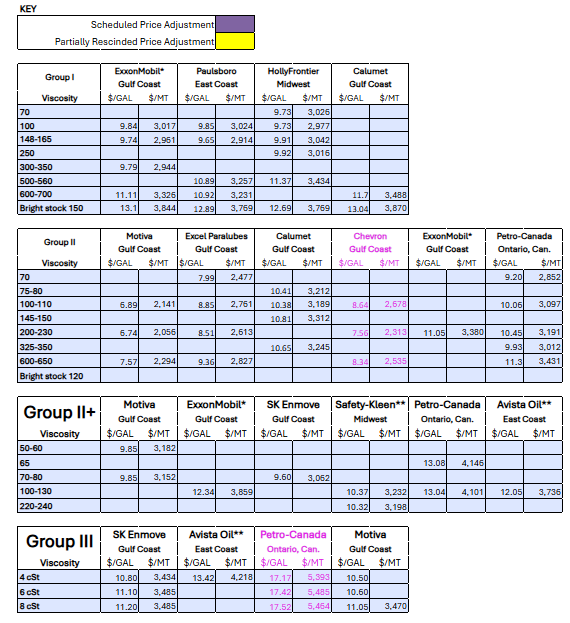
Additional posted price increase notifications emerged this week, with Chevron and Petro-Canada informing customers of price adjustments. Some API Group III customers may breathe a sigh of relief as a large cargo was understood to have been successfully loaded in the Persian Gulf and shipped out to the United States. This follows increased tensions in the Middle East as Iran-backed rebels escalated their attacks on Saudi Arabian facilities and vessels, which had sent crude oil prices to fresh highs and fanned concerns about reduced crude oil, refined products and base oil shipments from the Middle East. The disruptions have exacerbated a global diesel shortage, with the U.S. considering a ban on diesel exports as prices for the fuel hit record levels this week.
Saudi Arabia’s East-West pipeline, which has been used to transport crude oil across the Arabian Peninsula and bypass the Strait of Hormuz, came under attack on Sept. 11 and its operator, Saudi Aramco, took it off-line as a precautionary measure. The pipeline has since been restarted, although it was been operating at reduced capacity. Subsequently, Houthi forces launched a wave of drone and missile strikes aimed at multiple areas in Saudi Arabia, including the capital, Riyadh, and the critical port city of Yanbu on the Red Sea. The Houthi military spokesman claimed strikes against Saudi Aramco facilities in Yanbu had ignited massive fires.
The Yanbu refinery houses a Group I and Group II base oils plant and is also a key Red Sea terminal and industrial zone where Saudi Arabia’s major East-West crude oil pipeline terminates. The Saudi-led coalition stated that the attacks targeting Yanbu and other cities had been successfully intercepted, and Saudi Arabia was planning to resume exports from Yanbu.
Crude oil futures extended declines this week on expectations of improved oil supply levels after the restart of the Saudi pipeline and as the U.S. and Iran held talks in New York on the sidelines of the United Nations General Assembly on Tuesday. West Texas Intermediate futures fell to around $90 per barrel, from levels near $105/bbl last week, while Brent slipped to $99/bbl from $107/bbl. Current national average retail price for diesel fuel in the U.S. reached an all-time record high of $6.50 per gallon amid a global fuel supply crunch, mostly driven by the Russian war on Ukraine and the Iran conflict.
Meanwhile, the firm crude oil and diesel prices, together with tight supply and demand fundamentals for most grades, maintained upward pressure on base oil values. On the other hand, signs that suppliers would be releasing extra inventories held during the hurricane season and expectations that some Persian Gulf cargoes would be arriving in the U.S. over the coming weeks tempered the upward price pressure.
Group I and Group II
In the Group II segment, Chevron communicated a 40 cents per gallon increase on its Group II 100R grade, and a 35 cents/gal hike on its 220R and 600R cuts, effective Sept. 22.
The Group I and Group II segments continued to display a fairly tight supply and demand ratio, even despite weaker demand following the end of the summer driving season. The slowdown coincides with producers’ need to clear the extra inventories kept during hurricane season, which is officially over at the end of November, but that has been very mild this year and storm risks were expected to wind down this month.
However, producers did not seem to be in a hurry to reduce inventories as they awaited geopolitical developments and watched diesel prices, which might influence refining decisions going forward. Record-high diesel prices were also driving freight costs up, offering further support to the finished lubricant price increases that many blenders hoped to implement.
Some base oil suppliers had offered cargoes for export and have adjusted spot export prices down to compete with Asian products, which have made their way to the Americas in recent weeks. However, fresh offers were limited as suppliers monitored geopolitical developments in the Middle East affecting crude and refined products as many uncertainties regarding crude supplies lingered. Producers prioritized internal product needs as well as contractual commitments, and some also shipped base oils to other locations to cover intra-company product needs. If crude oil shipments from Saudi Arabia and other Middle East countries suffered further disruptions, then crude supplies to European and Asian refineries could see curtailments, resulting in reduced base oil production there.
Supply and demand of most Group I grades was balanced-to-tight, with the exception perhaps of bright stock, which appeared to be more readily available. But these conditions may change as Paulsboro was expected to have embarked on a turnaround at its Group I plant in New Jersey for five weeks in mid-September. The producer was expected to have built inventories to cover contractual obligations during the outage. However, it was anticipated to be unable to offer spot supplies until close to the end of the year.
In the Group II category, the heavy-viscosity grade was more plentiful than the 100 neutral and the 200N, sources said.
As was the case in the Group I segment, upcoming shutdowns may impact the supply and demand balance in the coming weeks, although other suppliers may have extra inventories to clear after the end of the hurricane season.
Petro-Canada has also scheduled a 30-day turnaround on its Group II unit in Mississauga, Canada, this quarter that may be tightening supplies further.
Chevron was expected to reduce its Group II output in Pascagoula, Mississippi, as the company rolls out new Group III production at the site in October 2026.
In other regions, a Luberef plant in Yanbu, Saudi Arabia, was also expected to be shut down in October, but it appears the shutdown might only affect the Group II grades. Yanbu facilities have come under Houthi rebels’ attacks, with drone and missile hits reportedly having been deterred by Saudi forces over the weekend. The plant was running at reduced rates for a partial shutdown, according to sources.
There have also been turnarounds announced at a number of Chinese base oil plants and at the Petronas Group II/Group III plant in Melaka, Malaysia. While these turnarounds do not affect U.S. consumers directly, they do tend to tighten global base oil supplies, with more buyers vying for the reduced volumes that reach the market.
Offers of Asian Group I and Group II spot cargoes to destinations in the U.S. and Latin America have slowed down as crude oil supply uncertainties fanned concerns about potential feedstock shortages to run Asian plants. A 10,000-metric ton base oils cargo appeared to have been lined up to load in Asia for the U.S. Gulf between Oct. 5 and 15, possibly for intra-company operations. A second cargo, of around 5,000 tons, was also mentioned for shipment from South Korea to the U.S. Gulf on any September dates. A 3,000 to 5,000-ton lot was quoted for shipment from South Korea to Brazil in October. A 5,000-ton parcel was discussed for possible shipment from Daesan, South Korea, or Ningbo, China, to Rio de Janeiro, Brazil, at the end of September.
In Brazil, the domestic Group I producer, Petrobras, has been able to meet contractual obligations following a turnaround and a restart in August. Domestic Group I prices were heard to be holding steady and buyers were trying to meet product needs through domestic supplies. There were also reports of Brazilian Group I cargoes being offered into neighboring countries. On the West Coast of South America, buying interest focused on Asian supplies, which were considered more competitive. However, some of these offers have edged up because of crude supply uncertainties and a reduced number of suppliers who ventured into the spot market, although prices were still considered attractive compared to U.S. indications.
U.S. export volumes moving to Mexico have also slipped because of firm price levels and due to reduced demand from certain downstream segments on economic uncertainties and increased lubricant pricing. Imports of the light grades that were used as fuel extender have also slumped because of stricter import rules. Most buyers continued to receive cargoes under contract and tried to achieve lower prices from U.S. suppliers, citing competitive Asian pricing as a reason for their lower bid levels.
Group II+/Group III
Group III prices continued to be exposed to upward pressure due to the ongoing U.S.-Iran conflict, the shipping disruptions caused by Iran’s blockade of the Strait of Hormuz and attacks by Iran-backed Houthi rebels on vessels in the Bab al-Mandab Strait and the Red Sea. Base oil production in Bahrain, Qatar and Abu Dhabi remained mostly shut down, with some facilities having been damaged by drone attacks. Asian and domestic Group II+/Group III suppliers continued to maintain sales controls and allocations, with Asian suppliers able to meet contract requirements, but having to restrict spot sales.
But there appeared to be positive developments in this segment this week as news emerged that Penthol, the official distributor of Abu Dhabi producer Adnoc’s material in the U.S., had been able to lift products and sail a vessel through the Strait of Hormuz, with the 40,000 metric-ton cargo said to be on its way to the U.S. It could not be ascertained whether the cargo was entirely for Penthol customers, or whether part of it had been secured by Shell Trading. This company was also heard to have been able to ship base oils out of the Persian Gulf. There were also rumblings that another vessel had loaded at the Bapco terminal in Sitra, although further details were not forthcoming.
According to reports, Penthol had informed customers that they would be receiving product in late October, but the company would be maintaining its force majeure on contract commitments that has been in place since July as arranging passage through the strait was still uncertain and risky, and while Iran controlled the Strait of Hormuz, there was no warranty that future shipments could be achieved.
Meanwhile, suppliers have seen their production costs increase in recent weeks, and there were still product shortages. As a result, a number of producers announced posted price increases. This week, Petro-Canada announced a 50 cents per gallon increase on its Group III base oils, effective Sept. 25.
Earlier this month, SK Enmove implemented markups of 50 cents/gal on its Group II+ and Group III grades on Sept. 8, and Motiva implemented a $1.00/gal posted price increase on Sept. 1.
The Group III category continued to show critical shortages on a global scale, but if shipments out of the Persian Gulf can be achieved and plants can resume normal production, then the situation would improve in the coming months and some of the upward pressure would be lifted, although a return to normal conditions was not expected to be immediate as plants have suffered damages from Iranian drone and missile attacks. The Shell-Qatar Pearl GTL plant has two lines and one of them was severely damaged and was not expected to be restarted until at least next year, according to market sources.
Naphthenic Base Oils
Naphthenic base oil prices continued to be exposed to upward pressure from steep crude oil and competing diesel prices. Last week, San Joaquin Refining communicated a price increase of 50 cents/gal on on select, low-viscosity specialty oils, including the 200 SUS and lighter grades, which went into effect on Sept. 17. The producer explained that the increases were driven by volatile market conditions and regional supply/demand imbalances. Other producers continued to keep a close eye on market developments.
The light grades have shown ongoing tight conditions over the last several months as demand for the pale oil 60 from the transformer oil segment has been robust. But underlying conditions also offered support to the remaining pale oil grades, even though demand for the heavy cuts was not as strong and this has exerted downward pressure.
Crude Oil
Crude oil futures edged down as U.S. and Iran representatives met in New York on Tuesday on the sidelines of the United Nations General Assembly, with Iran voicing its requirements to reopen the Strait of Hormuz. At the same time, there were expectations that U.S. president Donald Trump would put pressure on Chinese President Xi Jinping to intervene in the war as Iran is a key trading partner of China.
- West Texas Intermediate November 2026 futures settled on the Nymex at $90.52 per barrel on September 22, down from $105.83 per barrel on Sept. 15.
- Brent November 2026 futures were trading on the ICE at $99.45/bbl on Sept. 23, down from $107.78/bbl on Sept. 16.
- Louisiana Light Sweet crude wholesale spot prices were hovering at $101.84/bbl on Sept. 14. Spot prices had settled at $108.42 on Sept. 14 and at $96.69/bbl on Sept. 4, according to the U.S. Energy Information Administration.
Diesel
Low-sulfur diesel wholesale, Sept. 21 (Sept. 14), EIA
New York Harbor: $4.98 per gallon ($5.08/gal)
Gulf Coast: $4.96/gal ($4.95/gal)
Los Angeles: $5.09/gal ($5.26/gal)
Gabriela Wheeler can be reached directly at gabriela@LubesnGreases.com
LNG Publishing Co. Inc./Lubes’n’Greases shall not be liable for commercial decisions based on the contents of this report.
Posted Paraffinic Base Oil Prices September 23, 2026 (Prices are FOB basis, in U.S. dollars per gallon and U.S. dollars per metric ton).
Archived base oil price reports can be found through this link: https://www.lubesngreases.com/category/base-stocks/other/base-oil-pricing-report/
Historic and current base oil pricing data are available for purchase in Excel format.
*ExxonMobil prices obtained indirectly.
**Rerefiner