Price activity shifted to the naphthenic base oils side this week, as San Joaquin Refining announced a price increase for its light grades, while other suppliers continued to monitor market conditions. A tight supply and demand balance and steep crude oil prices exerted upward pressure on both naphthenic and paraffinic grades. Just when it appeared that refiners all over the world had started to adapt to the Persian Gulf crude oil and feedstocks supply constraints and were sourcing products from alternative origins, crude oil supplies have been further impacted by the shutdown of a critical pipeline in Saudi Arabia and Houthi rebels’ tightening their grip on the Bab al-Mandab Strait. The East-West pipeline was taken off-line as a precautionary measure following drone attacks originating in Iraq on Saudi energy facilities on Sept. 11. The Saudi oil crisis deepened on Tuesday as Aramco suspended crude loadings from the Red Sea port of Yanbu.
Crude oil futures reacted immediately to the news by registering sharp increases, applying pressure on base oil prices. West Texas Intermediate jumped to $105 per barrel and Brent to levels above $108/bbl. An easing of API Group I and Group II base oil availability in the United States since suppliers began to release extra inventories kept during hurricane season had been expected to lead to downward price pressure, but the trend may be stalled by the new developments in the Middle East amid concerns about prolonged crude oil supply issues. Group III prices continued to rise given global supply shortages and prospects of prolonged production shutdowns in the Persian Gulf.
While many U.S. producers were insulated from the Middle East crude supply disruptions as they were able to use domestic crude, some depend heavily on Middle East imports to run their refineries. But crude oil availability was not the only factor playing a critical role in refining operations. Diesel has been extremely tight on a global scale, with inventories said to be below normal levels, and prices hitting record highs above $6 per gallon in the U.S., increasing the cost of shipping most goods, but also forcing refiners to decide whether producing diesel or base oil makes more economic sense. Russia is a large diesel exporter, but international sanctions and damaged energy facilities have curtailed its exports since the start of the Russian war on Ukraine.
Group I and Group II
Both suppliers and buyers confirmed that tight conditions continued to reign in the Group I and Group II segments, although demand has started to show signs of a slowdown following the end of the summer driving season. This coincides with producers’ drive to release some of the extra inventories held during hurricane season. Most storms occur in August and September and this year, the season was expected to be milder than in previous years. As a result, participants have already started to look for opportunities to place their extra barrels. Some have offered cargoes for export, with spot export prices heard to have edged down. U.S. export prices were also pressured by competitive offers for Asian products, which have moved to the Americas in recent weeks. However, most offers have now been withdrawn as suppliers awaited geopolitical developments affecting crude and refined products supplies.
Domestic spot availability was still limited, and prices were holding for the most part, sources noted.
A Group I supplier confimed that its position was tight on most grades, with the exception perhaps of bright stock, which was balanced. In the Group II category, the heavy-viscosity grade was more plentiful than the 100 neutral and the 200N, sources said.
Most producers were prioritizing contract commitments and were limiting spot availability. They were also protecting current and future inventories in case prolonged supply chain disruptions might lead to sudden production outages or reduced availability, and preferred to make sure they met internal product needs as well as contractual commitments. Some suppliers might need to ship base oils to other locations to cover intra-company demand. Buyers were resisting higher base oil prices because of difficulties implementing additional lubricant increases.
A number of plant turnarounds were expected to take place over the next few months, keeping supplies on the snug side. In the U.S., Paulsboro will take its Group I plant in New Jersey off-line for maintenance for five weeks in mid-September, but was expected to have built inventories to cover contractual obligations during the outage. However, the producer was anticipated to be unable to offer spot supplies until close to the end of the year.
Petro-Canada has also scheduled a 30-day turnaround on its Group II unit in Mississauga, Canada, this quarter that may be tightening supplies further.
Chevron was expected to reduce its Group II output in Pascagoula, Mississippi, as the company rolls out new Group III production at the site in October 2026.
A Luberef plant in Yanbu, Saudi Arabia, was also expected to be shut down in October, but it appears the shutdown might only affect the Group II grades. There have also been shutdowns announced at a number of Chinese base oil plants. While these turnarounds do not affect U.S. consumers directly, they do tend to tighten global base oil supplies, with more buyers vying for the reduced volumes that reach the market.
Asian Group I and Group II spot supplies have been offered to destinations in the U.S. and Latin America as refinery run rates were high in Asia, demand has weakened and producers were looking for opportunities to place their supply overhang. However, limited vessel space on certain routes and steep insurance and freight costs were still dampening transactions.
U.S. exports to Brazil have fallen because of steep prices and the ability of the domestic Group I producer, Petrobras, to meet contractual obligations following a turnaround and a restart in August. Domestic Group I prices were heard to be holding steady. There continued to be demand for Group II cargoes, although activity in downstream lubricant segments was heard to have weakened. Multiple offers for Asian product at competitive prices were exerting downward pressure on U.S. exports, with numbers heard to have been adjusted down to encourage Brazilian buyers to take U.S. base oils instead of Asian volumes. Demand for Asian supplies on the West Coast of South America continued to be noted as prices were competitive.
There was also ongoing buying appetite from Europe, where most grades were described as tight, while some shipments–possibly intra-company movement — from various origins to the U.S. Gulf were also noted. A 5,000-metric ton cargo was mentioned for possible shipment from Houston, Texas, to Amsterdam-Rotterdam-Antwerp, Oct. 5-10. A 1,000 to 5,000-ton lot was quoted for shipment from Singapore to Houston between Oct. 1-5. Details about a 3,200-ton cargo loading in Houston for Le Havre, France, in late August, and a 15,000-ton lot from Sohar, Oman, to the U.S. Gulf in the second half of Sep. also emerged.
U.S. export volumes moving to Mexico have also fallen significantly, both because of price levels, but also because imports of the light grades as fuel extender have been thwarted by stricter import rules and steep pricing. A weaker local currency, the Mexican peso, against the U.S. dollar has also turned U.S. products more expensive, further dampening demand. Most buyers continued to receive cargoes under contract and few ventured into the spot market, although there has been some interest in Asian barrels due to increased availability in that region and softer export prices.
Group II+/Group III
The ongoing U.S.-Iran conflict, the closing of the Strait of Hormuz and additional disruptions caused by Iran-backed Houthi rebels — who were effectively controlling transit through the Bab al-Mandab Strait and threatening vessels in the Red Sea — were placing more pressure on Group III price indications, as Group III plants in the Persian Gulf were not expected to be restarted any time soon.
Last week, SK Enmove announced a price increase of 50 cents per gallon on its Group II+ and Group III grades, effective Sept. 8, reflecting the extremely tight supply and demand balance in the U.S. amid firming feedstock costs. The initiative came on the back of similar price actions by other producers, including Motiva, which implemented a $1.00/gal posted price increase on Sept. 1.
Availability of 6 cSt and 8 cSt appeared to have improved over the last two weeks given current refinery yields against weakening demand for these grades in the domestic market, as well as in Asia, but suppliers have turned more cautious and have retracted offers at reduced prices as the Group III category continued to show critical shortages on a global scale and there were no expectations that a restart of Middle East plants could be achieved over the next few weeks.
Middle East Group III base oils were impossible to secure as shipments from the three main Group III producers on the Persian Gulf continued to be effectively cut off. Vessels have been attacked in the Strait of Hormuz and the Bab al-Mandab Strait by Houthi militants and Iran, and base oil production in Bahrain, Qatar and Abu Dhabi remained shut down, with some facilities having been damaged by drone attacks. Asian and domestic Group II+/Group III suppliers continued to maintain sales controls and allocations, with Asian suppliers able to meet contract requirements, but having to restrict spot sales.
Naphthenic Base Oils
San Joaquin Refining communicated a price increase of 50 cents per gallon on select, low-viscosity specialty oils, including the 200 SUS and lighter grades, effective Sept. 17. The producer explained that the increases were driven by volatile market conditions and regional supply/demand imbalances. Rising crude oil and competing fuel costs were exerting upward pressure on pale oil prices as well, sources noted.
Prices for other naphthenic base oil prices were reported as stable-to-firm, with suppliers monitoring both market conditions and crude oil prices and mulling additional price adjustments.
An atypical price difference between naphthenic and paraffinic grades promoted some blenders to use pale oils instead of paraffinic cuts in some applications as prices were more competitive. This was incentivizing suppliers to consider naphthenic price adjustments as well.
Crude Oil
Crude oil futures slipped on Wednesday, Sept. 16 on reports that Saudi Arabia would be offering additional crude cargoes via Oman, somewhat easing fears about increasing Middle East supply disruptions. Meanwhile, diesel prices in Europe have moved up, hovering at record highs.
- West Texas Intermediate October 2026 futures settled on the Nymex at $105.83 per barrel on Sept. 15, up from $93.03 per barrel on Sept. 8.
- Brent November 2026 futures were trading on the ICE at $107.76/bbl on Sept. 16, up from $100.68/bbl on Sep. 9.
- Louisiana Light Sweet crude wholesale spot prices were hovering at $108.42/bbl on Sept. 14. Spot prices had settled at $96.69/bbl on Sept. 4, according to the U.S. Energy Information Administration. There was no trading on Sept. 7 due to the U.S. Labor Day holiday.
Diesel
Low-sulfur diesel wholesale, Sept. 14 (Sep. 4), EIA
New York Harbor: $5.08 per gallon ($4.55/gal)
Gulf Coast: $4.95/gal ($4.56/gal)
Los Angeles: $5.26/gal ($5.05/gal)
Gabriela Wheeler can be reached directly at gabriela@LubesnGreases.com
LNG Publishing Co. Inc./Lubes’n’Greases shall not be liable for commercial decisions based on the contents of this report.
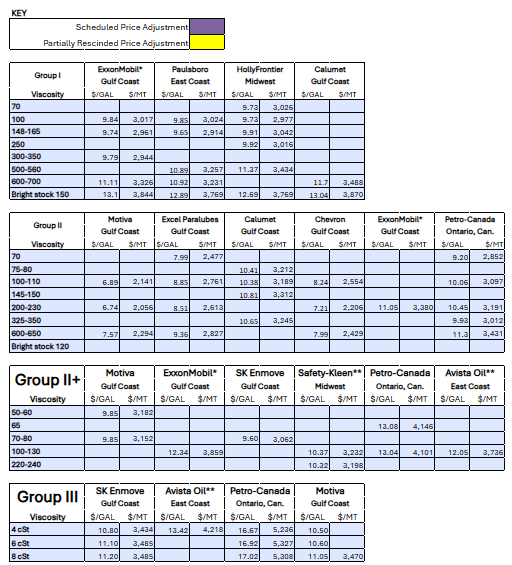
Posted Paraffinic Base Oil Prices September 16, 2026 (Prices are FOB basis, in U.S. dollars per gallon and U.S. dollars per metric ton)
Archived base oil price reports can be found through this link: https://www.lubesngreases.com/category/base-stocks/other/base-oil-pricing-report/
Historic and current base oil pricing data are available for purchase in Excel format.
*ExxonMobil prices obtained indirectly.
**Rerefiner