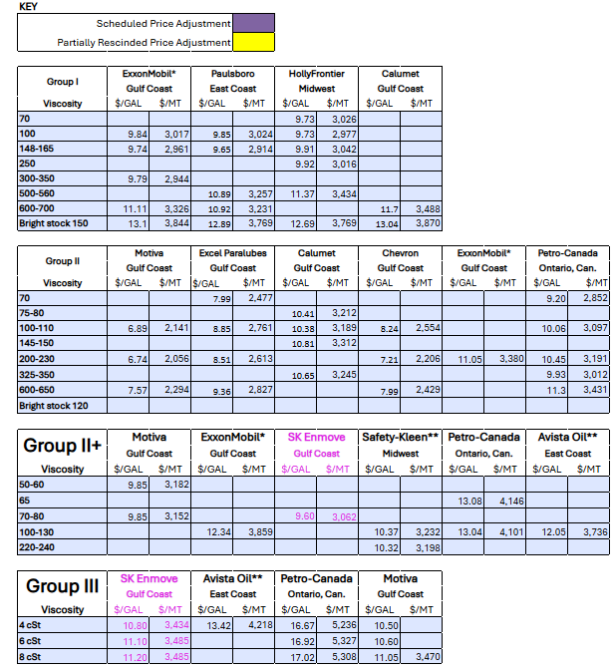
The supply and demand balance in the API Group III segment remained extremely tight, while crude oil and feedstock prices moved up, prompting SK Enmove to communicate a posted price increase this week. The increase comes on the heels of comparable initiatives by other producers, which were triggered by the same market fundamentals. While the Group III category showed the most critical global supply constraints, the Group I and Group II segments were also affected by the ongoing Middle East conflict, related shipping disruptions and surging feedstock prices, which have caused upheaval in all regions.
In the United States, there has been an acute shortage of Group III base oils from the Persian Gulf as plants were shut down following the closing of the Strait of Hormuz by Iran, making it impossible for producers to ship out products, and several attacks on facilities have also caused severe damages that are still being repaired. Vessels loading in the Red Sea are also being rerouted through the longer Suez route due to risks of Houthi attacks around the Bab al-Mandab Strait, which adds both time and cost to shipments. With the U.S.-Iran conflict largely unresolved, it was not clear when Persian Gulf facilities would be able to resume production and start shipping out product. Even if the war were to end tomorrow, restarting output will likely take some time. Asian supplies have been insufficient to fill the vacuum left by Middle Eastern products, keeping prices exposed to upward pressure.
The U.S. and Iran exchanged some of their fiercest attacks in weeks over the weekend, with the U.S. military reporting strikes on three Iranian “shadow fleet” oil tankers in retaliation for Iran launching missiles at two warships near Hormuz. Then on Tuesday, the U.S. military said it destroyed five Iranian oil tankers in response to the latest attacks on U.S. Navy ships, and Tehran launched missiles at American targets in Jordan. These actions sent crude oil prices to fresh highs, with Brent jumping over the symbolic barrier of $100 per barrel in early trading on Wednesday and West Texas Intermediate trading near $95/bbl.
Group I and Group II
The tight conditions affecting most Group I and Group II base oils were expected to start easing as demand tends to slow down following the Labor Day holiday on September 7 which marks the end of the summer driving season. At the same time, producers were striving to meet contractual obligations and were reluctant to offer extra volumes for spot business because they wanted to be able to cover potential production disruptions due to severe weather, or a sudden tightening caused by unexpected plant shutdowns.
While it appeared that the current hurricane season will be milder than in previous years, Tropical Storm Edouard did disrupt operations at Motiva’s and Valero’s refineries in Port Arthur, Texas, on September 2, causing power outages and other issues. According to reports, several pieces of equipment, including a small crude distillation unit shut down at Motiva’s refinery due to the severe weather, but the issues were resolved and the refineries were able to return to operations the following day. Motiva produces Group II, Group II+ and Group III base oils, but it was not clear whether the weather had affected base oil production in any way.
A number of plant turnarounds were expected to take place over the next few months. In the U.S., Paulsboro will take its Group I plant in New Jersey off-line for maintenance for five weeks in mid-September, but was expected to have built inventories to cover contractual obligations during the outage. However, the producer was anticipated to be unable to offer spot supplies until close to the end of the year.
Petro-Canada has also scheduled a 30-day turnaround on its Group II unit in Mississauga, Canada, this quarter that may be tightening supplies further.
Chevron was expected to reduce its Group II output in Pascagoula, Mississippi, as the company rolls out new Group III production at the site in October 2026.
In other parts of the world, Luberef was originally planning to start a shutdown at its Yanbu, Saudi Arabia, plant in August, but the refiner has reportedly postponed it to October. Luberef has faced difficulties when trying to ship Group I/Group II base oil cargoes from its ports on the Red Sea as vessels have come under Houthi rebels’ attacks. The producer was heard to have rerouted some shipments through the Suez Canal and around the Cape of Good Hope in Africa, which added several days to voyages and increased insurance and freight rates. Luberef is one of the key Group I and Group II suppliers to India and other Asian nations, and if these barrels are taken out of the market, the regional supply situation could tighten further.
Decreased global supplies of diesel and skyrocketing prices may incentivize refiners to stream vacuum gasoil feedstock into fuel production versus that of base oils, and despite high run rates, base oil supplies would remain more limited. These fundamentals would tighten domestic base oil availability even further, while high diesel values would continue to provide support to base oil prices. Several posted price initiatives have been implemented in the August/September time frame by various suppliers.
But buyers were counting on U.S. base oil suppliers starting to release the extra barrels they hold during the Atlantic hurricane season, which was expected to start winding down this month. Additionally, U.S. prices were being exposed to downward pressure because of competitive offers of Asian Group I and Group II spot supplies as refinery run rates were high in Asia, demand was sluggish and producers were looking for opportunities at faraway destinations such as the U.S., Mexico and Brazil, where netbacks could be more attractive. However, finding vessel space and overcoming steep insurance and freight costs represented roadblocks in the conclusion of some transactions.
Import buying interest in Brazil has declined somewhat because the domestic Group I producer, Petrobras, has resumed production following a turnaround in July and it has been able to meet contractual obligations. Domestic Group I prices inched down this month on increased availability and slowing consumption. However, there continued to be demand for Group II cargoes, although activity in downstream lubricant segments was heard to have weakened. Multiple offers for Asian product at competitive prices were exerting downward pressure on U.S. exports, with numbers heard to have been adjusted down to encourage Brazilian buyers to take U.S. base oils instead of Asian volumes. At the same time, there has been demand for Asian supplies on the West Coast of South America.
In Mexico, U.S. export prices have also come under pressure due to competition with Asian barrels. However, demand for these cargoes was not robust because Mexican blenders preferred to maintain business with their regular U.S. suppliers. Base oil consumption was also expected to dwindle in the coming weeks as conditions in lubricant segments were subdued and manufacturers were facing resistance to proposed price increases.
Group II+/Group III
SK Enmove announced that effective September 8, its Group II+ and Group III prices would be increasing by 50 cents per gallon. The increases were driven by the extremely tight supply and demand balance and firming feedstock costs.
SK’s announcement follows a $1.00/gal posted price increase implemented by Motiva on its Group II+ and Group III posted prices on Sept. 1. The producer’s Group II prices were unchanged.
While availability of the 6 cSt and 8 cSt grades appeared to have improved given current refinery yields against weakening demand for these grades, the Group III category in general continued to reflect critical shortages on a global scale.
Middle East barrels remained unavailable as shipments from the three main producers on the Persian Gulf continued to be effectively cut off. Vessels have been attacked in the Strait of Hormuz and the Bab al-Mandab Strait by Houthi militants and Iran, and base oil production in Bahrain, Qatar and Abu Dhabi remained shut down. This situation has led to a force majeure declaration for an indeterminate period by at least one distributor of Middle East base oils in the U.S., and other suppliers continued to maintain sales controls and allocations. Asian suppliers were able to meet most contract requirements, but did not have much extra product to offer for spot sales.
The tight supply of the Group III 4 cSt grade was exacerbated in Europe by an unexpected shutdown at Repsol/SK Enmove ILBOC plant in Spain, which was expected to restrict 4 cSt supplies until November, subject to the successful restart of refinery operations. The reduced 4 cSt availability was not expected to affect SK Enmove’s term customers in Asia and the U.S., but it was just another source of concern for Group III buyers as the overall 4 cSt supply situation seemed to be worsening instead of improving.
Naphthenic
Naphthenic base oil prices were reported as stable-to-firm, with some accounts seeing higher prices due to climbing Brent crude oil and diesel values and a tight supply/demand ratio for the light pale oil grades. Suppliers continued to monitor both market conditions and crude oil prices to determine whether a general price adjustment would be justified.
An atypical price difference between naphthenic and paraffinic grades promoted some blenders to use pale oils instead of paraffinic cuts in some applications as prices were more competitive. This was incentivizing suppliers to consider naphthenic price adjustments as well.
In related news, massive flames and thick black smoke erupted during an industrial transformer facility fire at the Howard Industries electrical transformer plant in Laurel, Mississippi, on Aug. 31.
The fire broke out at a paint booth and spread near a tanker truck carrying an explosive substance, Fox News reported. The fire was contained a few hours later and no injuries were reported. The company is one of the world’s largest consumers of transformer oil. As a leading manufacturer of liquid-filled and oil-immersed electrical transformers, they purchase massive quantities of dielectric insulating fluids. It could not be ascertained whether the incident had disrupted transformer oil supplies to the manufacturer.
Crude Oil
Crude oil futures jumped on Wednesday as Houthi attacks on Saudi Arabian energy infrastructure, U.S. strikes on five Iranian crude oil tankers and Iranian attacks on American vessels and assets in Jordan stoked fears of further crude oil supply disruptions.
- West Texas Intermediate October 2026 futures settled on the Nymex at $93.03 per barrel on September 8, up from $90.22 per barrel on Sep. 1.
- Brent November 2026 futures were trading on the ICE at $100.68/bbl on Sep. 9, up from $94.86/bbl on Sep. 2.
- Louisiana Light Sweet crude wholesale spot prices were hovering at $96.69/bbl on Sep. 4. Spot prices had settled at $89.84/bbl on Aug. 31, according to the U.S. Energy Information Administration. There was no trading on Sep. 7 due to the U.S. Labor Day holiday.
Diesel
Low-sulfur diesel wholesale, Sep. 4 (Aug. 31), EIA
New York Harbor: $4.55 per gallon ($4.49/gal)
Gulf Coast: $4.56/gal ($4.49/gal)
Los Angeles: $5.05/gal ($4.99/gal)
Gabriela Wheeler can be reached directly at gabriela@LubesnGreases.com
LNG Publishing Co. Inc./Lubes’n’Greases shall not be liable for commercial decisions based on the contents of this report.
Posted Paraffinic Base Oil Prices September 9, 2026 (Prices are FOB basis, in U.S. dollars per gallon and U.S. dollars per metric ton).
Archived base oil price reports can be found through this link: https://www.lubesngreases.com/category/base-stocks/other/base-oil-pricing-report/
Historic and current base oil pricing data are available for purchase in Excel format.
*ExxonMobil prices obtained indirectly.
**Rerefiner