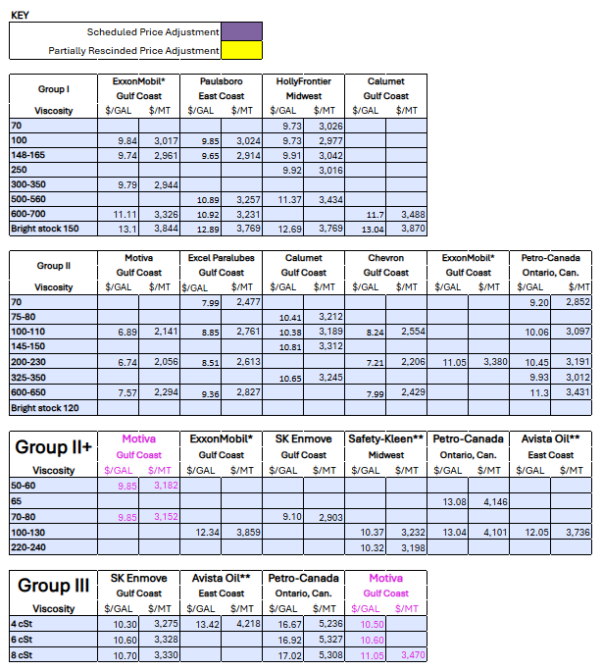
With the API Group III base oil segment seeing little relief in terms of supply levels, it was not surprising that yet another producer implemented a posted price increase. Motiva announced that it would be increasing its Group II+ and Group III postings on September 1, on the heels of similar initiatives by other suppliers. Aside from an extremely tight global supply and demand scenario, firm crude oil and feedstock values also supported the initiatives. Given that there has not been a resolution to the United States-Iran conflict and hostilities have flared up again, shipments were unable to leave the Persian Gulf as the Strait of Hormuz remained closed to most vessel traffic. Recent attacks on tankers by Iran-backed rebels in the Red Sea have exacerbated the general crude oil and base oils supply situation.
For many blenders, the ability to locate Group II+/Group III grades has taken center stage, and while prices still mattered, they did seem to be less of a factor when it came down to securing product. While many consumers still relied on contract volumes, most buyers who purchase Middle East products have been unable to receive shipments over the last several weeks or have received partial cargoes as suppliers were only able to ship limited amounts from storage, although these have also been largely depleted.
Participants were keeping a close eye on geopolitical developments in the Middle East because they kept pushing crude oil prices to higher ground. Crude oil futures rose sharply on Wednesday as renewed U.S.-Iran military exchanges fanned concerns over energy supply disruptions given the ongoing blockade of the Strait of Hormuz. Saudi Aramco’s attempt to boost flows from the Persian Gulf were thwarted by Iran’s drone attacks on two tankers this week. Vessels are also being rerouted through the longer Suez route due to shipping risks around the Bab al-Mandab Strait, which adds both time and cost to shipments.
In other news, the auto industry has voiced concern about the trade war between the U.S. and Canada,
because automakers face 50% U.S. tariffs on all cars and trucks imported from Canada, instead of the previous 25%, Reuters reported. “This is guaranteed to hurt an industry where cross-border supply chains and factories have evolved without issue until U.S. president Donald Trump’s second stint in office,” the article noted, adding that Toyota and Honda will likely be feeling the largest impact. The two Japanese automakers account for more than three-quarters of all cars made in Canada, and the new tariffs may force them to shutter some production lines if these levies go into effect on January 1 as proposed.
Group I and Group II
Group I and Group II base oil prices remained under upward pressure because of unrelenting tight supply conditions and firm crude oil and feedstock costs. Last week, Excel Paralubes announced that the company would be increasing its Group II posted prices by 30 cents per gallon on September 1, following other announcements by various producers during the month of August.
Most producers kept strict allocations and sales controls to ensure that customers would receive contractual volumes and were not entertaining spot opportunities as they did not have much extra product. Even though contract customers saw some limits to how much product they were able to obtain under contract, it appears that availability has improved compared with previous months. While most Group I cuts were snug, bright stock and Group II 220N were reported as the hardest cuts to obtain. Any additional barrels that become available are kept to cover potential supply disruptions during the Atlantic hurricane season, which typically sees a higher number of storms in August and September.
While buying interest from Mexico, Brazil and Europe has picked up—particularly for Group II grades, there was only a limited number of spot export transactions concluded given the lack of sizeable spot cargoes.
Brazilian blenders have received some relief because the domestic Group I producer, Petrobras, has resumed production following a turnaround in July and it has been able to meet contractual obligations for the most part. Domestic Group I prices inched down during the second half of August on increased availability and slowing demand. There was particular appetite for U.S. Group II spot cargoes in Brazil, and although these were not readily available and prices were steep, a couple of transactions were heard concluded from the U.S. Gulf. There were also reports of Asian shipments making their way to Brazil to meet some of these requirements.
In Mexico, buyers were facing some of the same issues that affected other buyers in Latin America, although contract cargoes continued to be shipped from the U.S. at a regular pace and some suppliers have been able to increase contract volumes moving to the neighboring nation. However, economic uncertainties and firm prices were making some buyers more cautious in terms of how much product to secure.
Latin American buyers, as well as some U.S. blenders, were dealing with more restricted cash flows and limited credit terms, thwarting the conclusion of business as base oil prices continued on an upward trend. If the trend continues, it might lead to demand destruction because some blenders may not be able to replenish stocks and will be forced to trim base oil purchases and reduce lubricant output.
Low fuel supplies, particularly diesel, on a global scale may continue to provide an incentive for U.S. refiners to divert feedstocks into fuel production versus that of base oils, and despite high run rates, base oil supplies would remain more limited. These fundamentals would tighten domestic base oil availability even further, while high diesel values would continue to provide support to base oil prices.
Recent and upcoming plant turnarounds and output reductions may also exacerbate the tight supply and demand balance. In the U.S., Paulsboro will take its Group I plant in New Jersey off-line for maintenance for five weeks this month but was expected to have built inventories to cover contractual obligations during the outage.
Petro-Canada has also scheduled a 30-day turnaround on its Group II unit in Mississauga, Canada, in the third quarter that may be tightening supplies further.
Chevron was expected to reduce its Group II output in Pascagoula, Mississippi, as the company rolls out new Group III production at the site in October 2026.
In other parts of the world, Luberef was originally planning to start a shutdown at its Yanbu, Saudi Arabia, plant in August, but the refiner has reportedly postponed it to October. Luberef—a Saudi Aramco subsidiary—has faced difficulties when trying to ship Group I/Group II base oil cargoes from its ports on the Red Sea as vessels have come under Houthi rebels’ attacks. The producer was heard to have rerouted some shipments through the Suez Canal and around the Cape of Good Hope in Africa, which added not only several days to voyages, but also increased insurance and freight rates.
Group II+/Group III
Motiva communicated a $1.00 per gallon price increase on its Group II+ and Group III posted prices, which went into effect on September 1. The producer’s Group II prices were unchanged. The increases were driven by the extremely tight supply and demand balance and high feedstock costs.
Market participants continued to express great concern at the lack of Group II+/Group III base oils as production and shipping disruptions in the Middle East have put a huge dent in global supplies. Participants reiterated that supply has taken priority over pricing as it has been very difficult to secure base oils and even though some blenders have resorted to using other cuts such as Group II grades, not all applications allow substitution.
Middle East barrels remained unavailable as shipments from the three main producers on the Persian Gulf are unable to leave the region. Vessels have been attacked in the Strait of Hormuz and the Bab al-Mandab Strait by Houthi militants and Iran, and base oil production in Bahrain, Qatar and Abu Dhabi remained shut down until vessel traffic through Hormuz can resume safely and damaged facilities can be repaired. This has led to force majeure declaration for an indeterminate period by at least one distributor of Middle East base oils in the U.S.
The tight supply of the Group III 4 cSt grade was exacerbated in Europe by an unexpected shutdown at Repsol/SK Enmove ILBOC plant in Spain, which was expected to restrict 4 cSt supplies until November, subject to the successful restart of refinery operations. The reduced 4 cSt availability was not expected to affect SK Enmove’s term customers in Asia and the U.S., sources said, but may trigger European import inquiries for the 4 cSt cut. SK was also heard to keep substantial stocks at its storage terminal in Antwerp, Belgium, and may be able to meet some requirements from those inventories.
There continued to be reports of Indian offers of Group III base oils into the U.S., and although these barrels do not carry the required approvals that many blenders need, there has been high buying interest because of the current supply shortages. The Indian producer was heard to be prioritizing Group III production over that of Group II grades because of the possibility of moving products to countries which offered attractive netbacks.
Naphthenic Base Oils
Naphthenic base oil prices were reported as generally stable, supported by firm crude oil and diesel values and a tight supply and demand ratio. While the light grades were described as snug and a couple of producers were sold out, the heavy grades were more widely available but not long, according to sources. Demand for the heavier grades from the rubber and tire segment was steady, but not extraordinary, and requirements may be weakening as the summer driving season traditionally ends after the Labor Day weekend (September 7).
The unusually large price gap between naphthenic and paraffinic grades has prompted some consumers to use pale oils instead of paraffinic cuts in some applications as prices are more competitive. This is incentivizing suppliers to consider naphthenic price adjustments, but no price revisions had emerged by the publishing deadline.
Crude Oil
Crude oil futures climbed for a sixth session as renewed U.S.-Iran strikes reignited fears of prolonged supply disruptions. The hostilities were not limited to these two countries, but included targets in Gulf State nations and other sites, raising concerns about the conflict spreading in the region.
- West Texas Intermediate October 2026 futures settled on the Nymex at $90.22 per barrel on September 1, up from $82.36 per barrel on Aug. 25.
- Brent November 2026 futures were trading on the ICE at $94.86/bbl on Sep. 2, up from $85.90/bbl on Aug. 26.
- Louisiana Light Sweet crude wholesale spot prices were hovering at $91.68/bbl on Aug. 31. Spot prices had settled at $89.84/bbl on Aug. 24, according to the U.S. Energy Information Administration.
Diesel
Low-sulfur diesel wholesale, Aug. 31 (Aug. 24), EIA
New York Harbor: $4.49 per gallon ($4.27/gal)
Gulf Coast: $4.49/gal ($4.30/gal)
Los Angeles: $4.99/gal ($4.39/gal)
Gabriela Wheeler can be reached directly at gabriela@LubesnGreases.com
LNG Publishing Co. Inc./Lubes’n’Greases shall not be liable for commercial decisions based on the contents of this report.
Posted Paraffinic Base Oil Prices
September 2, 2026
(Prices are FOB basis, in U.S. dollars per gallon and U.S. dollars per metric ton).
Archived base oil price reports can be found through this link: https://www.lubesngreases.com/category/base-stocks/other/base-oil-pricing-report/
Historic and current base oil pricing data are available for purchase in Excel format.
*ExxonMobil prices obtained indirectly.
**Rerefiner