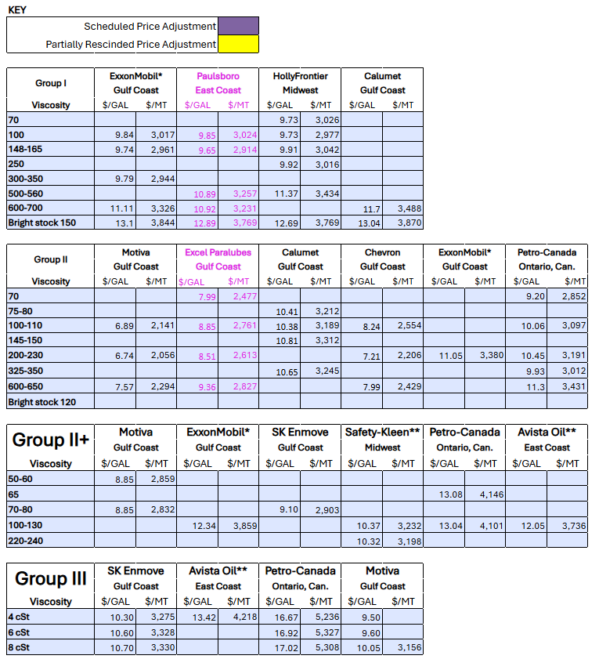
Excel Paralubes communicated a posted price increase, following similar initiatives by other base oil producers since the beginning of the month. The increases were prompted by constrained supply levels and steep crude oil and feedstock costs. Geopolitical tensions in the Middle East continued to sway crude oil values, with futures moving up one day and falling the next, depending on whether negotiations between the United States and Iran showed any progress. On Monday, the U.S. announced an “Economic D-Day” plan to impose sanctions on Iran and its trading partners, while Iran issued a warning that vessels violating its rules for transiting the Strait of Hormuz could face fines, detention, or confiscation. The Persian Gulf crude oil and base oil supply disruptions continued to impact base oil prices, with API Group III values taking the hardest hit as global availability has plummeted and prices have skyrocketed.
In lubricant markets, independent manufacturers in the U.S. recently announced another round of lubricant price increases to offset rising production costs over the last several months, including the most recent round of base oil price increases, as well as steeper additive, packaging, transportation and raw material costs.
Upstream, crude oil futures showed a sharp decline on Wednesday on reports of a potential ceasefire between the U.S. and Iran. Analysts interpreted the proposed U.S. economic sanctions on Iran as a sign that the strategy may have shifted and there would not be renewed armed attacks for the time being. Iran and Oman continued to discuss a temporary joint maritime arrangement to manage the Strait of Hormuz. West Texas Intermediate futures were hovering near $85 per barrel a week ago but traded near $82/bbl on Tuesday.
Other economic developments that market participants were keeping an eye on this week were the flaring up of trade tensions between the U.S. and Canada. New 50-percent U.S. tariffs on about $20 billion worth of Canadian exports went into effect over the weekend after talks failed between the two countries. Canadian prime minister Mark Carney vowed that Canada would retaliate by matching the duties “dollar for dollar.” While base oils and lubricants continued to be exempt from duties because they fall under the energy products category, the ongoing trade conflict with the U.S. neighbor led some experts to wonder whether Canada would leverage its energy and critical minerals exports to get the Trump administration to back down.
Group I and Group II
Excel Paralubes informed customers that effective September 1, the company would be changing its Group II posted prices to reflect a 30 cents per gallon increase across the board.
In the previous week, Calumet and Chevron had also implemented posted price hikes, following initiatives by several other suppliers that went into effect between August 1-18.
Paulboro’s Group I prices were also adjusted up in the Price Table below to reflect a posted price increase of 71 cents/gal not previously reported that went into effect on June 19.
The price increases were propelled by an extremely tight supply and demand ratio and firm crude oil and feedstock costs, which exerted upward pressure on both Group I and Group II grades. However, some cuts appeared to see more limited supply than others, with the Group II 600N mentioned as one of the least available grades. Bright stock also remained in high demand and it is a difficult cut to replace.
A majority of producers were striving to fully meet contract commitments and did not have much extra product to offer for spot deals because they preferred to hold on to any additional barrels to cover potential production issues during hurricane season. Most tropical storms occur in the August-September timeframe. As a result, spot business was limited and export transactions were also few and far between, with export indications remaining elevated compared to a month ago. While buying interest from Europe had slowed down in July and August due to the summer holidays, it was expected to tick up as participants returned to the office in September.
There has been a slowdown in appetite for U.S. Group I grades from Brazil as the local producer has resumed production following a turnaround, and it has been able to meet its term commitments. Group I domestic prices were heard to have been adjusted down for August shipments. Group II grades were still tight in Brazil and buyers were eager to secure products, with some requirements being met through Asian cargoes.
Several offers from Asia also emerged for the U.S. and South American destinations at attractive prices. Group II cuts were under pressure in Asia on growing supplies and lackluster demand, and producers were therefore seeking fresh export opportunities elsewhere, but Group II indications were steady in Brazil because of tight availability. Some Group III cargoes were also heard to have been concluded for shipment from India to the U.S. Gulf. A 7,000-8,000-metric ton lot was mentioned for possible shipment from Haldia, India, to Tampa, Florida, between Sep. 10-20, although it could not be ascertained what base oil grades were involved. A 4,000-ton parcel was also heard to have been concluded for shipment from Port Arthur, Texas, to Chile in the second half of August. A 3,000-ton cargo was also on the table for shipment from Port Arthur to Rio de Janeiro, Brazil, between Aug. 20-30.
Mexican demand was fairly healthy, but has weakened slightly because of uncertainties in downstream lubricant markets, as blenders were unsure whether they would be able to offset recent base oil increases through lubricant price hikes. Group I and Group II prices continued to hover at steep levels, reflecting U.S. values that continued to receive support from tight availability amid supply allocations.
Participants were keeping an eye on global base oil supply levels, as disruptions in other regions have impacted U.S. production and availability since the beginning of the war in Iran. There were still concerns that Group I and Group II supplies may tighten further if attacks on Saudi refineries and vessels by Iran-backed Houthi rebels continue, as these might prevent Luberef—a Saudi Aramco subsidiary—from loading crude and Group I/Group II base oil cargoes from its ports on the Red Sea.
The producer has rerouted some crude shipments through the Suez Canal and around the Cape of Good Hope in Africa instead of attempting to cross the Bab al-Mandab Strait, which is where some of the Houthi attacks have taken place. This added not only several days to voyages, but also increased insurance and freight rates.
Luberef was originally planning to start a shutdown at its Yanbu, Saudi Arabia, plant in August, but the refiner has reportedly postponed it to October.
In the U.S., Paulsboro is planning to take its Group I plant in New Jersey off-line for maintenance for five weeks in September and was expected to build inventories to cover contractual obligations during the outage. Petro-Canada has also scheduled a 30-day turnaround on its Group II unit in Mississauga, Canada, in the third quarter that may be tightening supplies further.
While production disruptions and plant turnarounds may impact base oil supplies in the next few weeks, refinery economics was another factor that may affect base oil production rates. Refiners may be reducing base oil output to maximize diesel production, incentivized by high profit margins and low domestic supplies. Diesel and gasoline prices have been trading close to record premiums over crude oil. International diesel availability remains severely limited by trade sanctions on Russian energy exports and refinery disruptions as Ukraine has launched drone attacks on Russian refining units, terminals and energy hubs.
Group II+/Group III
The most dramatic effects of the supply disruptions in the Middle East continued to be felt in the Group III segment, as global supplies have dwindled and prices continued to surge. In the U.S., suppliers have recently implemented posted price increases, while price indications in Asia increased $50 per metric ton on an FOB Asia basis for a second week in a row, after $100/ton adjustments the previous week, reflecting the extreme scarcity of product.
With commercial vessels having been attacked in the Strait of Hormuz and the Bab al-Mandab Strait by Houthi militants and Iran, and base oil production in Bahrain, Qatar and Abu Dhabi shut down until vessel traffic through Hormuz can resume safely, availability from the Persian Gulf will remain effectively cut off. This takes a significant portion of Group III supply off the market as the region accounts for approximately 20% to 25% (or nearly a third according to some assessments) of total global Group III base oil production capacity.
No updates have been issued pertaining the force majeure that Penthol, the official distributor of ADNOC material in the U.S., was compelled to declare in late July as it was unable to resume shipments from the plant in Abu Dhabi. The supplier continued to monitor developments and communications from ADNOC and evaluating alternative supply arrangements and logistics to restore deliveries as soon as possible. Other suppliers maintained strict sales controls and allocations.
The tight supply of the Group III 4 cSt grade was exacerbated in Europe by an unexpected shutdown at Repsol’s plant in Spain. According to sources, Repsol encountered production issues in the line that produces its Group III 4 cSt grade, with operations in Spain having reportedly been affected by extreme summer temperatures and a “filtration” problem over the last couple of months. Last week, Repsol informed customers about an upcoming maintenance program affecting its 4 cSt availability from the company’s refinery between August and October, with availability expected to be restored in November, subject to the successful restart of refinery operations. Repsol produces Group III base oils in Spain through ILBOC (Iberian Lube Base Oils Company), a joint venture with South Korea’s SK Enmove at the Cartagena Refinery in Murcia. But the reduced 4 cSt availability was only expected to impact Repsol/SK customers in Europe, not SK Enmove’s term customers in Asia and the U.S., sources said. SK was also heard to keep substantial stocks at its storage terminal in Antwerp, Belgium, and may be able to meet some requirements from those inventories.
Group III base oils of Asian origin remained very tight in the U.S. and most producers had no extra spot supplies as they prioritized contractual obligations. Some offers of Indian and Chinese Group III base oils have emerged, and although these barrels do not carry the required approvals that many blenders need, acceptance has been surprisingly high because many consumers are desperate to secure premium base oils, sources commented.
Naphthenic Base Oils
Naphthenic base oil prices continued to be exposed to upward pressure due to firm crude oil and diesel values, as many contracts are indexed against these indicators. While oil prices have fluctuated over the last few weeks, they are still high compared to earlier in the year, keeping pressure up on base oil values.
There is also an atypical price gap between naphthenic and paraffinic grades, with many consumers seeking pale oils to replace paraffinic cuts in some applications as prices are more competitive. This is incentivizing suppliers to consider naphthenic price adjustments.
Solid demand, particularly of the lighter grades from the transformer oils segment, also offered support to pricing. The heavy grades were less sought-after due to a slowdown in the rubber and tire segment as the summer driving season was poised to wrap up on Labor Day (September 7).
Crude Oil
Crude oil futures fell by more than 3% on Tuesday as investors largely ignored the announced U.S. trade sanctions on Iran and focused on expectations of reduced global oil demand in the coming months. Efforts by Iran and Oman to reach an agreement for the management and reopening of the Strait of Hormuz eased ongoing concerns of prolonged disruption to oil supplies.
- West Texas Intermediate October 2026 futures settled on the Nymex at $82.36 per barrel on August 25, down from $84.94 per barrel on Aug. 18.
- Brent October 2026 futures were trading on the ICE at $85.90/bbl on Aug. 26, down from $91.70/bbl on Aug. 19.
- Louisiana Light Sweet crude wholesale spot prices were hovering at $89.84/bbl on Aug. 24. Spot prices had settled at $88.27/bbl on Aug. 17, according to the U.S. Energy Information Administration.
Diesel
Low-sulfur diesel wholesale, Aug. 24 (Aug. 17), EIA
New York Harbor: $4.27 per gallon ($4.53/gal)
Gulf Coast: $4.30/gal ($4.40/gal)
Los Angeles: $4.39/gal ($4.53/gal)
Gabriela Wheeler can be reached directly at gabriela@LubesnGreases.com
LNG Publishing Co. Inc./Lubes’n’Greases shall not be liable for commercial decisions based on the contents of this report.
Posted Paraffinic Base Oil Prices
August 26, 2026
(Prices are FOB basis, in U.S. dollars per gallon and U.S. dollars per metric ton).
Archived base oil price reports can be found through this link: https://www.lubesngreases.com/category/base-stocks/other/base-oil-pricing-report/
Historic and current base oil pricing data are available for purchase in Excel format.
*ExxonMobil prices obtained indirectly.
**Rerefiner