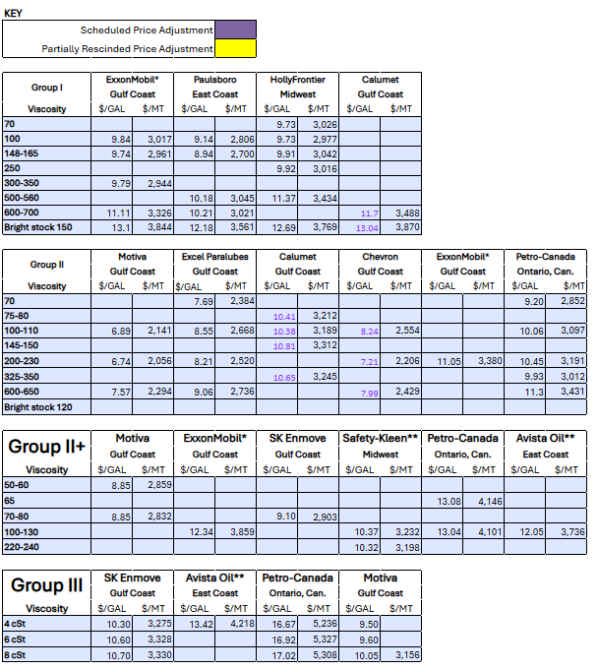
Calumet and Chevron joined several other base oil producers who communicated posted price increases in August. The markups were driven by a very tight supply and demand ratio along with firm crude oil and feedstock costs. With gasoline and diesel prices on the rise, refiners must also prop up base oil margins to justify streaming feedstocks into base oil production versus that of competing fuels. Negotiations between the United States and Iran have stalled and the Strait of Hormuz remained effectively closed to most vessel traffic, causing global base oil supplies to remain constrained. The Group III segment was particularly impacted by production outages and shipments that remained trapped in the Persian Gulf, while Houthi rebels’ attacks on tankers in the Red Sea caused additional crude oil and base oil disruptions. Some grades may see even more strained conditions as a European Group III plant was heard to have embarked on an unplanned turnaround affecting the 4 cSt grade this week.
Houthi militants’ attacks on tankers and ongoing turmoil affecting oil shipments from Saudi Arabia and the United Arab Emirates have pushed producers to establish larger oil reserves in Japan and South Korea as the regional conflict threatens supply routes, particularly those to Asian refineries, which rely heavily on Middle East crude slates. Saudi Arabia and UAE both have overland pipelines that bypass the Strait of Hormuz and enable them to continue exporting oil, but tankers were at risk of being attacked by Iran-backed Houthi rebels in the Red Sea.
Given that tensions in the key oil producing region were still running high, crude oil futures continued on an upward trek, with West Texas Intermediate hovering near $85 per barrel and Brent above $90/bbl on Tuesday. U.S. president Donald Trump said he was not willing to extend the memorandum of understanding that was signed on June 17 and that expired on Monday. Meanwhile, the UAE reported on Tuesday that Iran had launched two ballistic missiles toward the country — an ally of the U.S. — but the report was not confirmed by Iranian sources.
In downstream lubricant markets, independent manufacturers in the U.S. recently announced another round of lubricant price hikes to combat rising production costs stemming from the conflict in Iran, but these initiatives face strong resistance from buyers because previous attempts by blenders to raise finished product prices have yielded mixed results.
Group I and Group II
Calumet communicated a price increase for paraffinic oils, effective August 18. The producer’s Group I SN600 and bright stock will be raised by 35 cents/gal, and its Group II base oils will be going up by 50 cents/gal.
Chevron also announced a posted price increase for its Group II base oils, with the 100N and 600N cuts increasing 20 cents/gal and its 220N by 40 cents/gal, with an effective date of August 18.
Last week, ExxonMobil had announced a posted price increase of 24 cents per gallon on its Group I SN100, SN150 and SN330 base oils and 36 cents/gal on its Group I SN600 and bright stock. The refiner also raised the postings of its Group II EHC65 and Group II+ EHC45 base oils by 48 cents/gal on August 12.
HF Sinclair/Petro-Canada has also communicated posted price increases of 40 cents/gal on its Group II 100N, 200N, 350N and 650N grades, while the price of the 70N cut did not change. The company’s Group II+ grades increased by 40 cents/gal, and the Group III cuts by 50 cents/gal as of Aug. 14.
Healthy demand and tight availability continued to exert pressure on Group I and Group II prices, with allocations and sales controls reported to remain in place and producers unable to offer sizeable cargoes for spot business. These fundamentals have pushed spot prices up, but trading was subdued given the limited availability. European buying interest was somewhat subdued because of summer holidays but was expected to pick up in the coming weeks as producers replenish stocks.
Demand for U.S. exports from Mexico and Brazil was ongoing, although the restart of the Brazilian producer following a turnaround has allowed it to meet Group I contract commitments. However, Group II base oils were still strained in that country and prices have moved up. In Mexico, Group I and Group II prices continued to hover at steep levels in line with U.S. values that are supported by limited availability amid supply allocations.
Some cargoes were heard making their way from India to Brazil, and there have also been several offers from Asian suppliers into other Latin American destinations at competitive prices. Group II cuts were under pressure in Asia on sluggish demand and growing supplies and producers were therefore seeking export opportunities, with South Korean cargoes looking to move to the west coast of Mexico. A 4,000-metric-ton cargo was discussed for shipment from Mumbai, India, to Rio de Janeiro, Brazil, in the first half of September. A 3,000-ton lot was also quoted for shipment from Port Klang, Malaysia, to New Orleans, Louisiana, in the second half of August.
Blenders were also utilizing Group II cuts to replace Group III cuts in some formulations that allow substitution, which explained some of the additional buying appetite for Group II cuts. Rerefiners have few extra volumes to offer as they strive to meet term commitments and have reported sold-out positions for several weeks.
There may be further tightening of global supplies if attacks on Saudi refineries and vessels by Iran-backed Houthi rebels continue, as these might prevent Luberef — a Saudi Aramco subsidiary — from loading crude and Group I/Group II base oil cargoes from its ports on the Red Sea. The producer may be able to ship products out and traverse the Suez Canal instead of attempting to cross the Bab al-Mandab Strait, which is where some of the Houthi attacks have taken place, but this also means that shipments will take longer to arrive at destination.
Luberef was originally planning to start a shutdown at its Yanbu plant in August, but the refiner has postponed it to October. The company has been completing construction and integration activities at its Group II plant to produce Group III base oils, but plans to focus on Group II output for now given healthy margins.
In the U.S., Paulsboro is planning to take its Group I plant in New Jersey off-line for maintenance for five weeks in September and was expected to build inventories to cover contractual obligations during the outage. Petro-Canada has also scheduled a 30-day turnaround on its Group II unit in Mississauga, Canada, in the third quarter that may be tightening supplies further.
Another factor that participants were keeping in mind was that some refiners may be reducing base oil output to maximize diesel production, incentivized by high profit margins and low domestic supplies. Diesel and gasoline prices have been trading close to record premiums over crude oil. International diesel availability remains severely limited by trade sanctions on Russian energy exports and refinery disruptions, which are maintaining high fuel costs.
This week, Ukrainian drones struck a major refinery deep inside Russia, as Kyiv tries to choke Moscow’s revenue-generating oil sector. Ukraine’s General Staff reported that its forces had struck the Gazprom Neftekhim Salavat oil refining and petrochemical complex on Aug. 13, causing a fire at the facility. Russia is a major exporter of crude oil and diesel, but its ability to export diesel has plummeted to multi-year lows, while its crude oil export capacity remains largely intact but increasingly restricted.
Group II+/Group III
The Group III segment continues to feel the brunt of the base oil supply disruptions in the Persian Gulf as the region is one of the main suppliers of premium base oils. Global supplies have diminished considerably, and this situation may be exacerbated in the next few weeks by an unexpected shutdown at Repsol’s plant in Spain.
According to sources, Repsol informed customers about upcoming production issues affecting Yubase 4 availability from the company’s refinery during August, September, and October. The refinery will ostensibly undergo a scheduled shutdown, and the limited remaining stock will be reserved exclusively for Repsol Lubricants. As a result, the company will only be able to supply Yubase 2, Yubase 3 and Yubase 6 during this period. Yubase 4 availability was expected to be restored in November, subject to the successful restart of refinery operations. Repsol produces Group III base oils in Spain through ILBOC (Iberian Lube Base Oils Company), a joint venture with South Korea’s SK Enmove at the Cartagena Refinery in Murcia. The reduced availability was not expected to impact SK Enmove’s supplies in the U.S. An official confirmation from the producer was not available by the publishing deadline.
The extremely curtailed global availability of Group III cuts has sent prices to all-time highs. SK Enmove, Motiva, ExxonMobil, HF Sinclair/Petro-Canada and rerefiner Avista Oil have all implemented posted price increases over the last few weeks.
Last week, ExxonMobil announced increases of 48 cents/gal on its Group II EHC65 and Group II+ EHC45 base oils, effective August 12.
HF Sinclair/Petro-Canada communicated a price increase on its Group II+ grades of 40 cents/gal, and 50 cents/gal on its Group III base oils, effective August 14.
Spot supplies remain extremely difficult to locate, with those buyers anxious to secure extra volumes beyond those stipulated under contract seemingly willing to pay steep prices to obtain product, which was offered above $13 per gallon, even for volumes that lacked approvals. Some buyers were hesitant to accept current prices because it was not clear whether they would be able to offset the heftier values through lubricant increases, particularly as not all major suppliers have announced price hikes.
There were no changes to the force majeure that Penthol, the official distributor of ADNOC material in the U.S., was compelled to declare in late July as it was unable to resume shipments from the plant in Abu Dhabi. The supplier continued to monitor developments and communications from ADNOC and evaluating alternative supply arrangements and logistics to restore deliveries as soon as possible. Other suppliers maintained strict sales controls and allocations.
Group III base oils were expected to remain severely impacted by the supply constraints stemming from facility damage and shipping obstructions at three key Persian Gulf producers’ plants—ADNOC, BAPCO and Shell Qatar Pearl GTL, as these producers can only ship products through Hormuz.
Group III base oils of Asian origin remained extremely constrained and producers were mostly unable to offer spot supplies as they prioritized contractual obligations in the U.S. Some offers of Indian and Chinese Group III base oils have emerged, but these barrels do not carry the required approvals that many blenders need and were therefore only able to meet a limited number of inquiries.
Naphthenic Base Oils
Naphthenic base oil prices remained firm due to tight supply-demand balances and rising crude oil costs, with refiners maximizing production to leverage strong margins. While light-grade supplies faced strain from robust demand, heavy-viscosity oils experienced steady but inconsistent purchasing, all amid close monitoring of volatile Brent crude oil price fluctuations and geopolitical events.
Lubricant Increases
A majority of lubricant manufacturers have implemented price increases since the start of the Iran war to offset rising production costs over the last five months, with a fresh round announced by several independent manufacturers last week as crude prices were very volatile and base oil prices hovered at elevated levels. Some suppliers have been successful at achieving the full intended amounts given concerns of potential shortages due to recent and ongoing supply disruptions. A number of manufacturers have faced resistance, particularly as buyers were dealing with cash flow constraints and credit limitations against a backdrop of demand uncertainties in downstream markets.
Some manufacturers have already been forced to reduce output given difficulties in transferring the higher production costs down the supply chain, coupled with base oil shortages, particularly of Group III cuts. Several OEM dealers were understood to be facing serious challenges in fulfilling genuine motor oil demand given the current conditions.
Crude Oil
Crude oil futures settled at three-week highs on Tuesday after Iran said it would adopt a more offensive stance and the Strait of Hormuz would remain closed, while the U.S. refused to extend a ceasefire, according to Reuters.
- West Texas Intermediate September 2026 futures settled on the Nymex at $84.94 per barrel on August 18, up from $83.20 per barrel on Aug. 11.
- Brent September 2026 futures were trading on the ICE at $91.70/bbl on Aug. 19, up from $89.48/bbl on Aug. 12.
- Louisiana Light Sweet crude wholesale spot prices were hovering at $88.27/bbl on Aug. 17. Spot prices had settled at $85.71/bbl on Aug. 10, according to the U.S. Energy Information Administration.
Diesel
Low-sulfur diesel wholesale, Aug. 17 (Aug. 10), EIA
New York Harbor: $4.53 per gallon ($4.21/gal)
Gulf Coast: $4.40/gal ($4.15/gal)
Los Angeles: $4.53/gal ($4.33/gal)
Gabriela Wheeler can be reached directly at gabriela@LubesnGreases.com
LNG Publishing Co. Inc./Lubes’n’Greases shall not be liable for commercial decisions based on the contents of this report.
Posted Paraffinic Base Oil Prices: August 19, 2026 (Prices are FOB basis, in U.S. dollars per gallon and U.S. dollars per metric ton).
Archived base oil price reports can be found through this link: https://www.lubesngreases.com/category/base-stocks/other/base-oil-pricing-report/
Historic and current base oil pricing data are available for purchase in Excel format.
*ExxonMobil prices obtained indirectly.
**Rerefiner