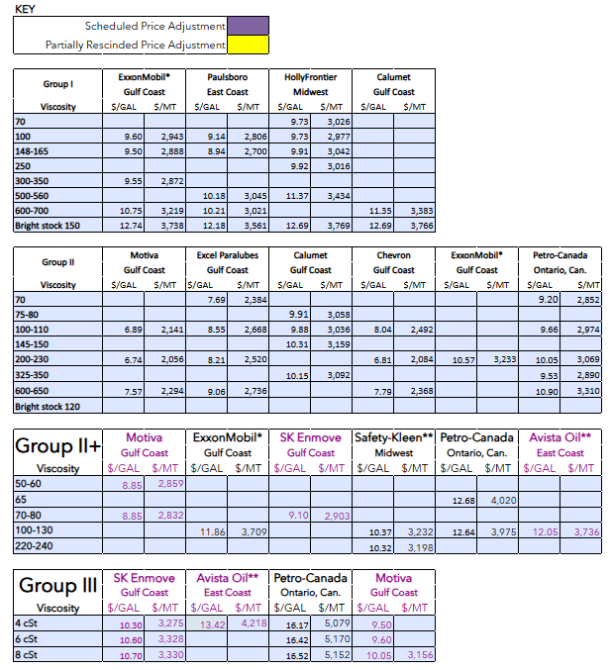
Motiva, SK Enmove and Avista Oil announced posted price increases, driven by tight global availability of Group II+ and Group III base oils and recent crude oil price spikes. SK and Chevron also announced new supply agreements with HF Sinclair. Last week, the company had communicated that it planned to retire its base oils plant in Canada by the end of 2027. Base oil prices remained exposed to upward pressure given robust demand and constrained domestic availability, with allocations and sales controls still largely in place and producers unable to offer significant volumes for spot transactions.
Much of the turmoil affecting global base oil markets is a consequence of the war between the United States and Iran, which started on February 28. Early on in the conflict, Iran closed the Strait of Hormuz to vessel traffic, trapping oil tankers in the Persian Gulf and blocking transit of oil tankers that carry crude oil and refined products from Middle East producers to the rest of the world. The closure had driven crude oil prices to historic highs, and while prices have fluctuated over the last five months, swayed by geopolitical developments, they continued to hover at elevated levels.
A temporary pause in military action between the U.S. and Iran occurred over the weekend as U.S. President Donald Trump embarked on negotiations to ease tensions and reopen the Strait of Hormuz. The diplomatic shift was strongly encouraged by Saudi Arabia’s Crown Prince Mohammed bin Salman. Despite this pause, maritime movements remained heavily restricted in the Middle East due to separate Houthi rebel attacks targeting vessels near the Bab el-Mandeb Strait. These Iran-backed militants are actively trying to block Saudi Arabian crude oil and refined product exports, keeping global energy markets highly volatile. Saudi Arabia’s national oil company, Saudi Aramco, had been shipping increased volumes of crude oil from its Red Sea port of Yanbu, helping ease the crude supply crunch felt after the closing of Hormuz.
Oil prices closed higher in late July, marking the largest monthly increase since March due to supply fears, but futures plunged over 5% on Monday following a canceled U.S. strike on Iran. West Texas Intermediate crude futures were hovering at around $75 per barrel on Tuesday, substantially down from their peak at $111.54/bbl peak on April 2, but up from the pre-war $65/bbl baseline.
While many U.S. refiners are insulated from Middle East supply disruptions because they run facilities on domestic crude oil or supplies from other origins, the potential curtailment of crude oil and refined products shipments from Saudi Arabia might affect several U.S. producers, and it could also impact the global base oil supply-demand balance as Saudi Arabia is a key exporter of Group I and Group II base oils. If countries such as India that routinely import Saudi base oils are unable to receive cargoes, then they would seek supplies from other sources, potentially tightening supplies in other regions and exerting upward pressure on pricing. In 2025, India remained the world’s largest importer of base oils, registering over 3 million metric tons in total annual import volume, with Saudi Arabia coming in as its fourth largest source.
The Group III base oil segment has already been severely impacted by the supply constraints from three key Persian Gulf producers — ADNOC, BAPCO and Shell Qatar Pearl GTL.
Last week, market participants had shared some concerns about future base oil supplies in North America as HF Sinclair communicated that it was retiring its Group II and Group III plant in Mississauga, Ontario, Canada, by the end of 2027. The Petro-Canada base oils plant in Mississauga has the capacity to produce 11,600 barrels per day of Group II base oils and 4,000 bbl/day of Group III base oils, according to Lubes’n’Greases’ Base Stock Plant Data.
However, this week, Chevron announced that the company had signed an agreement with HF Sinclair Lubricants and Specialties which will allow HF Sinclair to maintain supply to Petro-Canada customers. Chevron will be able to expand its North American base and process oils distribution network. According to a press release, HF Sinclair will become Chevron’s exclusive distributor of Group II base oils in Canada, and its existing customer territories in the U.S. HF Sinclair will also have non-exclusive distribution rights for Group II base oils in select additional regions of the U.S., effective May 1, 2027.
Chevron also signed an agreement with Renkert Oil. Renkert will continue as Chevron’s distributor for Paralux and Paramount process oils throughout the United States, Canada and Europe; Nexbase Group III base oils in the United States and Canada; and Chevron Group II base oils throughout the United States outside HF Sinclair Lubricants & Specialties’ exclusive territory. (For additional information, please see “Chevron Taps HF Sinclair, Renkert for Base Oil Distribution” in this issue of Lube Report Global).
Chevron will be bringing new capacity on stream at its Pascagoula, Mississippi, base oils plant by the end of the year, with Group III+ products expected to be commercially available in Q1 2027. The global Group III segment was likely to see tight supply as long as the war in Iran remains unresolved and the Strait of Hormuz does not reopen to all vessel traffic.
SK Enmove announced a strategic agreement with HF Sinclair as well. Under the agreement, SK Enmove will become the Group III base oil supplier to HF Sinclair’s Lubricants & Specialties segment, delivering premium base oils directly into its finished product lines under a multi-year arrangement.
The agreement also designates HF Sinclair as the exclusive distributor for SK Enmove’s Group III base oil, YUBASE, in its key regional markets in North America.
Group I and Group II
Group I and Group II domestic customers reported that there were no issues with contract volumes, even though the market remained tight and suppliers maintained allocations and sales controls. Buyers may be encountering problems when trying to find spot supplies, as most producers were in no position to offer extra barrels. Buyers and sellers also reported that they had been unable to build inventories to the same extent that they have in the past to cover potential supply disruptions during hurricane season. However, weather forecasts called for a milder hurricane season along the U.S. Atlantic Coast than in the previous years. Most storms occur in August and September, so refineries were still on high alert, but most averted damages from Tropical Storm Bertha–the first severe weather system to hit the Gulf Coast this year.
Participants were also keeping an eye on developments in the Middle East. Global Group I and Group II availability may experience further tightening if Luberef — a Saudi Aramco subsidiary — is unable to load crude and base oil cargoes from its ports on the Red Sea due to the threat of Houthi rebel attacks. Saudi base oils have been fulfilling a large number of requirements in the Middle East and Asia, with substantial volumes routinely moving to India and other key base oil markets.
Luberef was originally planning to start a shutdown at its Yanbu plant in August, but the refiner has postponed it to October. The company has been completing construction and integration activities at its Group II plant to produce Group III base oils, but plans to focus on Group II output for now given healthy margins. The company expects that the project will provide it with the flexibility to optimize production of Group II and Group III as needed, depending on market conditions and prices.
Recent and upcoming scheduled turnarounds at domestic plants and lower yields due to altered crude slates have also exacerbated the Group II/Group III supply situation in the U.S. Chevron’s Pascagoula, Mississippi, Group II/Group III plant reportedly started a turnaround in early June which was completed at the end of that month, and this may have impacted spot supply at the time. Paulsboro is planning to take its plant in New Jersey off-line for maintenance for five weeks in September and was expected to build inventories to cover contractual obligations during the outage. Petro-Canada has also scheduled a turnaround in the third quarter that may be tightening supplies even further.
Some refiners may be favoring fuel output as margins have been healthy and diesel stockpiles are dwindling, and they may be curtailing base oil production. International sanctions and production disruptions affecting Russian diesel have resulted in a global tightening of diesel supplies, which was expected to keep prices elevated. Some refiners were also dealing with reduced base oil yields given that they have been forced to alter their crude oil slates.
With spot supplies almost non-existent in the U.S., spot export business has been largely muted and prices continued to edge up. A number of Group II cargoes were expected to move to Europe, where prices were very attractive. There was still buying interest for U.S. base oils from Brazil and Mexico, with Mexican buyers heard to be able to get additional volumes under contract, but spot shipments to Brazil remained more constrained. Despite this situation, Group I availability has improved in Brazil because the local producer has completed a turnaround and has been able to meet contract commitments.
Group II barrels were anticipated to remain tight for some time as blenders use these grades to replace Group III cuts if formulations permit it. Rerefiners have also been in sold-out positions for several weeks as buyers seek additional volumes beyond those they receive under contract.
Group II+/Group III
There were few changes to supply conditions in the Group III segment—if anything, the situation has turned even more critical as no fresh cargoes have loaded on the Persian Gulf for months and transit through Hormuz remains well below pre-war levels. As a result, a vast majority of suppliers are keeping strict allocations and sales controls in place. Producers were mostly unable to offer additional volumes beyond those earmarked for contract commitments. A supplier was heard to have extended its 60 percent allocation. The ADNOC base oils distributor in the U.S., Penthol USA, also maintained its force majeure as it was unable to resume shipments from the plant in Abu Dhabi.
Meanwhile, in the U.S., Motiva communicated price increases of 50 cents per gallon on its Group II+ and Group III base oils, effective August 1.
SK Enmove also announced a posted price increase on its Group II+ and III base oils, effective August 3. The producer’s Group GII+ 70N edged up by 30 cents/gal; its Group III 4cSt by 50 cents/gal, and its Group III 6cSt and 8 cSt by 30 cents/gal.
Avista Refining and Trading communicated a posted price increase of 50 cents/gal on its Group II+ grade and $1.00/gal on its Group III base oil, which went into effect on July 31.
Even if the Strait of Hormuz were reopened to all traffic tomorrow, it would take some time for Group III shipments from the Persian Gulf to resume. Abu-Dhabi producer ADNOC had been ready to ramp up base oil operating rates at its plant in Ruwais in preparation for a resumption of export shipments following a June ceasefire, but these plans were suspended as vessels were unable to enter or leave the Persian Gulf. According to reports, ADNOC had been producing base oils at reduced rates following an Iranian attack on the Ruwais industrial complex on March 10 and was solely supplying its own downstream operations.
Penthol, ADNOC’s distributor in the U.S., said that the company was maintaining force majeure on shipments, but continued to monitor developments and communications from ADNOC and evaluating alternative supply arrangements and logistics to restore deliveries as soon as possible.
Another key facility in the Middle East was not expected to resume full output for some time. The Shell Qatar Pearl gas-to-liquids (GTL) plant in Qatar was anticipated to keep at least one train off-line for an extended period after damages sustained during Iranian drone attacks in March, with repairs likely to take several months to complete.
There was still no official update about the status of BAPCO’s Group III base oil plant in Bahrain, which had also been damaged during drone strikes and a fire on March 5. Sources indicated that base oil supply from BAPCO continued under force majeure.
Meanwhile, Asian producers continued to focus on meeting contractual obligations in the U.S., with strict sales controls and allocations in place, but they also tried to fulfill some spot requirements if inventories allowed. Offers of Indian and Chinese Group III base oils became available, but did not help meet the gap left by the absence of Middle East product as these barrels do not carry the required approvals that many blenders need.
One domestic Group III producer was reportedly operating its refinery at reduced production rates, a condition that could further tighten an already constrained supply environment. At the same time, most suppliers remained unable to accommodate the steady influx of additional spot demand. Rerefined base oils have played an increasingly important role in bridging the supply gap left by virgin base oil producers, with rerefiners indicating that their available volumes are now fully committed.
Naphthenic Base Oils
Naphthenic prices were stable, and producers were closely monitoring crude oil prices—Brent, in particular–which remained highly volatile. Producers indicated that they would consider adjustments once crude prices were maintained at a certain level for an extended period of time, which seemed unlikely given continuous geopolitical tensions pulling crude oil prices in different directions.
Supply and demand of pale oils was balanced-to-tight, with availability of the light naphthenic base oils slightly strained given robust consumption from the transformer oil and metalworking segments. The heavy-viscosity pale oils saw steady demand from the rubber and tire segment.
Lubricant Increases
A majority of lubricant manufacturers have implemented price increases since the start of the Iran war to offset rising production costs over the last five months. With crude prices remaining very volatile and base oil prices hovering at elevated levels, some blenders have attempted the implementation of additional increases in recent weeks. Some suppliers have been successful at achieving the full intended amounts given concerns of potential shortages due to recent and ongoing supply disruptions. A number of manufacturers have faced resistance, particularly as buyers were dealing with cash flow constraints and credit limitations against a backdrop of demand uncertainties in downstream markets.
Independent lubricant manufacturers were facing competition from major manufacturers, who have started to reduce finished lubricant prices. Smaller blenders were largely unable to offset the sky-high base oil costs if they decreased lubricant prices, and may have to reduce output if price pressure from steep raw material prices does not let up soon.
Some manufacturers have already been forced to reduce output given difficulties in transfering the higher production costs down the supply chain, coupled with base oil shortages, particularly of Group III cuts. Several OEM dealers were understood to be dealing with serious challenges in fulfilling genuine motor oil demand given the current conditions.
Crude Oil
Crude oil futures fell early in the week on renewed optimism that a potential U.S.-Iran draft agreement might be reached over the next few days. President Trump also criticized U.S. oil companies keeping fuel prices high and achieving significant profits. But uncertainties lingered because Trump said Iran would be “hit very hard’ if Hormuz Strait does not open soon,” as vessel traffic remained largely blocked by Iran.
- West Texas Intermediate September 2026 futures settled on the Nymex at $75.77 per barrel on August 4, down from $79.26 per barrel on July 28.
- Brent September 2026 futures were trading on the ICE at $90.12/bbl on Aug. 5, up from $87.70/bbl on July 29.
- Louisiana Light Sweet crude wholesale spot prices were hovering at $83.66/bbl on Aug. 3. Spot prices had settled at $86.50/bbl on July 27, according to the U.S. Energy Information Administration.
Diesel
Low-sulfur diesel wholesale, Aug. 3 (July 27), EIA
New York Harbor: $3.90 per gallon ($4.10/gal)
Gulf Coast: $3.87/gal ($4.11/gal)
Los Angeles: $4.01/gal ($4.24/gal)
Gabriela Wheeler can be reached directly at gabriela@LubesnGreases.com
LNG Publishing Co. Inc./Lubes’n’Greases shall not be liable for commercial decisions based on the contents of this report.
Posted Paraffinic Base Oil Prices August 5, 2026 (Prices are FOB basis, in U.S. dollars per gallon and U.S. dollars per metric ton).
Archived base oil price reports can be found through this link: https://www.lubesngreases.com/category/base-stocks/other/base-oil-pricing-report/
Historic and current base oil pricing data are available for purchase in Excel format.
*ExxonMobil prices obtained indirectly.
**Rerefiner