Market attention partly turned to events happening closer to home than the Middle East conflict this week, as a tropical storm threatened to disrupt refinery operations along the United States Gulf Coast, a North American Group II/Group III producer announced that production would be permanently halted next year, refiners were prioritizing diesel production over base oils, and Group III supply shortages along with soaring prices continued to afflict many lubricant manufacturers. Needless to say, the U.S.-Iran war was still on everyone’s radar, but a pause in hostilities and fresh peace discussions over the weekend provided renewed hope to industry participants concerned about the current turmoil surrounding crude oil and base oil supplies.
According to sources, most Gulf Coast refineries were unaffected by Tropical Storm Bertha, which first made landfall in southern Louisiana on Wednesday, July 22. The exception may have been Phillips 66’s Sweeny refinery in Texas, which suffered a malfunction because of a lightning strike as the remnants of the storm passed near Houston on Thursday night. Market participants explained that most refiners are well-prepared and have contingency plans in place given the typical threat of severe weather along the Atlantic Gulf Coast during hurricane season. Both buyers and sellers typically maintain extra inventories in case of production disruptions from June until November–a plan that has been slightly complicated by the tight supply situation affecting most base oil categories.
In recent months, the API Group III segment has been particularly affected by a critical supply crunch because of the war in Iran and the closing of the Strait of Hormuz. This week, participants expressed some concern about future supply as HF Sinclair communicated that it was closing its Group II and Group III plant in Canada next year. In a company press release, HF Sinclair announced plans to “pursue a separation of its lubricants and specialties segment through the capital markets, creating a new independent, publicly traded company.”
As part of its transformation, HF Sinclair will also retire its base oil refining assets in Mississauga, Ontario, with the transition expected to be completed in 2027. The Petro-Canada base oils plant in Mississauga has the capacity to produce 11,600 barrels per day of Group II base oils and 4,000 bbl/day of Group III base oils, according to Lubes’n’Greases’ Base Stock Plant Data. Without providing company names, HF Sinclair said it plans to continue delivering base oil solutions “through new strategic commercial agreements with two premier global base oil manufacturers,” and will have access to Group I and specialty products from HF Sinclair’s Tulsa, Oklahoma, refinery.
There have been expectations that additional Group III production would be coming on stream before the end of the year as Chevron plans to bring new Group III+ capacity online in Q4 2026, but commercial product was not anticipated to be available until Q1 2027. The Group III segment was likely to see tight supply as long as the war in Iran remains unresolved and the Strait of Hormuz does not reopen to all vessel traffic.
Meanwhile, U.S. president Donald Trump said Washington was engaged in “very friendly negotiations” with Iran after both countries paused military attacks last week, fanning hopes that the conflict could be resolved through diplomatic channels. The two countries are currently engaged in indirect, Oman-mediated negotiations, with a focus on de-escalation, maritime security, and restoring commercial shipping through the Strait of Hormuz, and both sides signaling cautious optimism while maintaining significant disagreements over security guarantees and the future management of the key waterway. However, both governments have warned that military action could resume if talks fail.
The Strait of Hormuz, through which roughly one-fifth of the world’s seaborne oil and liquefied natural gas normally transits, remains only partially operational. Commercial traffic has resumed on a limited basis but remains well below normal levels because of continued security risks, insurance costs, and uncertainty over navigation arrangements. Oman announced a new shipping corridor through the strait that it said had been coordinated with the International Maritime Organization and supported by the U.S., but Iran claimed that this violated the memorandum of understanding signed on June 17, according to media reports.
Maritime logistics in the Middle East have been further complicated by a naval blockade of the Bab el-Mandeb Strait — a key passageway that connects the Red Sea to the Gulf of Aden and the Indian Ocean — by Iran-backed, Yemen-based Houthi rebels. Asian refiners were heard to be considering the Suez Canal to move Saudi oil amid the Houthi shipping threats. Saudi Arabia’s national oil company, Saudi Aramco, had been shipping increased volumes of crude oil from its Red Sea port of Yanbu, somewhat easing the crude supply crunch felt in global markets after the closing of Hormuz.
On Tuesday, tensions escalated once again as Iran launched a surprise attack with ballistic missiles aimed at U.S. forces in the region, which were intercepted by the U.S. military, with oil prices jumping again amid the renewed Middle East tensions.
West Texas Intermediate futures shot up by 4% to over $82 per barrel on Tuesday evening, with Brent futures climbing to around $87/bbl. Meanwhile, the U.S. Strategic Petroleum Reserve has fallen to its lowest level since March 1983.
Group I and Group II
Group I and Group II supplies remained tight in the U.S. despite the fact that domestic refinery operations had not been as impacted as those in Asia by the Middle East oil supply crisis. However, several refiners were prioritizing diesel production over that of base oils, despite base oils offering more attractive margins, as diesel inventories were extremely low. International sanctions and production disruptions affecting Russian diesel have resulted in a global tightening of diesel supplies. Some refiners were also dealing with reduced base oil yields given that they have been forced to alter their crude oil slates.
Global Group I and Group II availability may experience a further tightening if Luberef — a Saudi Aramco subsidiary — is unable to load crude and base oil cargoes from its ports on the Red Sea due to the threat of Houthi rebel attacks. Saudi base oils have been fulfilling a large number of requirements in the Middle East and Asia.
Base oil demand experienced an uptick in the U.S. as participants worried that a prolonged conflict would continue to reduce global base oil supplies, keeping prices at elevated levels. Some buyers have been able to secure additional cargoes. However, a majority of U.S. producers maintained strict sales controls and allocations and were not in a position of offer large volumes for spot business, which drove spot prices to steeper levels. Climbing crude oil futures after a surprise Iranian attack on U.S. forces also exerted upward pressure on base oil price indications.
Group II availability of the light grades was also expected to remain tight as consumers utilize these grades to replace Group III cuts whenever formulations allow.
Recent and upcoming scheduled turnarounds and lower yields due to altered crude slates have exacerbated the Group II/Group III supply situation in the U.S. Chevron’s Pascagoula, Mississippi, Group II/Group III plant reportedly started a turnaround in early June which was completed at the end of June, and this may have impacted spot supply at that time. A Group I refiner is planning to take its plant off-line for maintenance for five weeks in September and was building inventories to cover contractual obligations during the outage. A Group II producer has also scheduled a turnaround in the third quarter that may be tightening supplies even further.
Traders had reportedly hoped to ship base oils from India and other origins in Asia to the U.S and Latin America, and even though a few transactions appeared to have been concluded, logistics were complicated and freight rates were very high, making prices less competitive than originally expected. In shipping circles, an 8,000-10,000-ton cargo was being discussed for prompt shipment from South Korea to the U.S. Gulf Coast.
Export opportunities to Europe persist but have dwindled slightly as many European players are on holiday this month and the next. There was also ongoing buying interest in U.S. Group II supplies from Brazil, but availability was minimal, driving prices up. However, lubricant demand in Brazil has declined and blenders were more hesitant to secure base oils at all costs. They were also eyeing opportunities to acquire Asian Group II base oils, which were offered at competitive levels but also faced logistical and transportation challenges.
Similarly, prices in Mexico were exposed to upward pressure due to the limited export supplies that U.S. producers were able to offer, with buyers therefore also eager to explore the option of importing base oils from South Korea or India.
Group III
While a few vessels appeared to have been able to transit the Strait of Hormuz, a majority of tanker traffic remained halted, trapping vessels and cargoes in the Persian Gulf. Producers in Qatar, Abu Dhabi and Bahrain had been expected to restart operations and export shipments once the Strait had been reopened, but hopes were dashed when renewed hostilities between the U.S. and Iran emerged and breached the MoU signed on June 17. With base oil shipments unable to be shipped out of ports in the Persian Gulf, almost a fifth of the world’s Group III supplies have been taken out of the market.
Abu-Dhabi producer Adnoc had been expected to ramp up base oil operating rates at its plant in Ruwais in preparation for a resumption of export shipments following the June ceasefire, but these plans appeared to have been scrapped as vessels were largely unable to load at Persian Gulf ports. According to reports, Adnoc had been producing base oils at reduced rates following an Iranian attack on the Ruwais industrial complex on March 10 and was solely supplying its own downstream operations.
The U.S. distributor of Adnoc’s base oils, Penthol, declared force majeure on July 15 on contract commitments for an indeterminate period because the company is unable to ship product out of the UAE. Penthol said the disruptions in the Middle East had resulted in the suspension of AD base oil supply from Adnoc, and this had affected its ability to meet contractual obligations, adding that transportation issues, unplanned outages, equipment failures, power disruptions, government actions, war-related events and reduced or unavailable supply had caused the FM declaration. Penthol also said that the company was monitoring developments and communications from Adnoc and evaluating alternative supply arrangements and logistics to restore deliveries as soon as possible.
Another key facility in the Middle East was not expected to resume full output for some time. The Shell Qatar Pearl gas-to-liquids plant in Qatar was anticipated to keep at least one train off-line for an extended period after damages sustained during Iranian drone attacks in March, with repairs likely to take several months to complete. The supplier was heard to be seeking additional base oil barrels from other producers to meet some of its contractual obligations in the U.S. and Mexico.
There was still no official update about the status of Bapco’s Group III base oil plant in Bahrain, which had also been damaged during drone strikes and a fire on March 5. Sources indicated that base oil supply from Bapco continued under force majeure.
Meanwhile, Asian producers tried to meet as many spot requirements as possible, but supplies were very strained and the suppliers were focusing on meeting contractual obligations, with strict sales controls and allocations in place.
One domestic Group III producer was reportedly operating its refinery at reduced production rates, a situation that could further tighten an already constrained supply environment. At the same time, most suppliers remained unable to accommodate the steady influx of additional spot demand. Rerefined base oils have played an increasingly important role in bridging the supply gap left by virgin base oil producers, with rerefiners indicating that their available volumes are now fully committed.
Naphthenic Base Oils
Naphthenic prices were largely unchanged, but recent spikes in crude oil prices were exerting upward pressure on values and discouraging suppliers from offering discounts when oil prices slipped. Producers indicated that they would consider adjustments once crude prices were maintained at a certain level for an extended period of time — a situation that was not likely to occur if the Middle East tensions continued, making crude oil prices more volatile.
Most suppliers described the situation as balanced-to-tight, because availability of light naphthenic base oils was more strained, with a producer heard to be consistently sold out of pale 40, 60 and 100 grades given strong demand from the transformer oil and metalworking segments. Consumption of pale oils had also seen an uptick because blenders were using some of these cuts to replace paraffinic oils given current supply constraints and steep prices, although naphthenic suppliers did not encourage this strategy. The heavy-viscosity pale oils were slightly more available but were by no means overflowing, sources said.
Lubricant Increases
Independent lubricant manufacturers were facing competition from major manufacturers, who have started to reduce finished lubricant prices. Smaller blenders were largely unable to offset the sky-high base oil costs if they decreased lubricant prices and may have to reduce output if price pressure from steep raw material prices does not let up soon.
A majority of lubricant manufacturers have implemented price increases since the start of the Iran war to offset rising production costs over the last four months. Some suppliers have been successful at achieving the full intended amounts given concerns of potential shortages due to recent and ongoing supply disruptions. Some manufacturers have faced resistance, particularly as buyers were dealing with cash flow constraints and credit limitations against a backdrop of demand uncertainties in downstream markets.
Lubricant manufacturers have announced three rounds of increases, with effective dates peppered between April and the end of May. The markups have been driven by the mounting costs of base oils, additives, packaging and transportation over the last two months. Participants underscored that given current uncertainties and the fast pace of market changes — not to mention the escalating production costs — it remained very challenging to plan inventories and make pricing decisions.
Among the manufacturers that have announced various lubricant, grease and finished products increases were TotalEnergies USA, Highline Warren, Martin Lubricants, Omni Specialty Packaging, AOCUSA/Amalie, Calumet, CAM2, Castrol, Shell/SOPUS, PennStar, Chevron, ExxonMobil, Citgo, Phillips 66, Reliance Fluid Technologies, Consolidated Brands/ZXP Technologies and Valvoline. During the first two rounds of increases, suppliers had announced lubricant and grease increases of up to 9% to 35%, depending on the product, with some lubricant increases ranging 48 cents per gallon to $5/gal, and $0.07-0.11/lb for greases. The third round called for increases of up to 26% for most products from one supplier, and markups of $3.00/gal-$3.70/gal for synthetic oils, $2.40/gal-$2.60/gal for other oils, and $0.25/lb-$0.29/lb for greases from the rest of the suppliers.
Some manufacturers have already been forced to reduce output given difficulties in transfering the higher production costs down the supply chain, coupled with base oil shortages, particularly of Group III cuts. Several OEM dealers were understood to be bracing for difficulties in fulfilling genuine motor oil demand given the current conditions. Dealers and distributors of a number of major automotive manufacturers received notifications of temporary motor oil supply shortages “due to production and logistics constraints within the global petrochemical supply chain,” one letter read.
Even if the Strait of Hormuz was reopened tomorrow, the repercussions of the current supply disruptions were expected to be felt until next year. Some small blenders were considering closing their doors because of financial difficulties and credit limitations to purchase raw materials to keep operations running.
Crude Oil
Crude oil futures climbed by more than $2 per barrel in early trade on Wednesday on plummeting U.S. crude inventories, reversing some of the previous session’s losses following a pause in fighting between the U.S. and Iran. A surprise attack by Iran on U.S. forces in the Middle East that was intercepted also fueled the price jump.
- West Texas Intermediate September 2026 futures settled on the Nymex at $79.26 per barrel on July 28, down from $84.34 per barrel on July 21, but substantially higher than $70.44/bbl for front-month futures on July 7.
- Brent August 2026 futures were trading on the ICE at $87.70/bbl on July 29, down from $92.32/bbl on July 22, but up from $76.04/bbl for front-month futures on July 8.
- Louisiana Light Sweet crude wholesale spot prices were hovering at $86.50/bbl on July 27. Spot prices had settled at $86.88/bbl on July 20, according to the U.S. Energy Information Administration.
Diesel
Low-sulfur diesel wholesale, July 27 (July 20), EIA
New York Harbor: $4.10 per gallon ($4.12/gal)
Gulf Coast: $4.11/gal ($4.04/gal)
Los Angeles: $4.24/gal ($4.28/gal)
Gabriela Wheeler can be reached directly at gabriela@LubesnGreases.com
LNG Publishing Co. Inc./Lubes’n’Greases shall not be liable for commercial decisions based on the contents of this report.
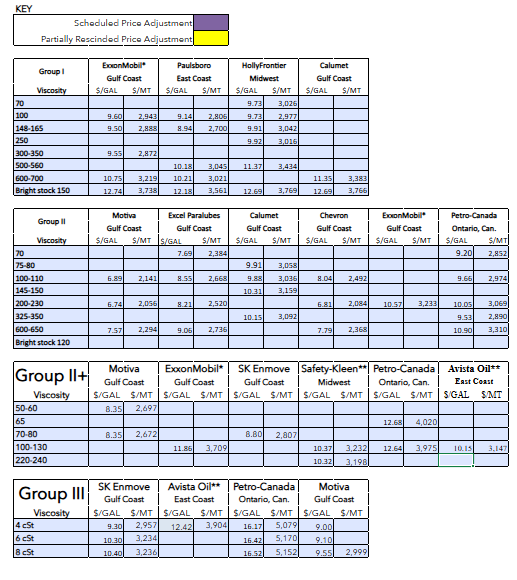
Posted Paraffinic Base Oil Prices July 29, 2026 (Prices are FOB basis, in U.S. dollars per gallon and U.S. dollars per metric ton).
Archived base oil price reports can be found through this link: https://www.lubesngreases.com/category/base-stocks/other/base-oil-pricing-report/
Historic and current base oil pricing data are available for purchase in Excel format.
*ExxonMobil prices obtained indirectly.
**Rerefiner