With the Strait of Hormuz once again effectively closed to vessel traffic, the chances that fresh crude oil and base oil shipments would be able to leave production sites in the Persian Gulf turned more remote. Crude oil prices jumped to four-week highs and exerted pressure on base oil values. Most base oil segments were described as tight, with the API Group III category showing critical shortages, which catapulted global prices sky-high. In the United States, SK Enmove announced posted price increases, while in Europe and Asia, prices continued their relentless ascent.
Following Iranian strikes on three vessels that were transiting the strait last week, the U.S. retaliated with attacks on Iranian targets and a naval blockade of the passageway. Iran reported that it had struck a United Arab Emirates-registered oil tanker, killing a crew member. On Tuesday, U.S. president Donald Trump reversed his plan to start charging a protection fee for vessels crossing the strait. With hostilities between both countries intensifying over the last few days, a prompt resolution to the conflict seemed increasingly less likely. Crude oil prices reacted to the uncertainties surrounding a reopening of the crucial stretch of water, with West Texas Intermediate futures rising from around $70 per barrel to above $79/bbl, and Brent futures advancing to over $85/bbl from $76/bbl a week ago.
Middle East producers had begun preparations to restart crude oil and refined products output following a memorandum of understanding between the U.S. and Iran on June 17, but with no vessels being allowed to cross the strait, many tankers remained trapped in the Persian Gulf and producers were therefore unable to resume exports.
Reports had circulated that Adnoc had ramped up API Group II and Group III production in Abu Dhabi in late June, hoping that export shipments would resume shortly, but another key facility in the Middle East was not expected to resume full output for some time. The Shell Qatar Pearl gas-to-liquids (GTL) plant in Qatar was anticipated to keep at least one train off-line for an extended period after damages sustained during Iranian drone attacks in March, with repairs likely to take several months to complete. This was likely to keep Group III supplies extremely snug until next year, sources commented, while Group II availability would also remain tight as consumers utilized these grades instead of Group III cuts whenever formulations allowed for substitution.
Availability in the Group I and Group II segments was also strained in the U.S. despite domestic refinery operations had not been as impacted as those in Asia by the Middle East oil supply crisis. However, U.S. producers continued to implement strict sales controls and allocations and offered very little in terms of spot volumes, keeping spot prices at elevated levels.
Group I and Group II
While there has been a slight improvement in Group I and Group II supply volumes in the U.S. compared to levels in April and May, suppliers said the uptick had been minimal and “not anything needle-moving,” as one source described it. Another source mentioned receiving “multiple calls” from consumers looking for extra base oil barrels as contractual volumes have been limited and most producers continued to focus on contract supplies, keeping strict allocations in place.
Even if extra supplies became available, producers were careful about maintaining stocks to be able to meet contractual obligations and build reasonable inventories to cover potential supply disruptions caused by severe weather during the hurricane season. Unlike last year, when an increased number of storms had been forecast, this year, forecasters with NOAA’s National Weather Service were predicting a below-normal hurricane season for the Atlantic basin.
While there have been export opportunities opening up, a majority of producers were in no position to ship substantial volumes overseas. Some of the buying appetite in Latin America was expected to be quenched by products from Asia, where the tight supply and demand fundamentals have started to ease as refiners have increased operating rates and demand has declined. However, limited vessel space and steep freight rates were rather daunting. “I have heard logistics from that region are a nightmare,” a source emphasized.
Nevertheless, at least a couple of cargoes were quoted in shipping circles to move from South Asia to South America, with a 2,500-metric-ton cargo mentioned for shipment from West Coast India to East Coast South America between July 7-17, and a second 5,000-7,000-ton lot expected to be lifted from West Coast India to Brazil between July 10-17.
As has been the case over the last several weeks, the Group I cuts were still tight in the U.S., with bright stock particularly difficult to obtain. The Group II light grades have also tightened because some blenders were using them to replace the light Group III cuts in some applications as Group III cuts have been extremely scarce.
Lower crude oil prices over the previous weeks following a ceasefire had taken some pressure off of prices, but an inflamed exchange of attacks between the U.S. and Iran has driven crude futures up again. Steep feedstock values and other rising production costs had prompted blenders to increase lubricant and finished product prices as well. But some blenders have faced challenges when trying to offset the steep base oil values, and demand in some segments has started to decline. A few base oil buyers had attempted to attain base stock price decreases given lower crude oil values, but oil futures have inched up again.
While many U.S. refiners had not been impacted by the Middle East oil supply deficits stemming from the closure of the Strait of Hormuz as many refineries can run on domestic crudes, experts warned that national strategic emergency crude stocks were nearing critical levels. Furthermore, many domestic refiners also import heavier Middle Eastern grades to maintain optimal margins for producing heavy fuels like diesel and jet fuel, as well as for base oil production. These refiners will continue to be impacted by the closure of the strait. A U.S. Group I refiner was heard to have encountered some challenges as it has started to run on a new crude slate. In Europe, jet fuel levels were “paper thin,” according to market participants, and the serious problem airlines were facing will be prolonged if the conflict in the Middle East is not resolved.
Recent and ongoing scheduled turnarounds have exacerbated the Group II/Group III tight supply situation in the U.S. Chevron’s Pascagoula, Mississippi, Group II/Group III plant was expected to have started a turnaround in early June which was completed at the end of June, and this may have impacted spot supply further. No confirmation was available from Chevron as the producer does not comment on its plant operations.
Buying interest for Group I cuts from Brazil was steady as availability of these cuts has tightened in that country because of a production outage at Brazilian producer Petrobras’ plant earlier this year, coupled with a planned turnaround that started in mid-June. Domestic prices have edged up in tandem with international prices and in response to limited availability.
In Mexico, there had been hopes that mounting availability of Asian spot cargoes would translate into attractive options for imports. However, difficulties in securing vessels along with steep freight rates proved to be a major obstacle. Buyers were looking for heavy-vis grades and bright stock, but spot supplies were minimal in the U.S. and prices have increased significantly. Some buyers have postponed orders hoping that availability levels would improve, but the ongoing Middle East conflict will likely continue to disrupt global energy and base oil markets.
Group III
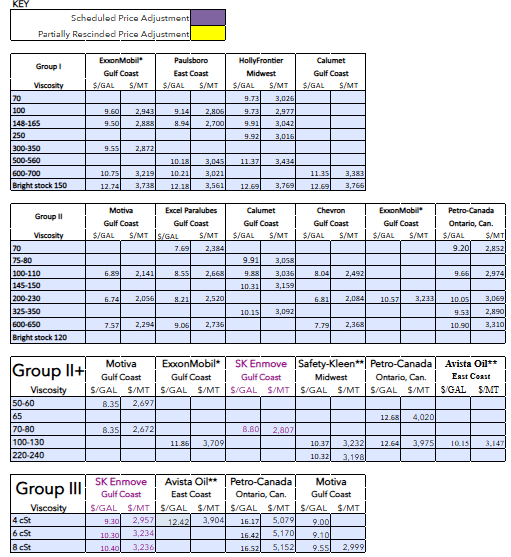
SK Enmove communicated a posted price increase for its Group II+ and Group III base oils of 50 cents per gallon, with an effective date of July 15, driven by the severe supply shortages noted for Group III base oils in most regions amid volatile crude oil prices. A majority of producers in the Americas, Asia and Europe who are running Group III plants are unable to offer substantial spot cargoes. The supply shortages were impacting manufacturers that supply lubricants to the automotive industry in particular.
Group III supply levels in Asia have improved because refiners have been able to obtain crude oil from sources outside the Middle East to run their plants, and demand has weakened as price levels were deemed unsustainable for many consumers. Asian suppliers have been trying to export any extra barrels to meet demand in the Americas and Europe, where prices keep inching up, but spot volumes were not significant. The lack of Middle East supplies, which meet close to half of Group III demand in the U.S., has become even more critical over the last couple of weeks as existing inventories at different destinations have been depleted and fresh shipments were not likely to arrive for several weeks. Middle East suppliers had so far been able to fulfill some contract commitments by shipping product kept in storage, but stocks have run out.
Before the hostilities between the Iran and the U.S. were reignited last week, ADNOC’s distributor in the U.S. was heard to have been preparing a Group III base oils shipment from Abu Dhabi. Even if the Strait of Hormuz had been open to all vessels, the first shipment of ADNOC material would not have reached the U.S. until the end of August. The distributor had been able to meet contractual commitments by restricting volumes and shipping from storage at different locations, but this material was expected to have been depleted.
Sources said that ADNOC had started to ramp up base oil production at its refinery in Abu Dhabi as soon as the memorandum of understanding and a 60-day ceasefire had been announced in late June. The producer had reportedly been running its plant at reduced rates for its downstream production of lubricants, and it may take some time for the producer to build inventories and for regular export shipments to resume.
Another key facility in the Middle East was not expected to resume full output for some time. The Shell Qatar Pearl gas-to-liquids (GTL) plant in Qatar was anticipated to keep at least one train off-line for an extended period after damages sustained during Iranian drone attacks in March, with repairs likely to take several months to complete. The supplier was heard to be seeking additional base oil barrels from other producers to meet some of its contractual obligations in the U.S. and Mexico.
There was still no official update about the status of BAPCO’s Group III base oil plant in Bahrain, which had also been damaged during drone strikes and a fire on March 5. Sources had indicated that BAPCO operations remained suspended. The March attack had forced the producer to shut down and declare force majeure on its group operations, although the company confirmed that domestic supplies remained fully secured under pre-established contingency plans. At the time, sources familiar with the plant’s operations had said that Group III production had been unaffected by the fire, but some reports indicated that production had stopped temporarily for damage assessments. Other sources agreed that base oil supply from BAPCO continued under force majeure.
South Korean and North American producers continued to supply contractual volumes, but allocations were in place and spot supplies were limited. To make matters worse, a domestic Group III refiner was understood to be running its plant at reduced rates. Suppliers noted that they continued to receive requests for additional supplies from buyers who are not regular customers and were impacted by supply shortages, but most sellers were largely unable to meet the extra requirements. Rerefiners have also been actively filling the gap left by the lack of virgin base oils in this segment of the market, but they reported being largely sold out as well.
Naphthenic Base Oils
Naphthenic suppliers kept a watchful eye on Brent crude oil prices as these have a direct impact on refinery economics, and oil prices had shown large swings after renewed hostilities between the U.S. and Iran. While a number of naphthenic price increases had been implemented since the start of the Iran war, no official announcements were communicated this week. Some customers have seen price decreases given their contracts are indexed against crude and diesel prices, and values have softened in recent weeks.
Most suppliers reported balanced-to-tight supply and demand conditions, depending on the grade and the supplier. Availability of light naphthenic base oils was generally more limited, with a producer heard to be sold out of the pale 40, 60 and 100 grades due to robust demand from the transformer oil segment. Suppliers also reiterated that consumption of pale oils had increased because blenders tried to replace paraffinic cuts with naphthenic base oils in certain applications given supply constraints and steep prices in the paraffinic segment. This situation was also providing additional support to naphthenic values.
Lubricant Increases
Independent lubricant manufacturers were facing competition from major manufacturers, who have started to reduce finished lubricant prices. Smaller blenders were largely unable to offset the sky-high base oil costs if they decreased lubricant prices and may have to reduce output if price pressure from steep raw material prices does not let up soon.
A majority of lubricant manufacturers have implemented price increases since the start of the Iran war to offset rising production costs over the last four months. Some suppliers have been successful at achieving the full intended amounts given concerns of potential shortages due to recent and ongoing supply disruptions. Some manufacturers have faced resistance, particularly as buyers were dealing with cash flow constraints and credit limitations against a backdrop of demand uncertainties in downstream markets.
Lubricant manufacturers have announced three rounds of increases, with effective dates peppered between April and the end of May. The markups have been driven by the mounting costs of base oils, additives, packaging and transportation over the last two months. Participants underscored that given current uncertainties and the fast pace of market changes—not to mention the escalating production costs–it remained very challenging to plan inventories and make pricing decisions.
Among the manufacturers that have announced various lubricant, grease and finished products increases were TotalEnergies USA, Highline Warren, Martin Lubricants, Omni Specialty Packaging, AOCUSA/Amalie, Calumet, CAM2, Castrol, Shell/SOPUS, PennStar, Chevron, ExxonMobil, Citgo, Phillips 66, Reliance Fluid Technologies, Consolidated Brands/ZXP Technologies and Valvoline. During the first two rounds of increases, suppliers had announced lubricant and grease increases of up to 9% to 35%, depending on the product, with some lubricant increases ranging 48 cents per gallon to $5/gal, and $0.07-0.11/lb for greases. The third round called for increases of up to 26% for most products from one supplier, and markups of $3.00/gal-$3.70/gal for synthetic oils, $2.40/gal-$2.60/gal for other oils, and $0.25/lb-$0.29/lb for greases from the rest of the suppliers.
Some manufacturers have already been forced to reduce output given difficulties in transfering the higher production costs down the supply chain, coupled with base oil shortages, particularly of Group III cuts. Several OEM dealers were understood to be bracing for difficulties in fulfilling genuine motor oil demand given the current conditions. Dealers and distributors of a number of major automotive manufacturers received notifications of temporary motor oil supply shortages “due to production and logistics constraints within the global petrochemical supply chain,” one letter read. Even if the Strait of Hormuz were reopened tomorrow, the repercussions of the current supply disruptions were expected to be felt until next year. Some small blenders were considering closing their doors because of financial difficulties and credit limitations to purchase raw materials to keep operations running.
Middle East Base Oil Capacity Shutdowns
According to reports, Shell/Qatar Petroleum has halted production at one train of its Pearl GTL Group II/Group III facility in Qatar after sustaining damage during Iranian aerial attacks on March 19. The plant, which can produce 300,000 metric tons of Group II and 1.07 million tons of Group III base oils per year, was expected to remain offline for an extended period, possibly one year or longer as the specially designed equipment at the plant may be difficult to repair and may need to be replaced, according to sources. The explosion at a gas production unit in Ras Laffan Industrial City on June 21 has reportedly not impacted production at the QatarEnergy LNG refinery or the Shell Qatar Pearl unit, although QatarEnergy shut production down as a precautionary measure and has warned customers of a delay in LNG shipments. QatarEnergy supplies feedstocks to the Pearl GTL unit.
Abu Dhabi state oil giant Adnoc shut part of its Ruwais refinery complex in response to a fire that broke out on March 10, following a drone strike. Sources indicated that while the Ruwais West refinery was shut down for inspection and safety reasons at that time, other operations within the massive complex continued at reduced capacity. The trimmed base oil output was utilized for the company’s downstream lubricant production. The Ruwais complex houses a 600,000 metric-tons-per-year Group II and Group III plant. According to reports, ADNOC was expected to ramp up base oil production once the Strait of Hormuz reopened and export shipments are able leave the Persian Gulf.
In Bahrain, fire erupted at Bapco’s refinery in Maameer on March 5 following an Iranian attack, forcing the refinery to declare force majeure on production. The company operates a 400,000 tons-per-year Group III base oil facility in Sitra, within the Bapco refinery complex. BAPCO originally indicated that base oil production had been unaffected, but it was later heard that the producer had trimmed supply levels. There was no update from the producer by the publishing deadline.
Crude Oil
Crude oil futures soared to one-month highs on Tuesday given an escalation in hostilities between the U.S. and Iran, amid declarations by U.S. president Trump that the U.S. would again impose a naval blockade on the Strait of Hormuz.
- West Texas Intermediate August 2026 futures settled on the Nymex at $79.34 per barrel on July 14, up from $70.44/bbl for front-month futures on July 7.
- Brent August 2026 futures were trading on the ICE at $85.76/bbl on July 15, up from $76.04/bbl for front-month futures on July 8.
- Louisiana Light Sweet crude wholesale spot prices were hovering at $79.10/bbl on July 13. Spot prices had settled at $69.10/bbl on July 6, according to the U.S. Energy Information Administration.
Diesel
Low-sulfur diesel wholesale, July 13 (July 6), EIA
New York Harbor: $3.87 per gallon ($3.31/gal)
Gulf Coast: $3.78/gal ($3.25/gal)
Los Angeles: $4.02/gal ($3.36/gal)
Gabriela Wheeler can be reached directly at gabriela@LubesnGreases.com
LNG Publishing Co. Inc./Lubes’n’Greases shall not be liable for commercial decisions based on the contents of this report.
Posted Paraffinic Base Oil Prices
July 15, 2026
(Prices are FOB basis, in U.S. dollars per gallon and U.S. dollars per metric ton).
Archived base oil price reports can be found through this link: https://www.lubesngreases.com/category/base-stocks/other/base-oil-pricing-report/
Historic and current base oil pricing data are available for purchase in Excel format.
*ExxonMobil prices obtained indirectly.
**Rerefiner