A flare-up in hostilities between the United States and Iran pushed a tenuous ceasefire in the Middle East into the unknown, and kept crude oil prices at elevated levels. This, together with an ongoing scarcity of most base oil grades continued to exert upward pressure on postings. A number of producer initiatives surfaced during the week, with Chevron, SK Enmove and HF Sinclair nominating posted price increases, following nearly weekly adjustments by a majority of suppliers since the beginning of the Iran war. A gradual recovery of supply levels in Asia may offer some relief to the global constraints, although API Group III grades were not expected to become widely available until the Strait of Hormuz reopens.
Crude oil prices had retreated on expectations that diplomatic exchanges between the U.S. and Iran would result in a peace agreement, but hopes for a deal grew dim as U.S. and Iranian forces directly exchanged strikes in the Gulf, triggered by the downing of a U.S. army helicopter near the Strait of Hormuz. The Israeli Defense Forces also conducted large-scale airstrikes across Iran, and against targets in southern Lebanon and the suburbs of Beirut, while Iran carried out attacks on U.S. military bases in Bahrain, Kuwait and Jordan.
Oil futures had climbed over the weekend on renewed U.S.-Iran fighting, but fell by about 3% to seven-week lows on Tuesday after Israel and Iran said they had halted attacks. Meanwhile, the U.S. Energy Information Administration warned that crude inventories in the world’s largest economies were being drawn down at a record pace toward multi-decade lows as oil shipments from the Persian Gulf remained largely cut off.
Group I and Group II
Chevron communicated a 45 cents per gallon posted price increase on its Group II base oils, effective June 9, “to reflect current market conditions,” the company said.
HF Sinclair informed its customers that it was increasing HollyFrontier’s Group I base oils by $1.10/gal, effective June 12.
Petro-Canada’s Group II and Group II+ base oils will be moving up by 75 cents/gal and its Group III grades by $1.25/gal, all with an effective date of June 19. The increases were triggered by “continuous supply-demand imbalance,” the company said, while it also cited efforts to minimize the impact of upward pressure on feedstock, energy and manufacturing costs. The increases will be reflected in the Price Table below next week, which is when they go into effect.
SK Enmove announced that the company’s Group II+ and Group III posted prices would be increasing by 30 cents/gal, effective June 15.
Even though there were posted price increases surfacing almost every week, the pace of the increases seems to have slowed as producers have turned more cautious to avoid further demand destruction. Many blenders have been forced to trim purchases because they were unable to absorb the rising production costs as they faced credit limitations, cash flow constraints and demand uncertainties from downstream markets.
While a majority of producers mentioned the high crude prices as a major driver for the increases that have been implemented in recent weeks, the extremely tight market conditions were another key factor driving base oil prices up. A majority of suppliers appeared to be able to meet contractual obligations for the most part, but several have implemented strict sales controls and allocations and were unable to offer spot availability. Producers and rerefiners said that they had received inquiries from buyers looking for additional barrels, but most were unable to meet these extra requirements, particularly as there was a need to build inventories during the hurricane season along the U.S. Atlantic Basin.
Within the Group I category, bright stock and the heavy cuts were showing the tightest conditions, and the Group II cuts were generally limited as well, particularly as some Group III consumers have turned to Group II light grades to replace Group III cuts that have become unavailable in those applications that allowed substitution.
Recent and upcoming scheduled turnarounds in the U.S. may exacerbate the tight supply situation.
Chevron’s Pascagoula, Mississippi, Group II/Group III plant was expected to have started a turnaround in early June and the producer was anticipated to have built inventories ahead of the outage, restricting its spot availability even further. No confirmation was available from Chevron as the producer does not comment on its plant operations.
In recent months, Motiva was understood to have completed a two-week partial turnaround at its Port Arthur, Texas, Group II/III plant in April, which mainly affected its mid-viscosity base oils. HF Sinclair’s Tulsa, Oklahoma, Group I unit also completed a maintenance program in April.
Rerefined base oils have also tightened on the back of strong offtake from contract customers and robust demand from buyers who were unable to receive extra supplies from their regular suppliers, although rerefiners also said they had very little spot availability.
The strained supplies at home limited export movements, even though prices in Europe were very attractive and there was a need for most grades there, opening arbitrage opportunities. U.S. supplies have started to compete with Asian and Indian availabilities in Latin America, but prices from these origins were lower than U.S. suppliers’ expectations. In any case, producers either had no additional supplies to offer, preferred to focus on shipments to Europe, or kept any extra volumes to build emergency stocks for the hurricane season, which just started.
Demand for Group I grades from Brazil was also very robust as a production outage at Brazilian producer Petrobras’ plant that started back in February has resulted in snug Group I supplies, particularly of the heavy-viscosity base oils and bright stock. A planned turnaround that will start in mid-June may compound the ongoing supply tightness. Domestic Group I prices were heard to have been adjusted up by 40% and up, depending on the grade, with buyers having few options but to accept the markups given the pervasive supply tightness. Growing supplies in Asia may be offering an alternative to U.S. supplies for Brazilian buyers, but shipments were still limited and they may take some time to arrive. Additional offers of all grades were heard to have come particularly from South Korea.
In Mexico, demand for U.S. base oils has been slightly mixed because buyers were not willing to pay higher prices, particularly for the light grades, and some U.S. suppliers had halted exports temporarily because they preferred to destinations with more substantial margins. The situation was slightly different for the heavy-vis grades and bright stock, since these cuts have been very difficult to obtain and consumers appeared willing to pay higher values in line with export markets in Latin America and Europe, with Asian supplies becoming a contender as well.
Group III
As mentioned above, SK Enmove announced that the company’s Group II+ and Group III posted prices would be increasing by 30 cents/gal, effective June 15.
HF Sinclair nominated posted price increases of 75 cents/gal for Petro-Canada’s Group II+ cuts and $1.25/gal for its Group III base oils, with an effective date of June 19. The increases will be reflected in the Price Table below when they go into effect next week.
The recent increases received support from an extremely tight supply situation as most Group III base oils produced in Qatar, Bahrain and Abu Dhabi have seen production disruptions due to Iranian drone attacks on several refineries, and remained captive in that region given that Iran maintained its blockade of the Strait of Hormuz.
Although Group III producers in Asia were running plants at top rates–with some able to increase operating rates because they have been able to secure crude oil from sources outside the Middle East–these supplies were not deemed sufficient to make up for the absence of Group III from the Persian Gulf. A key South Korean Group III producer had been able to continue running its plant at high rates and produce base oils to fully meet contract commitments as it has diversified its crude sources over the last few years, with the refinery able to handle alternative crudes much better than other refineries. Another Asian producer was expected to offer spot supplies of Group II grades, which some blenders may be able to use to replace Group III cuts in some applications.
Up until this month, a couple of the Middle East suppliers had been able to continue meeting contract obligations by shipping products from inventories at various locations around the world, but these stocks seem to be close to depleted, with perhaps some availability through the end of the month. A supplier was heard to have implemented a strict allocation program, while another continued to ship small cargoes out of the Middle East through ports on the Red Sea, with an expected arrival in July or August. These shipments were considered mere drops compared to the pre-war Group III base oil volumes moving to the U.S.
U.S. Group III producers were running plants at high rates, but most of their output is used for internal lubricant production or has been allocated for contract business. Chevron started a turnaround at its Pascagoula, Mississippi, Group II/Group III plant in June, and the producer was anticipated to have built inventories ahead of the outage. No further details were forthcoming from the producer.
The tight global supply situation may be extended beyond a reopening of the strait. There are expectations that even if shipments through Hormuz resumed tomorrow, it would take about four months for 80% of pre-war flows of crude oil and refined products to restart, and full flows may not be achieved before 2027.
Naphthenic Base Oils
Prices in the naphthenic segment were mostly stable, although some suppliers have pushed through small increases into select accounts over the last couple of weeks. Producers have implemented several general increases since March and continued to monitor prices as a resurgence in hostilities in the Middle East have caused further volatility.
Most refiners were heard to be running base oil plants at full rates due to steady demand and improving margins. The heavy grades have seen an uptick in demand from the rubber and tire segments as the summer travel season got officially underway in late May, as well as from buyers who resorted to replacing paraffinic heavy grades with naphthenic grades due to supply shortages and soaring prices. The lighter grades continued to see robust requirements from the transformer oil segment, as well as some export opportunities to Europe.
Lubricant Increases
Lubricant manufacturers were working on implementing recently announced increases. Some have been successful at achieving the full amounts given concerns of potential shortages if the war in the Middle East continued. Some manufacturers have faced resistance, particularly as buyers were dealing with cash flow constraints and credit limitations against a backdrop of demand uncertainties in downstream markets.
Lubricant manufacturers have announced three round of increases, with effective dates peppered between April and the end of May. The markups have been driven by the mounting costs of base oils, additives, packaging and transportation over the last two months. Participants underscored that given current uncertainties and the fast pace of market changes—not to mention the escalating production costs–it remained very challenging to plan inventories and make pricing decisions.
Among the manufacturers that have announced various lubricant, grease and finished products increases were TotalEnergies USA, Highline Warren, Martin Lubricants, Omni Specialty Packaging, AOCUSA/Amalie, Calumet, CAM2, Castrol, Shell/SOPUS, PennStar, Chevron, ExxonMobil, Citgo, Phillips 66, Reliance Fluid Technologies, Consolidated Brands/ZXP Technologies and Valvoline. During the first two rounds of increases, suppliers had announced lubricant and grease increases of up to 9% to 35%, depending on the product, with some lubricant increases ranging 48 cents per gallon to $5/gal, and $0.07-0.11/lb for greases. The third round called for increases of up to 26% for most products from one supplier, and markups of $3.00/gal-$3.70/gal for synthetic oils, $2.40/gal-$2.60/gal for other oils, and $0.25/lb-$0.29/lb for greases from the rest of the suppliers.
Some manufacturers have been forced to reduce output given difficulties in transfering the higher production costs down the supply chain, coupled with base oil shortages, particularly of Group III cuts. Several OEM dealers were understood to be bracing for difficulties in fulfilling genuine motor oil demand given the current conditions. Dealers and distributors of a number of major automotive manufacturers received notifications of temporary motor oil supply shortages “due to production and logistics constraints within the global petrochemical supply chain,” one letter read. Even if the Strait of Hormuz were reopened tomorrow, the repercussions of the current supply disruptions were expected to be felt until next year. Some small blenders were considering closing their doors because of financial difficulties and credit limitations to purchase raw materials to keep operations running.
Middle East Base Oil Capacity Shutdowns
According to reports, Shell/Qatar Petroleum has halted production at one train of its Pearl GTL Group II/Group III facility in Qatar after sustaining damage during Iranian aerial attacks on March 19. The plant, which can produce 300,000 metric tons of Group II base oils and 1,072,000 metric tons of Group III base oils per year, was expected to remain offline for an extended period, possibly one year or longer as the specially designed equipment at the plant may be difficult to repair and may need to be replaced, according to sources.
Abu Dhabi state oil giant ADNOC shut part of its Ruwais refinery complex in response to a fire that broke out on March 10, following a drone strike. Sources indicated that while the Ruwais West refinery was shut down for inspection and safety reasons, other operations within the massive complex might be continuing at reduced capacity. The Ruwais complex houses a 600,000 metric-tons-per-year Group II and Group III plant. ADNOC has been able to ship product out through ports on the Red Sea, according to sources.
In Bahrain, fire erupted at BAPCO’s refinery in Maameer on March 5 following an Iranian attack, forcing the refinery to declare force majeure on production. BAPCO operates a 400,000 tons-per-year Group III base oil facility in Sitra, within the BAPCO refinery complex. BAPCO originally indicated that base oil production had been unaffected, but it was later heard that the producer had trimmed supply levels.
Crude Oil
Crude oil futures steadied on Tuesday afternoon after slipping earlier in the day as Iran and Israel agreed to a ceasefire and some vessels have been able to traverse the Strait of Hormuz in recent days. However, a drawdown in U.S. crude inventories for the eighth consecutive week offered support to prices.
- West Texas Intermediate July 2026 futures settled on the Nymex at $88.20 per barrel on June 9, down from $93.76/bbl for front-month futures on June 2.
- Brent August 2026 futures were trading on the ICE at $91.56/bbl on June 10, down from $97.16/bbl for front-month futures on June 3.
- Louisiana Light Sweet crude wholesale spot prices were hovering at $97.62/bbl on June 8. Spot prices had settled at $100.09/bbl on June 2, according to the U.S. Energy Information Administration.
Diesel
Low-sulfur diesel wholesale, June 8 (June 2), EIA
New York Harbor: $3.59 per gallon ($3.69/gal)
Gulf Coast: $3.53/gal ($3.63/gal)
Los Angeles: $3.71/gal ($4.12/gal)
Gabriela Wheeler can be reached directly at gabriela@LubesnGreases.com
LNG Publishing Co. Inc./Lubes’n’Greases shall not be liable for commercial decisions based on the contents of this report.
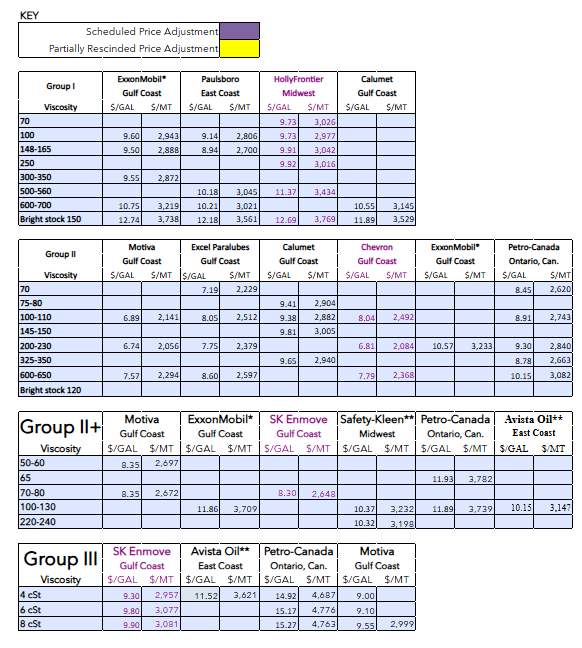
Posted Paraffinic Base Oil Prices June 10, 2026
(Prices are FOB basis, in U.S. dollars per gallon and U.S. dollars per metric ton).
Archived base oil price reports can be found through this link: https://www.lubesngreases.com/category/base-stocks/other/base-oil-pricing-report/
Historic and current base oil pricing data are available for purchase in Excel format.
*ExxonMobil prices obtained indirectly.
**Rerefiner