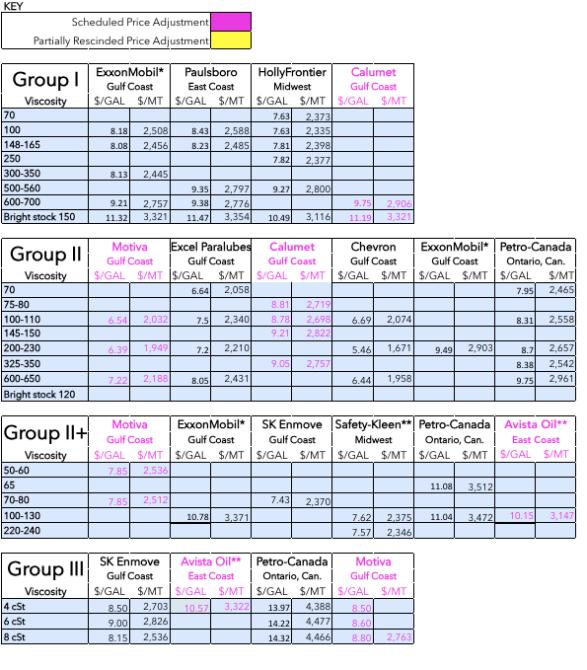
In view of the fact that crude oil prices were still hovering at sky-high levels, and global base oil supplies were shrinking because of ongoing supply disruptions in the Middle East and other regions dependent on Persian Gulf crude, a number of U.S. base oil producers increased prices once again during the week, joining several suppliers who had done so in the previous few days. Motiva and Calumet communicated a fresh round of posted price increases, and Paulsboro’s markups that were announced last week were slated to go into effect this week.
Meanwhile, the war in Iran did not seem closer to being resolved, although U.S. President Donald Trump said on Tuesday that significant progress was being made towards an agreement with Iran. The strait has been virtually closed since the conflict began on February 28, halting shipments of a fifth of the world’s oil supplies and creating a global energy crisis.
Crude oil futures had climbed on Monday on reports that Iran had attacked a United States vessel after U.S. president Trump had suggested that the U.S. Navy would escort stranded ships through the Strait of Hormuz in an operation he dubbed “Project Freedom.” However, futures slipped on Tuesday and retreated further on Wednesday on expectations that oil supply that has been captive in the Middle East could be released soon after the U.S. president indicated that a possible peace deal may be reached with Iran imminently.
Group I and Group II base oils
Following posted price increases by ExxonMobil, Paulsboro and Excel Paralubes last week, Motiva and Calumet stepped out with a fresh round of increases this week, driven by lofty crude oil prices and tightening global base oil supplies.
According to reports, Motiva communicated a posted price increase of 75 cents per gallon for all of its Group II grades and $1.00/gal for all of its Group II+/Group III base oils, with an effective date of May 4.
Calumet announced a price increase for its paraffinic oils, which went into effect on May 5. All of the producer’s Group I and Group II base oil postings were lifted by 70 cents/gal, with the exception of bright stock, which was raised by 95 cents/gal.
Spot business was hampered by a lack of readily available cargoes as U.S. base oil producers have focused on meeting contract commitments. Suppliers have had to place customers on allocation and some were considering cuts for the coming months. Even though a number of suppliers had been able to provide spot cargoes from existing inventories, available volumes have been drawn down, and it was difficult for suppliers to rebuild stocks as demand was robust. Buying appetite was particularly strong in other regions that were feeling the Middle East supply disruptions more strongly. However, there were hardly any spot supplies to be found.
Supply in most segments has become strained on a global scale, pushing prices up. Aside from the overall tight conditions in all regions, a two-week partial turnaround at Motiva’s Port Arthur, Texas, Group II/III plant and a turnaround at HolyFrontier’s Tulsa, Oklahoma, Group I unit in April may have contributed to the snug supply situation in the U.S.
Both buyers and suppliers have also started to discuss the need to start building extra inventories to cover potential supply disruptions during the hurricane season along the U.S. Atlantic Basin, which runs from June 1 through November 30.
While U.S. spot export barrels have diminished, suppliers tried to ensure that most contract shipments were fulfilled. There has been keen buying interest from Europe, as base oil supplies have tightened considerably and prices have shot up, and there has also been increased appetite from Brazil and Mexico, as buyers worried about potential product shortages.
In Brazil, an outage at Brazilian producer Petrobras’ plant that started back in February was still affecting availability and has exacerbated the snug Group I supply conditions, particularly of the heavy-viscosity base oils and bright stock. Base oil prices have surged because of the challenges importers face in finding supplies from the U.S., and Asian exports have also dwindled. Domestic prices were heard to have climbed by up to 50 percent in May, exerting pressure on finished products.
In Mexico, prices continued to be exposed to upward pressure due to climbing crude oil prices, strained supplies and limited export availability from the U.S. and Asia. Contract shipments continued to move from the U.S. to Mexico, but suppliers were being more restrictive in terms of volumes and have placed some customers on allocation. Much like their U.S. counterparts, Mexican blenders were trying to pass steeper raw materials, transportation and packaging costs down the supply chain, but lubricant and finished products consumers resisted the hikes on growing economic uncertainties and question marks regarding future demand.
While a large portion of base oils produced in the Middle East were still trapped there due to the closure of the crucial Strait of Hormuz and the damages to a number of base oil plants from Iranian drone attacks, some base oil volumes were moving out of Saudi Arabia as they were able to be shipped from ports on the Red Sea to various destinations. A 17,000-metric ton lot was reported to have been loaded on the GC Sapphire in Jeddah/Yanbu on April 30, and although there had been indications that the cargo was heading to China, the vessel’s destination remained unclear. An 18,000-ton base oil parcel was also lifted from Yanbu to Mumbai, India, on the Sea Fortune in mid-April.
Group III
The Group III segment was suffering the most direct consequences of the supply disruptions brought about by the war in Iran and closing of the Strait of Hormuz. Group III volumes moving to the U.S. from the Middle East have fallen substantially because a number of base oil plants have been hit by Iranian drone attacks, with at least two of the refiners said to have suspended production. This situation has taken a large supply wedge out of the market. While some Middle East cargoes arrived in the U.S. over the last few weeks as shipments had been on the water when the war started, supplies were expected to be exhausted by the end of the month or early June if shipments did not resume soon, according to sources. Buyers that procure Middle East products were heard to have been placed on 50-60 percent allocation.
Additionally, some Asian refineries have also had to cut back base oil production rates to prioritize fuels output, and have also had to trim operating rates due to Middle East crude oil supply constraints. A majority of Asian refineries have been designed to run on Dubai/Oman, Murban and Arab sour crudes, and supply shortages of these types of oil have been an issue. However, a number of governments have released strategic emergency crude supplies and have started to import crude from other origins to make up for the crude shortfall. This will likely allow refiners to improve run rates once the cargoes are received, although yields may be affected.
A key South Korean supplier was heard to be able to produce enough base oils to meet contract commitments as it has diversified its crude sources in the last few years, with the refinery ostensibly able to handle alternative crudes much better than other refineries. The supplier is therefore able to meet customer demand, both on the domestic front, as well as for export, with barrels continuing to move to the U.S., but it has also been managing inventories closely.
A second South Korean producer was heard to be highly dependent on Middle East crude imports and was therefore only focusing on meeting term obligations, placing customers on strict allocations, sources said.
Domestic Group III producers were running plants at close to full rates to meet contract obligations, with a couple having to place customers on allocation.
Naphthenic Base Oils
On the naphthenics side of the business, steep crude oil prices and a tightening supply and demand balance prompted producers to implement several price increases since the start of the Iran conflict. Recent plant turnarounds, steady domestic demand and brisk export business have exacerbated the extremely tight market conditions. Ergon, Process Oils/Cross Oil, Calumet and San Joaquin Refining have all announced increases since the beginning of the Iran war on February 28. The latest initiative lifted San Joaquin’s prices by 50 cents/gal on May 4.
Demand for the heavier grades has ticked up as the rubber and tire segments prepare inventories for the U.S. summer driving season, which traditionally starts on Memorial Day weekend in late May, and there has also been increased demand of naphthenic oils that can be used as a substitute for some heavy paraffinic cuts.
Calumet has restarted its naphthenic base oil plant in Princeton, Louisiana, following a turnaround that started in mid-April. The producer said that the turnaround had gone to plan, and the unit was running well, allowing the supplier to work on building back inventory levels.
San Joaquin Refining completed a scheduled turnaround at its refinery in Bakersfield, California, in March, while Cross Oil also completed a turnaround at its plant in Smackover, Arkansas, that month.
Lubricant Increases
A majority of lubricant and grease manufacturers have communicated price increases given the mounting costs of base oils, additives, packaging and transportation over the last two months. The implementation dates have been set between March 11 and May 20, with some suppliers nominating one increase and some two increases since the start of the war in Iran. Participants underscored that given current uncertainties and the fast pace of market changes—not to mention the escalating production costs–it has been very challenging to plan inventories and make pricing decisions.
Among the manufacturers that have announced increases were Calumet, CAM2, Castrol, Shell/SOPUS, PennStar, Chevron, ExxonMobil, Citgo, Phillips 66, Martin Lubricants, AOCUSA/Amalie, Highline Warren, Reliance Fluid Technologies, TotalEnergies USA, Consolidated Brands/ZXP Technologies, Omni Specialty Packaging, and Valvoline. Most suppliers announced lubricant and grease increases of up to 9% to 35%, depending on the product, with some lubricant increases ranging 48 cents per gallon to $5/gal, and $0.07-0.11/lb for greases. The higher end of the range applied to fully synthetic lubricants and it was also inclusive of previous increases.
Middle East Base Oil Capacity Shutdowns
According to reports, Shell/Qatar Petroleum has halted production at one train of its Pearl GTL Group II/Group III facility in Qatar after sustaining damage during Iranian aerial attacks on March 19. The plant, which can produce 300,000 metric tons of Group II base oils and 1,072,000 metric tons of Group III base oils per year, experienced a fire at one of its processing trains and production has been shut down at that train, with sources expecting the plant to remain offline for an extended period, possibly one year or longer as the specially designed equipment at the plant may be difficult to repair and may need to be replaced, according to sources. Earlier Iranian attacks on Qatar Energy’s LNG refinery in Ras Laffan, which supplies feedstocks to the Pearl unit, caused damages that will put the facilities out of commission for several years, with the company expected to declare force majeure on LNG contracts for up to five years, Reuters reported.
Abu Dhabi state oil giant ADNOC has shut part of its Ruwais refinery complex in response to a fire that broke out on March 10, following a drone strike. Sources indicated that while the Ruwais West refinery was shut down for inspection and safety reasons, other operations within the massive complex might be continuing at reduced capacity. According to sources, the Ruwais East unit was running and was expected to continue production, including that of base oils, but this could not be confirmed with the producer directly. The Ruwais complex houses a 600,000 metric-tons-per-year Group II and Group III plant. ADNOC has been able to ship product out through ports on the Red Sea, according to sources.
In Bahrain, fire erupted at BAPCO’s refinery in Maameer on March 5 following an Iranian attack, forcing the refinery to declare force majeure on production. BAPCO operates a 400,000 tons-per-year Group III base oil facility in Sitra, within the BAPCO refinery complex. BAPCO originally indicated that base oil production had been unaffected, but it was later heard that the producer had trimmed supply levels.
In Saudi Arabia, a drone struck the SAMREF oil refinery in Yanbu, while Saudi forces intercepted a ballistic missile targeting the Port of Yanbu–one of the few ports where tankers are still able to lift cargoes as it is located on the Red Sea.
Crude Oil
Crude oil futures slipped on Wednesday following reports that the U.S. and Iran were close to finalizing a deal to end the war.
- West Texas Intermediate June 2026 futures settled on the Nymex at $102.27 per barrel on May 5, up from $99.93/bbl for front-month futures on April 28.
- Brent July 2026 futures were trading on the ICE at $103.44/bbl on May 6, down from $114.47/bbl for front-month futures on April 29.
- Louisiana Light Sweet crude wholesale spot prices were hovering at $107.16/bbl on May 5. Spot prices had settled at $101.29/bbl on April 27, according to the U.S. Energy Information Administration.
Diesel
Low-sulfur diesel wholesale, May 5 (April 27), EIA
New York Harbor: $4.11 per gallon ($4.01/gal)
Gulf Coast: $4.04/gal ($3.94/gal)
Los Angeles: $4.20/gal ($4.34/gal)
Los Angeles: $4.34/gal ($3.65/gal)
Gabriela Wheeler can be reached directly at gabriela@LubesnGreases.com
Lubes’n’Greases shall not be liable for commercial decisions based on the contents of this report.
Posted Paraffinic Base Oil Prices May 6, 2026
(Prices are FOB basis, in U.S. dollars per gallon and U.S. dollars per metric ton).
Archived base oil price reports can be found through this link: https://www.lubesngreases.com/category/base-stocks/other/base-oil-pricing-report/
Historic and current base oil pricing data are available for purchase in Excel format.
*ExxonMobil prices obtained indirectly.
**Rerefiner