As the latest deadline set by United States president Donald Trump demanding that Iran reopen the Strait of Hormuz loomed on the horizon, crude oil prices continued to climb, with West Texas Intermediate futures touching the U.S.$117 per barrel mark on April 6. Crude oil’s relentless ascent prompted both paraffinic and naphthenic base oil producers to announce additional price increases during the week. These follow a string of almost weekly markups since the beginning of the conflict on Feb. 28. Aside from reduced global crude oil supplies due to Iran’s chokehold on the vital maritime channel, damage inflicted by Iran on Middle East base oil facilities has significantly reduced worldwide base oil availability, adding upward pressure on pricing, particularly that of API Group III grades. U.S. suppliers were monitoring the situation closely, and several have implemented strict allocations that would allow them to meet most contract commitments over the next few weeks.
At the time of writing, Iranian media reported that Iran had delivered a 10-point proposal to end the war with the U.S. and Israel, with Pakistan acting as a primary intermediary in diplomatic negotiations. According to an article in The New York Times, the proposal stated that if the U.S. and Israel ceased hostilities and lifted all sanctions on Iran, its government would lift its de facto blockade of the Strait, and would also impose a fee of roughly $2 million per ship traversing the waterway that it would split with Oman, which is located across the Strait. The U.S., Israel and Iran eventually agreed to a two-week ceasefire on Tuesday evening and pledged to continue negotiations, with Pakistan serving as mediator.
Meanwhile, crude oil futures reacted to the tense situation, with WTI briefly hitting $117.63/bbl on Tuesday as president Trump’s 8 p.m. ET deadline for Iran to reopen the Strait approached. However, prices fell immediately after Trump announced the two-week ceasefire. The escalating crude prices since the start of the war have driven gasoline and diesel values to historic highs. The average price per gallon of retail gasoline was $4.14 on Tuesday, while diesel fuel was at $5.64, close to its 2022 all-time high of $5.82 per gallon, according to NBC News.com.
Base Oil Price Increases
The soaring crude oil prices and reduced global availability of base oils, given the closure of the Strait, and plant shutdowns in the Middle East following Iranian drone and missile attacks, have driven base oil producers to seek several base oil price increases since the start of the conflict.
HF Sinclair announced posting increases of 50 cents/gal for its HollyFrontier Group I base stocks, effective April 6.
Petro-Canada’s Group II grades increased by 60 cents/gal, its Group II+ grades by 70 cents/gal and its Group III base oils by $1.50/gal, all with an effective date of April 6.
Excel Paralubes communicated a price increase of 60 cents/gal on its Group II 225N, and 50 cents/gal on its 70N, 110N and 600N grades, which went into effect on April 6.
Chevron increased its Group II posted prices by 70 cents/gal on April 7 to “reflect market conditions,” the producer said.
SK Enmove announced that the company would be increasing its Group II+ and Group III postings by 30 cents/gal as of April 7—its fifth increase since the beginning of the war in Iran. Group III base oils have been particularly impacted by the geopolitical situation in the Middle East.
Calumet communicated a paraffinic price increase that went into effect on April 7. The producer’s Group I SN600 grade and bright stock moved up by 50 cents/gal, and its Group II neutral 60/75/80/100/150/325 grades edged up by 60 cents/gal.
Market sources said that Motiva had also communicated a price increase during the week. The company’s Group II grades will increase by 60 cents/gal and its Group II+/Group III cuts by $1.00/gal, with an effective date of April 8.
According to reports, ExxonMobil communicated its fifth posted price increase which will go into effect on April 9. The company explained that the price increase was “due to continued rapidly changing global and regional supply/demand balances.” ExxonMobil’s API Group I SN100 and SN150 grades will increase by 83 cents/gal; its Group I SN330, SN600, SN800 and bright stock by 71 cents/gal. The company’s Group II EHC65 and its Group II+ EHC45 grade will be raised by 83 cents/gal.
Paulsboro will be increasing prices of its Group I light grades by 83 cents/gal and its Group I mid- and heavy-viscosity grades by 71 cents/gal on April 14. This is also the producer’s fifth increase since early March.
On the rerefining front, Avista Oil increased the price of its Group II+ and Group III base oils by 75 cents/gal on April 5.
On the naphthenic base oils side, producers have also communicated price increases for contractual transactions, following previous adjustments.
San Joaquin Refining announced that the company would be increasing all naphthenic and aromatic specialty oils by 70 cents/gal on April 6. This was the first announcement by the producer, who cited volatile market conditions as a driver for the increases.
Calumet announced a price increase for all of the company’s naphthenic oils of 40 cents/gal, effective April 7. Calumet had alsopreviously announced increases that went into effect on March 10, March 17 and March 25.
Ergon and Process Oils/Cross Oil implemented increases on March 13 and March 27. Ergon explained that the company was “closely monitoring developments within the Middle East and would provide pricing updates as needed in a timely manner.”
The supply and demand balance within the naphthenic base oils segment remained tight, particularly for the light grades, because of recent, ongoing and upcoming plant turnarounds and healthy demand from the transformer oil sector. Consumption of the heavy grades was not as robust, but may see an uptick ahead of the summer driving season from the rubber and tire segments.
San Joaquin Refining completed a scheduled turnaround at its refinery in Bakersfield, California, in March. The turnaround and a delayed restart depleted the producer’s inventory, but the supplier was currently working on rebuilding stocks.
Cross Oil started a turnaround at its plant in Smackover, Arkansas, on Feb. 20. The program was expected to last approximately 23 to 25 days, and after a failed restart attempt, the plant was heard to be running.
Calumet was expected to have built inventories ahead of a turnaround at its naphthenic plant in Princeton, Louisiana, in the second half of April, and has restricted spot sales for that purpose.
Lubricant Increases
Lubricant manufacturers have also communicated price increases given the mounting cost of base oils, additives, packaging and transportation, with implementation dates peppered between mid-March and May. A number of suppliers have announced a second round of increases as the first adjustments were deemed insufficient to offset the sharp rise in production costs. Among the manufacturers that have announced increases so far were Calumet, CAM2, Shell/SOPUS, PennStar, Chevron, ExxonMobil, Citgo, Phillips 66, Martin Lubricants, Amalie, Highline Warren, Reliance Fluid Technologies and Omni Specialty Packaging. Most suppliers announced lubricant and grease increases of up to 9% to 25%, depending on the product, and some marked up prices by 48-85 cents/gal.
Group I and Group II
Both the Group I and Group II segments have tightened due to shifts in refinery economics that have favored increased production of gasoline, diesel and jet fuel because of potential shortages and soaring prices. However, it could not be ascertained whether most base oil producers were streaming more feedstocks into competing fuels output and trimming base oil production. Crude oil supplies were not necessarily an issue for U.S. producers because the U.S. is the top crude oil producer in the world, but some refineries along the U.S. Gulf do run on Middle East oil. Panic purchases by a number of base oil consumers also contributed to the tightening conditions.
The reduced output would coincide with the traditional spring lubricant production cycle, when base oil demand from the automotive, agricultural and construction segments tends to increase. The supply constraints affecting the Group III segment were particularly worrisome to blenders who serve the engine oil segment as demand for lubricants rises during the summer driving season. Some concerns about supplies during hurricane season have also started to emerge, as both buyers and sellers start to pad inventories ahead of the season that runs between June and November.
A majority of U.S. base oil producers have withdrawn spot offers and focused on fulfilling contract commitments, while protecting inventory levels. Most producers have restricted sales volumes or have placed customers on allocation. The few suppliers that have been able to offer spot volumes for export have increased prices substantially. Some buyers have turned to rerefined base oils to make up for product deficits, and this has helped support rerefined base oil prices, with at least one rerefiner announcing a posted price increase during the week.
There was some optimism as the U.S., Israel and Iran agreed to a two-week ceasefire at the eleventh hour on Tuesday, ahead of a deadline set by president Trump, but even if the war were to end tomorrow, the situation was not expected to improve overnight, with the consequences of the global crude supply crunch and demand destruction likely to last for quite some time. The supply shortages were especially noticeable in the Group III segment.
In Brazil, buyers were also worried about supply shortages as export volumes from the U.S. and Asia have become difficult to come by, with prices surging on a weekly basis. To make matters worse, the local producer, Petrobras, was heard to have suffered production setbacks affecting Group I heavy-viscosity base oils and bright stock since mid-February and local supplies have therefore tightened. Prices have climbed in line with those in other regions, with Group III base oils experiencing the most significant increases due to reduced supplies from the Middle East and a suspension of spot offers from Asian suppliers. The domestic producer has also announced hefty increases of approximately 30% for domestic sales in April.
In Mexico, base oil prices have also jumped because of reduced availability from the U.S. as suppliers have withdrawn spot offers. Contract cargoes continued to be shipped from the U.S. to Mexico, but suppliers were very restrictive in terms of volumes and have placed customers on allocation. Spot offers for Asian base oils into Latin America have also been suspended because of production cutbacks and climbing freight rates. Blenders were trying to pass on the raw material increases onto lubricants, but buyers were resisting the hikes.
Group III
One of the main sources of Group III base oils that are utilized in the Americas is the Middle East, with close to half of all U.S. Group III imports originating in Qatar, Bahrain, and the United Arab Emirates. These countries have ports on the Persian Gulf, which is effectively closed off to vessel traffic, curtailing shipments to the rest of the world. Not only has the closure of this vital passageway tightened supplies, but Iranian missile and drone attacks have damaged several refineries and base oil plants. With the Shell/Qatar Pearl GTL plant in Ras Laffan, Qatar, out of commission following drone attacks on both its facilities and the gas refinery that supplies its feedstocks, and supply disruptions at the Adnoc plant in Abu Dhabi and Bapco facilities in Bahrain, roughly 20% of the world’s Group III base oil supply has been taken out of the market.
Another key region in terms of Group III production is Asia, but many Asian producers are facing oil supply shortages as most refineries run on Middle East crude, and volumes moving out of the Persian Gulf have plummeted. Some governments have released strategic emergency crude inventories to ensure refineries continue to run and the population and businesses have access to heating oil, gasoline, diesel and jet fuel. South Korea announced that it was launching its first strategic oil swap program, lending government crude reserves to refiners in exchange for future deliveries of alternative supplies, The Korea Herald reported last week. Under the program, the government will provide Middle Eastern crude from its reserves to refiners that have secured cargoes from other regions but were dealing with shipment delays. The borrowed volumes must be returned once those cargoes arrive. South Korean refineries were largely designed to run on Middle East crude, which makes it difficult for them to switch to crude from other regions. By participating in this program, the four domestic refiners will be able to maintain stable production utilizing Middle East crude. Refiners were heard to be sourcing replacement crude from other regions, including Africa, Central Asia, the Americas and Oceania. According to the article, the program will initially run through April and May, with a possible extension depending on market conditions.
A South Korean supplier explained that the latest base oil posted price increases had been necessary because production costs are tied to Asian gasoil prices, which have skyrocketed by more than $1,000 per metric ton since February. Some market prices have increased by more than $3.00/gal over the last month given the steep feedstock prices and tightening supplies. While Middle East suppliers have been able to supply around 50-60% of volumes stipulated in contracts, Asian suppliers continued to meet most commitments.
Meanwhile, domestic Group III producers were trying to continue running plants at top rates to fulfill contract obligations, with a couple having to place customers on allocation. Spot offers have been withdrawn by a majority of suppliers. While there had been speculation that domestic producers would try to increase Group III production rates, sources said it was unlikely refiners would switch to Group III output as this could damage their refining equipment.
Middle East Base Oil Capacity Shutdowns
Iran and its allied militias launched drones and missiles across the Middle East in retaliation to the U.S. and Israeli attacks, targeting energy infrastructure in Saudi Arabia, the United Arab Emirates, Qatar, Kuwait, Bahrain and Iraq, and putting several facilities out of commission. These strikes exacerbated the dire oil supply situation, as not only were crude tankers unable to transit the Strait of Hormuz, but crude oil and refined products output have also been shut down. Several Middle East base oil producers have been forced to halt production and declare force majeure.
According to reports, Shell/Qatar Petroleum has halted production at its Pearl GTL Group II/Group III facility in Qatar after sustaining damage during aerial attacks on March 19. The unit, which can produce 300,000 tons of Group II base oils and 1.072 million tons of Group III base oils per year, experienced a fire at one of its processing trains and production has been shut down, with sources expecting the plant to remain offline for an extended period, possibly one to two years. Earlier Iranian attacks on Qatar Energy’s LNG refinery in Ras Laffan, which supplies feedstocks to the Pearl unit, caused damages that will put the facilities out of commission for several years, with the company expected to declare force majeure on LNG contracts for up to five years, Reuters reported.
Abu Dhabi state oil giant Adnoc has shut part of its Ruwais refinery complex in response to a fire that broke out on March 10, following a drone strike. Sources indicated that while the Ruwais West refinery was shut down for inspection and safety reasons, other operations within the massive complex might be continuing at reduced capacity. According to sources, the Ruwais East unit was running and was expected to continue production, including that of base oils, but this could not be confirmed with the producer directly. The Ruwais complex houses a 600,000-tons-per-year Group II and Group III plant.
In Bahrain, fire erupted at Bapco’s refinery in Maameer on March 5 following an Iranian attack, forcing the refinery to declare force majeure on production. Bapco operates a 400,000 t/y Group III base oil facility in Sitra, within the Bapco refinery complex. Bapco originally indicated that base oil production had been unaffected, but it was not clear whether the unit was currently producing base oils.
Iran also attacked Iraqi oil facilities, further crippling refining operations in the country. In Saudi Arabia, a drone struck the SAMREF oil refinery in Yanbu, while Saudi forces intercepted a ballistic missile targeting the Port of Yanbu—one of the few ports where tankers are still able to lift cargoes as it is located on the Red Sea.
Crude Oil
Crude futures jumped on Tuesday ahead of the deadline set by Trump for Iran to open the strait or face intense bombing of bridges and power plants, with WTI briefly hitting $117/bbl. However, futures retreated on news of a two-week ceasefire between the U.S. and Iran, with talks scheduled to continue later this week in Islamabad, Pakistan. Stock markets in Asia jumped on Wednesday morning as investors welcomed the news.
- West Texas Intermediate May 2026 futures settled on the Nymex at $112.95/bbl on April 7, up from $101.38/bbl for front-month futures on March 31.
- Brent May 2026 futures were trading on the ICE at $94.13/bbl on April 8, down from $105.50/bbl for front-month futures on April 1.
- Louisiana Light Sweet crude wholesale spot prices were hovering at $122.01/bbl on April 6. Spot prices had settled at $110.69/bbl on March 30, according to the U.S. Energy Information Administration.
Diesel
Low-sulfur diesel wholesale, April 6 (March 30), EIA
New York Harbor: $4.39 per gallon ($4.49/gal)
Gulf Coast: $4.42/gal ($4.53/gal)
Los Angeles: $5.10/gal ($5.20/gal)
Gabriela Wheeler can be reached directly at gabriela@LubesnGreases.com
LNG Publishing Co. Inc./Lubes’n’Greases shall not be liable for commercial decisions based on the contents of this report.
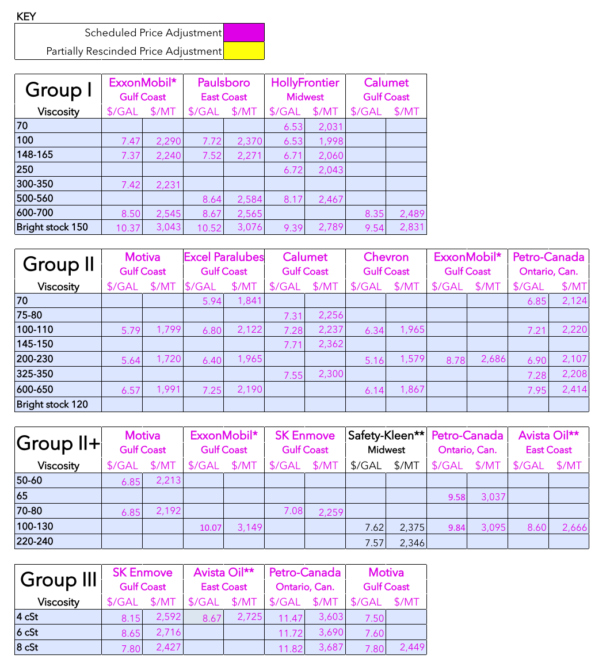
Posted Paraffinic Base Oil Prices April 8, 2026
(Prices are FOB basis, in U.S. dollars per gallon and U.S. dollars per metric ton).
Archived base oil price reports can be found through this link: https://www.lubesngreases.com/category/base-stocks/other/base-oil-pricing-report/
Historic and current base oil pricing data are available for purchase in Excel format.
*ExxonMobil prices obtained indirectly.
**Rerefiner