With crude oil prices skyrocketing to multi-year highs amid ongoing hostilities in the Middle East, it was not surprising that several paraffinic and naphthenic base oil producers stepped out with price increases this week, while one supplier communicated its second increase this month. Crude oil price changes do not typically synchronize with base oil price adjustments overnight, but several factors that had been brewing for some time finally boiled over, triggering the posted price revisions. Meanwhile, the United States, Israel and Iran conflict raged on, with U.S. President Donald Trump threatening to intensify attacks if Iran continued to block oil shipments in the Strait of Hormuz, a waterway crucial to global oil supply.
Aside from the shipping disruptions due to the closure of the strait, analysts estimated that about 120 million barrels of oil have already been lost to the global market due to the combination of missile and drone strikes, output outages and the inability to load tankers in many Middle East nations, according to global maritime consultancy and shipping agency Clarksons.
Crude oil futures showed sharp price swings between Sunday and Tuesday as the conflict continued to disrupt oil production and shipments. Brent futures rose to a peak of nearly $120 per barrel before retreating to near $90/bbl on Tuesday in reaction to a text by the U.S. Secretary of Energy Chris Wright announcing that the U.S. Navy had safely escorted an oil tanker through the Strait of Hormuz. This information turned out to be incorrect. President Trump also commented that the U.S. was considering taking over the strait, partly easing supply concerns. Oil prices were expected to remain highly volatile while the war dragged on.
Several base oil suppliers have communicated base oil price increases, and a few were still evaluating market conditions, with prices anticipated to remain exposed to upward pressure as long as crude oil hovered at steep levels. There were also reports that several additive companies had communicated price increases as well, given the raw materials mark-ups and supply chain turmoil. These developments have led finished lubricant manufacturers to indicate that they would have no choice but to consider price adjustments if the base oil and additive increases hold.
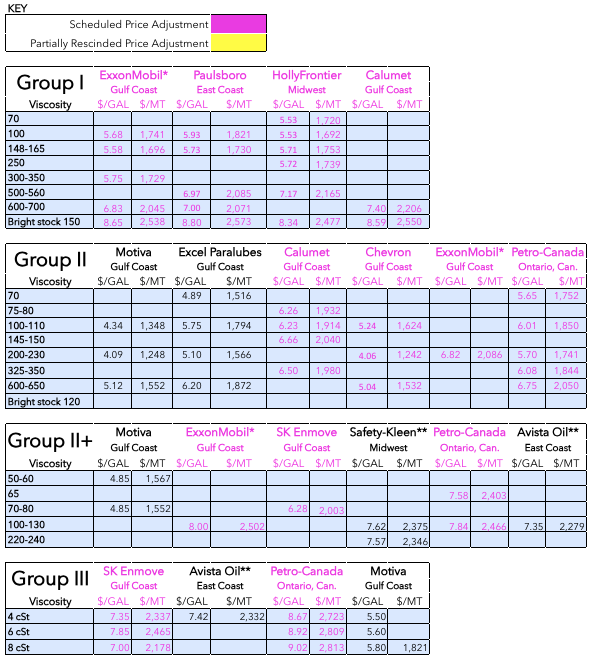
In terms of base oils, according to reports, ExxonMobil increased posted prices on March 9. The producer raised its API Group I base stocks by 24 cents per gallon, with the exception of bright stock, which edged up by 19 cents/gal. ExxonMobil’s Group II EHC65, Group II+ EHC45 and EHC120 grades were marked up by 36 cents/gal. (The EHC120 is not yet listed on Lube Report’s Price Table).
Paulsboro lifted posted prices on March 12. All of the producer’s Group I base stocks increased by 24 cents/gal, except bright stock, which went up by 19 cents/gal.
Chevron announced a 50 cents/gal price increase for its Group II base oils, with an effective date of March 10, “to reflect current market conditions,” the company noted in its communication.
Calumet communicated a price increase for its paraffinic oils, which also went info effect on March 10. The producer’s Group I cuts increased by 35 cents/gal, while its Group II grades moved up by 45 cents/gal.
HF Sinclair also advised customers that the company would be implementing base oil price increases across its Petro-Canada Lubricants and HollyFrontier Specialty Products base oil portfolios, effective March 10. In its communication to customers, HF Sinclair explained that over the last few months, the continued trend in global crude oil price volatility, along with increases in transportation and insurance costs and ongoing interruptions to supply chains, exacerbated by the recent conflict in the Middle East, had resulted in the need to increase base oil prices. HollyFrontier’s Group I base oils increased 25 cents/gal, with the exception of bright stock, which went up by 20 cents/gal. Petro-Canada’s Group II and Group II+ base oils increased 35 cents/gal, and the Group III grades edged up by 30 cents/gal.
SK Enmove also communicated a posted price increase for its Group II+ and Group III base oils of 20 cents/gal, effective March 12. This is in addition to the company’s 10 cents/gal increase announced last week, which went into effect on March 1.
Group I and Group II
A number of base oil producers have suspended spot offers, particularly for export business, given market uncertainties and the need to ensure that domestic contract commitments are met. Many suppliers worried that they would not be able to fulfill base oil orders if refineries were to increase competing fuels production as prices surged, and this would reduce base oil output. Sources also indicated that due to current crude oil price volatility and other uncertainties, it was difficult to make a spot offer today knowing that that price might not cover production costs later.
These challenges come as preparations for the spring lubricant and agricultural planting season were underway. Base oil suppliers typically see an uptick in domestic demand, but buyers were likely to be more conservative in terms of the volumes they purchase as lubricant prices have not moved up, and margins have thinned. However, lubricant manufacturers indicated that they contemplated finished products price revisions given the increases in production costs.
At the same time, some buyers were concerned that base oil prices would continue on an upward trend and they preferred to secure as much product as possible at current price levels, although some producers were restricting sales to contract volumes.
Group II producers who have the ability to also manufacture Group III grades might consider an increase in Group III production because of a dearth in Group III imports. This would lead to reduced Group II availability.
A few producers were still seeking export opportunities, but higher global freight rates were expected to thwart deals. There was buying interest from India as Middle East base oil shipments were unable to be delivered, and India typically receives many cargoes from that region.
Additional buying interest also emerged in Brazil, where reports circulated that a key refiner had suffered an unexpected production outage, although it was heard that the producer was planning a restart this week. Base oils, particularly bright stock, had been on the tight side in Brazil due to production outages that occurred late last year as well. Brazilian buyers were bracing for U.S. export prices to be exposed to upward pressure due to climbing crude prices and tightening global supplies.
Regular contract shipments of U.S products were anticipated to continue moving to Mexico, but buyers were managing inventories carefully in case supply restrictions were to occur in the U.S. Offers for Asian base oils into Latin America have subsided because of potential production cutbacks and climbing freight rates in that region.
Base oil and lubricant manufacturers in all regions worried that a prolonged conflict might not only pressure up crude oil and base oil prices, but also result in steep gasoline prices, heftier inflation and an economic downturn that would likely dampen automotive activities and lubricant demand in the coming months.
Group III
The Group III segment was expected to be severely impacted by the Middle East conflict, not only because close to half of all U.S. Group III imports originate in Bahrain, the United Arab Emirates and Qatar, but also because Asian Group III producers rely on Middle East crude imports to run their refineries. The U.S. sources large amounts of Group III grades from Asia. With shortages of diesel expected to hit that region, refiners in Asia were likely to trim base oil production and increase diesel/gasoil output. Steeper freight rates and insurance premiums were also expected to exert upward pressure on prices in the long term. As a result, producers were heard to have advised customers that Group III base oils may be under allocation.
Additionally, at least a couple of Middle East facilities were reported to have been hit by Iranian drone attacks. In Bahrain, fire erupted at Bapco’s refinery in Maameer on March 5 following an Iranian attack. The country’s Ministry of Interior reported that the fire had been brought under control without providing further details about potential damages. Bapco operates a 400,000-metric tons per year Group III base oil facility in Sitra, within the Bapco refinery complex. Sources reported that Bapco had declared force majeure on production following the fire, although the company had previously indicated that base oil production had been unaffected. It was unclear whether this would still be the case, following further inspection of the facilities.
In Qatar, Qatar Energy halted production of liquefied natural gas and other products following drone attacks on its facilities in Ras Laffan and Mesaieed. The company declared force majeure on production. While it could not be ascertained whether the Qatar/Shell Pearl gas-to-liquids base oil unit had suffered any damages, base oil production may be curtailed as the unit utilizes natural gas from the refinery to produce Group III base oils.
In the Group III segment, as mentioned above, SK Enmove announced a second posted price increase of 20 cents/gal on all of its Group II+ and Group III grades, effective March 12, following an increase of 10 cents/gal on March 1, given the relentless climb in crude oil prices and production disruptions.
A second supplier was heard to have increased the spot price of its Group III 4 cSt cut by 30 cents/gal as this grade was the tightest within the Group III category.
Naphthenics
On the naphthenic base oils front, price increases also started to emerge this week on the back of surging crude oil prices and potential base oil production cuts if refineries start to favor fuel production.
Calumet announced a price increase of 35 cents/gal on all of its naphthenic oils, effective March 10.
Process Oils communicated a price increase of 45 cents/gal for its line of Cross Oil naphthenic base oils, which will go into effect on March 13, adding that the company was closely monitoring developments within the Middle East and would provide pricing updates as needed in a timely manner.
Ergon also intends to raise naphthenic base oil prices by 45 cents/gal on March 13.
The pale oil supply and demand ratio has also tightened over the last few weeks on the back of recent and upcoming plant turnarounds and robust demand for the light grades from the transformer oil segment. The tightening conditions provided additional price support.
San Joaquin Refining completed a scheduled turnaround at its refinery in Bakersfield, California, last week. The turnaround and a delayed restart depleted the producer’s inventory and it was expected to be on allocation through March.
Cross Oil started a turnaround at its plant in Smackover, Arkansas, on Feb. 20. The program will last approximately 24 days, and the supplier was expected to have built inventories to fulfill orders during the shutdown.
Calumet will also likely start to build inventories over the next few weeks as the producer plans to have a turnaround at its naphthenic plant in Princeton, Louisiana, in the first half of April.
Crude Oil
Crude oil futures plunged by more than 11% on Tuesday, a day after Trump predicted a quick end to the war with Iran. Both Brent and WTI futures showed the biggest single-day percentage loss since March 2022, after jumping to four-year highs a day earlier, Reuters reported.
- West Texas Intermediate April 2026 futures settled on the Nymex at $83.45 per barrel on March 10, up from $74.56/bbl for front-month futures on March 3.
- Brent futures for May 2026 delivery were trading on the ICE at $87.29/bbl on March 11, up from $82.31/bbl for front-month futures on March 4.
- Louisiana Light Sweet crude wholesale spot prices were hovering at $104.15/bbl on March 9. Spot prices had settled at $75.38/bbl on March 2, according to the U.S. Energy Information Administration.
Diesel
Low-sulfur diesel wholesale, March 9 (March 2), EIA
New York Harbor: $3.36 per gallon ($3.00/gal)
Gulf Coast: $3.22/gal ($2.82/gal)
Los Angeles: $3.22/gal ($2.88/gal)
Gabriela Wheeler can be reached directly at gabriela@LubesnGreases.com
LNG Publishing Co. Inc./Lubes’n’Greases shall not be liable for commercial decisions based on the contents of this report.
Posted Paraffinic Base Oil Prices March 11, 2026
(Prices are FOB basis, in U.S. dollars per gallon and U.S. dollars per metric ton).
Archived base oil price reports can be found through this link: https://www.lubesngreases.com/category/base-stocks/other/base-oil-pricing-report/
Historic and current base oil pricing data are available for purchase in Excel format.
*ExxonMobil prices obtained indirectly.
**Rerefiner