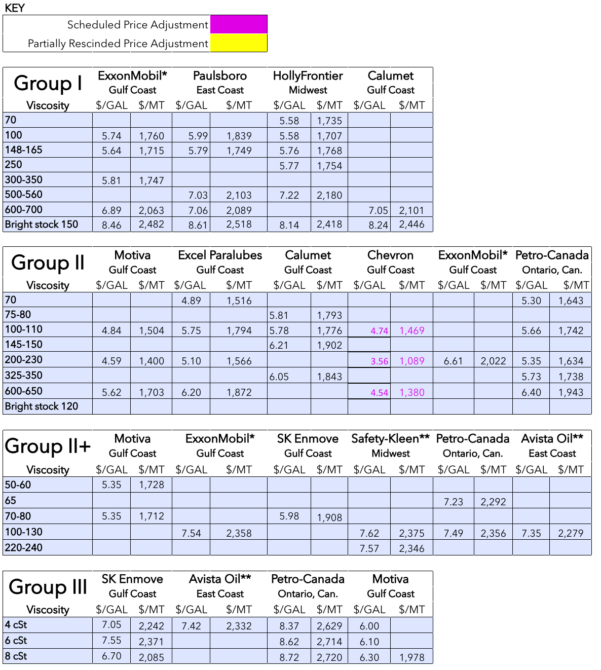
Chevron announced a posted price decrease for its API Group II base oils this week. The price revision wasn’t a complete surprise, as Group II cuts have been under downward pressure for some time, given ample supplies and sluggish demand along with the need for suppliers to lower inventories before the end of the year. Historically, producers have lowered prices during the last few days of the year to encourage orders and release the extra inventories that had been kept during hurricane season. Upstream, crude oil prices rose early in the week on news that Opec+ would be keeping oil production levels unchanged in Q1 2026, while Ukrainian drone attacks on Russian energy infrastructure fanned concerns about further oil supply tightness.
The week started off quietly, following the Thanksgiving Holiday weekend in the United States, but saw increased activity as the Chevron announcement triggered speculation that other adjustments might follow. No other revisions were issued by the publishing deadline. Some sources commented that it is currently a slow time of the year for demand, so a price reduction does not necessarily generate more business, and this may make some suppliers feel disinclined from lowering prices.
Chevron decreased the posted price of its Group II 100R base oil by 30 cents per gallon and its 220R and 600R by 35 cents/gal “to reflect current market conditions,” effective Dec. 2. Some sources said the revision brought posted prices more in line with actual market levels.
In the weeks preceding the announcement, suppliers had been exploring export opportunities to lower inventories as domestic demand remained lackluster. This is typically the case in the last quarter of the year as demand from the automotive segment, which accounts for the largest portion of base oils consumption, weakens at the end of the summer driving season and was not expected to improve until the spring.
Demand for industrial oils has also been lagging previous years as manufacturing rates have declined in the U.S., partly due to the tariffs imposed on many components that led to climbing finished product prices and dampened consumer demand. Participants were anticipated to get an overview on the state of the base oils, lubricants and rerefining industry at the ICIS Pan American Base Oils and Lubricants conference taking place in New Jersey this week.
There was also a question whether base oil plants would continue to be run at top rates as diesel prices have climbed because of a global tightening of supplies given the reduction of Russian diesel exports brought about by international sanctions, coupled with Ukrainian attacks on Russian refineries. Some refiners may choose to direct more vacuum gas oil towards diesel production to the detriment of base oils.
Group I
There was a general perception that supplies in the Group I segment continued to be tighter than for Group II grades. This has been the case for most of the year and it has also been a global phenomenon as demand for Group I base oils is still quite robust, while many Group I plants have been decommissioned in recent years.
Bright stock has been particularly sought-after in some regions and this led to climbing prices in the past months. Global availability appeared to ease lately as additional spot Group I cargoes emerged from Southeast Asia. Participants explained that this was partly because of the start-up of ExxonMobil’s Resid Upgrade Project in Singapore, which brought fresh Group II products into the global market, replacing Group I base in some cases, particularly bright stock as the plant produces an extra-heavy Group II base oil with some of the same properties as Group I bright stock.
As has been the case for Group II cuts, Group I light grades appeared to be less available than the heavy grades, likely due to seasonal patterns. Demand for industrial oils and metalworking fluids has declined due to reduced manufacturing rates, while consumption for marine and railway applications remained more vibrant, sources said.
While domestic bright stock demand was relatively steady, there was an uptick in buying appetite in Brazil because the local producer Petrobras was understood to have suffered some production setbacks and has shut down its refinery for at least two weeks. Despite the tighter conditions in Brazil, domestic prices for December were expected to be reduced from November levels.Recently, a 5,900-metric-ton base oil cargo was heard to have been lifted from the U.S. Gulf to Brazil on the Sunbird between Nov. 7-9.
There had been some fresh interest in Group I grades from Argentina as well following a recent fire at a YPF refinery in La Plata, Buenos Aires, with buyers looking for alternate sources of base oils in case of production disruptions at the base oils plant, although the unit was not directly affected by the fire.
Receivers in Mexico continued to show steady interest in U.S. base oils, but requirements have declined because of economic uncertainties, which have cooled down demand for automotive lubricants and industrial oils. There had also been some disruptions at Mexican automotive plants due to the tariffs imposed by U.S. president Donald Trump, with vehicle production and light vehicle exports from Mexico dropping in 2025 compared to 2024. While USMCA-compliant vehicles have largely remained tariff-free, other duties on steel, aluminum, and parts have increased costs and hurt the competitiveness of Mexican-made vehicles that include U.S.-sourced components. Tariffs have also led to economic hardship and reduced foreign direct investment in Mexico’s manufacturing sector. The tariffs have also indirectly impacted consumers because the increased cost of production can lead to higher prices, particularly affecting those who can only afford lower-priced new vehicles.
Mexican base oil buyers were also delaying purchases in hopes that U.S. base oil producers would offer more discounts as the end of the year approached.
Group II
While availability of the light-viscosity Group II base oils has improved, following a few months of fairly tight conditions, these grades were still in a tighter position than their heavier counterparts. This would partly explain why Chevron’s decrease for its 100-viscosity cut is smaller than for the other grades.
According to sources, the light grades had seen more limited supply levels because producers had prioritized Group II+ output to meet PCMO and HDEO specifications. Group II 220N was fairly balanced against demand, and 600N was more readily available.
The improved availability of spot supplies was partly attributed to the restart of the Excel Paralubes plant in Louisiana in late October, particularly as increased output was expected at the plant as a new catalyst has been installed, sources said. The unit had been running at reduced rates for most of the year until it was shut down for maintenance in early October. There was no producer confirmation about the plant’s operations or supply plans.
Rerefined base oils were also balanced to slightly long, depending on the cut. A recent turnaround has limited supplies, with a rerefiner heard to be sold out of one grade, while an upcoming maintenance program in the first part of 2026 could also strain availability as the affected rerefiner plans to build inventories to fulfill contractual requirements during the shutdown. However, the reduced supply levels might be offset by weaker demand during the last few weeks of the year and the first couple of months of 2026, resulting in balanced conditions.
Export Group II business into India has been slightly disappointing as U.S. prices were considered high compared to products from Asia. Fewer shipments than during the same period last year were concluded into India as a result.
Group III
The Group III segment is more than adequately supplied, with several additional import cargoes expected to reach U.S. shores over the coming weeks. The plentiful availability and weaker demand were exerting downward pressure on Group III prices.
Group III base oils consumption from the PCMO segment has declined with the end of the driving season in the U.S, but there was a momentary uptick in fuel and motor oil demand ahead of the Thanksgiving holiday, when several million drivers hit the road to spend the festive week with friends and family.
As mentioned last week, a portion of domestic requirements were being met by U.S. producers manufacturing Group III base oils for their own downstream lubricant operations. The start-up of rerefined Group III production at the Vertex rerefinery in Mobile, Alabama, could also satisfy some of the domestic Group III demand.
Even so, imports will continue to play a key role in the U.S. as domestic production is not sufficient to meet burgeoning Group III and Group III+ demand. Most imports originate in Canada, Asia and the Middle East. Competition between products that have official approvals and base oils that are not fully approved, but are of similarly high quality, persisted.
Naphthenics
Demand for the heavy naphthenic cuts has been lackluster throughout most of 2025 and was expected to remain soft into 2026. Conversely, demand for the lighter grades from the transformer oil sector has been generally steady and supplies were tighter than for the heavy grades, with at least one supplier in a sold-out position for the 40 and 60 grades. Freezing temperatures in many parts of the country and an expected economic slowdown could dampen construction activity and reduce pale oil demand from the electrical, transformer and infrastructure segments. A few paraffinic suppliers campaigned to encourage the use of paraffinic oils in typical naphthenic applications.
Export activity has also slowed down, limiting the number of outlets for suppliers who were trying to reduce inventories ahead of year-end.
The restart of Ergon’s naphthenic base oils plant following a comprehensive turnaround that was completed in mid-October was said to have brought additional products to the market, but San Joaquin Refining plans to start a three-week routine turnaround at its refinery in California in mid-January and was expected to start building inventories to keep customers supplied during the shutdown, which could limit short-term spot availability.
Crude Oil
Crude oil futures edged up by more than 1% on Monday following drone attacks on Russian infrastructure by Ukraine, the closure of Venezuelan airspace by the U.S., and OPEC+’s decision to leave output levels unchanged in the first quarter of 2026. A drawdown of U.S. inventories also supported prices. The American Petroleum Institute estimated that crude oil inventories had seen a drop of 2.48 million barrels in the week ending Nov. 28.
- West Texas Intermediate January 2026 futures settled on the Nymex at $58.64 per barrel on Dec. 2, up from $57.95/bbl for front-month futures on Nov. 25.
- Brent futures for February 2026 delivery were trading on the ICE at $62.36/bbl on Dec. 3, down from $62.44/bbl for front-month futures on Nov. 26.
- Louisiana Light Sweet crude wholesale spot prices were hovering at $61.34/bbl on Dec. 1. Spot prices had settled at $60.91/bbl on Nov. 24, according to the U.S. Energy Information Administration.
Diesel
Low-sulfur diesel wholesale, Dec. 1 (Nov. 24), EIA
New York Harbor: $2.39 per gallon ($2.47/gal)
Gulf Coast: $2.22/gal ($2.32/gal)
Los Angeles: $2.32/gal ($2.40/gal)
Gabriela Wheeler can be reached directly at gabriela@LubesnGreases.com
LNG Publishing Co. Inc./Lubes’n’Greases shall not be liable for commercial decisions based on the contents of this report.
Posted Paraffinic Base Oil Prices December 3, 2025
(Prices are FOB basis, in U.S. dollars per gallon and U.S. dollars per metric ton).
Archived base oil price reports can be found through this link: https://www.lubesngreases.com/category/base-stocks/other/base-oil-pricing-report/
Historic and current base oil pricing data are available for purchase in Excel format.
*ExxonMobil prices obtained indirectly.
**Rerefiner