Despite earlier optimism that a diplomatic accord would bring an end to the United States-Iran war, there appeared to have been little progress in the latest round of negotiations taking place in Qatar. Hostilities flared up again as Iran attempted to strike U.S. bases in Bahrain and continued to control transit in the Strait of Hormuz. The ongoing conflict was directly affecting crude oil and API Group III shipments from the Persian Gulf, but also placed upward pressure on other refined products.
A glimmer of hope sparkled on the horizon as a second Group III base oils shipment from Adnoc was heard to have been completed and be on its way to Europe and the U.S., with an expected arrival of late December/early January. While this cargo was not likely to entirely quench the pent-up thirst for Group III barrels in the U.S., it was seen as another sign that the situation might be improving, although loadings out of Abu Dhabi, Bahrain and Qatar were still considered to be risky and insurance premiums remained high.
Even if additional shipments manage to leave the Persian Gulf, market participants expected the Group III segment to remain extremely tight throughout the first half of 2027 as Middle East plants may not be able to run at full rates for some time, and several plant turnarounds have also been scheduled, including at a Group II/Group III plant in South Korea.
While some of the base oils price pressure from steep crude oil prices has weakened as oil futures have come down from their early November peaks, oil values were still firm and a global shortage of diesel could also impact refinery decisions and affect base oil output in the coming months.
Group I and Group II spot prices were also softer because of improved availability and efforts by suppliers to lower inventories at the end of the Atlantic hurricane season and ahead of the year-end tax assessments, while domestic demand and exports have slowed down.
Crude futures displayed volatility on Tuesday and inched up on renewed fighting in the Middle East and attacks on tankers in Hormuz, with West Texas Intermediate (WTI) hovering near $86 per barrel. Prices had fallen the previous session on reports by the International Energy Agency (IEA) that forecast a surplus in crude supply of roughly 2 million-barrels-per-day this quarter, on increased output in the Middle East and decreased global demand. Some market attention also focused on an upcoming gathering of President Trump, Chinese President Xi Jinping, and Russian President Vladimir Putin on the sidelines of the APEC Economic Leaders’ Meeting in Shenzhen, China, on November 18–19, where some discussions about the war in Iran might take place.
Group I and Group II
A majority of Group I and Group II grades appeared readily available in contrast to six months ago, when the market was extremely tight. This was partly attributed to producers releasing inventories held during the Atlantic hurricane season, but also to a slowdown in consumption levels. While most buyers continued to take volumes under contract, there was more subdued buying interest for spot supplies as buyers were concerned that stocks might lose some of their value since crude oil prices were trending down.
Blenders also preferred to finish the year with thin inventories, and credit and cash flow constraints for some players also stifled consumption. Participants were also concerned that lower crude oil and feedstock prices would encourage end-users to seek lubricant decreases when blenders have not had a chance to offset the rising production costs seen over the last nine months. While a number of price increases were implemented earlier in the year, consumers had resisted further price adjustments in recent months.
A maintenance shutdown at Paulsboro Refining’s (PBF Energy) Group I unit in New Jersey had contributed to a tightening of spot supplies. The producer restarted base oil production on October 26, and while it was expected to continue covering contract commitments, exports were not anticipated to resume until December and only after the company has been able to rebuild inventories.
In the Group II segment, Chevron was heard to be planning to bring Group III production online at its plant in Pascagoula, Mississippi, before the end of the year and this may impact its Group II production levels.
Other producers were able to offer spot supplies of the heavy grades and some of them have adjusted spot prices down to promote business, but the light grades were still tight. This, along with refinery economics that encouraged base oil managers to maintain base oil margins against diesel values, supported prices of these grades, particularly of the Group II 100N, which appeared to be the tightest grade.
Despite the more comfortable supply levels, producers continued to prioritize contractual obligations and were cautious about volumes offered up for spot business since market uncertainties lingered. Given the turmoil seen since the start of the war in Iran and how it had affected base oil availability, buyers appeared interested in obtaining more base oils through contracts next year, which also served as a sort of “security blanket” for producers who would have less pressure to sell spot cargoes.
U.S. export prices have softened, particularly for cargoes moving to Mexico, as U.S. suppliers were eager to lower inventories and maintain customer relationships for next year’s business. But Mexican buyers were also hesitant to secure too much product when prices were on a downward trend.
In Brazil, a key producer lowered its Group I prices for November because of growing supply levels against sluggish demand. The producer was heard to be able to meet contractual obligations and buyers did not seem anxious to secure additional spot supplies. Perhaps more consumers will step back into the market if they feel prices have bottomed out. Group II prices were mostly steady because of a tighter supply situation.
Demand for U.S. base oils in Latin America and Europe has weakened because of the approach of the end of the year, with buyers using up existing inventories and waiting for potential price adjustments since values appeared to be on a downward trend. While there had been spot offers for Asian cargoes which competed with U.S. barrels, buying interest in Asian products appeared to have fizzled as well, although there was mention of a couple of parcels moving to Brazil and the U.S. Gulf. A 3,000–ton parcel was discussed for shipment from Ulsan, South Korea, to Houston, Texas, in the second half of November/early December. A similar cargo was also considered for shipment from Ulsan to Rio de Janeiro, Brazil, on the same dates. An 11,000-ton lot was on the table for shipment from the U.S. Gulf to West Africa/Nigeria at the end of November. A 12,000-metric ton cargo was mentioned for possible shipment from Fujairah, United Arab Emirates, or Sohar, Oman, to Houston, Texas, between November 15-25, likely to contain Group III grades.
Group II suppliers were also eyeing export opportunities in India, which typically shows a burst of activity at the end of the year because Indian buyers secure products before the end of their fiscal year in March. However, Indian buying interest has been more lackluster than in the previous years because of steep prices for U.S. base oils, logistical challenges, and the fact that domestic production levels have increased. Despite this increase, local output was not deemed sufficient to meet demand, and an Indian Group I/Group II producer has also started a turnaround which might result in reduced availability until December.
Group II+/Group III
A second base oils cargo from Abu Dhabi producer Adnoc was reported to have shipped from Fujairah, United Arab Emirates, bound for Europe and the U.S. The shipment was thought to be between 18,000 to 19,000 metric tons and was expected to reach the U.S. Gulf Coast in late December or early January. The first cargo from Adnoc that managed to be loaded after months of failed attempts because of the Iranian chokehold on the Strait of Hormuz was lifted in late September and was delivered in late October/early November. The official distributor in the U.S. of Adnoc’s material, Penthol, has kept its force majeure on contract commitments as shipments from the Persian Gulf have not resumed a normal schedule yet, and the Adnoc plant was heard to be running at reduced rates.
While these shipments were sure to bring some relief after months of critically low supply levels, base oil shipments from Bahrain, Qatar and Abu Dhabi were not expected to fully resume until the U.S.-Iran reach a peace deal and the Strait of Hormuz is opened to all vessel traffic. At the moment, vessels attempting to transit the strait need to receive special permission from Iranian authorities, and some tankers have suffered damages while navigating in the area because of anchored mines. But reports point to the fact that an increased number of crude tankers have transited the strait in recent days.
Group III prices remained exposed to upward pressure, especially the 4 cSt grade due to limited availability and healthy demand. Upcoming turnarounds next year and the delayed start-up of Group III production in Saudi Arabia were anticipated to keep pressure on global supply levels and pricing in the first half of 2027. A turnaround at S-Oil’s Group II/Group III plant in Onsan, South Korea, in May, which was expected to last 45 to 60 days, could exacerbate the tight supply conditions.
HF Sinclair/Petro-Canada was also expected to decommission its Group II/II+/III base oils plant in Mississauga, Canada, some time next year. Although the company has signed an agreement with SK Enmove and Chevron to secure supply for its current customers once the plant is retired, there might be a temporary tightening of domestic supplies in North America.
Blenders also continued to secure rerefined base oils given the tight conditions over the last several months. Rerefiners reported limited extra availability beyond contract volumes and at least one rerefiner said it was fully committed until next February. Contract negotiations were heard to be ongoing.
Spot availability remained limited from Asian suppliers as they prioritized contractual obligations. While Asian Group II+/Group III supplies make up a significant portion of the total U.S. consumption of these cuts, they are still not able to fill the gap left by Middle East supplies. Furthermore, some Asian refiners had been impacted by the disruptions in oil flows from the Middle East, and although they have been able to replace Arab crude with oil from other origins, this has affected their yields. Refining decisions moving forward could also be impacted by a global dearth of fuels such as diesel, as the need to produce competing fuels could result in reduced base oil output.
Naphthenic Base Oils
Retreating crude oil prices have started to place downward pressure on naphthenic base oil values, with prices for the heavy grades, which were more widely available and less sought-after, being adjusted down by suppliers. The supply and demand balance of the light grades, particularly the pale 60, was still strained and prices were therefore stable-to-firm. Demand from the transformer oil segment remained robust.
As has been the case over the last several months, extremely tight diesel inventories in the U.S. impacted refining and pricing decisions, although diesel prices have softened since early November following crude oil decreases, and this has placed pressure on base oil managers to maintain base oil margins.
Sources mentioned contract discussions were ongoing, with some changes to the way prices are determined likely to take place for 2027 agreements. Numerous buyers would prefer to see contracts indexed against Brent, while producers were hoping to implement changes that would more closely reflect the continuous strained supply conditions of the light grades.
Crude Oil
Crude oil futures settled higher on Tuesday on concerns about continuing tanker attacks in the Strait of Hormuz and an expected drop in U.S. crude oil inventories, although gains were capped by a projected supply surplus due to recovering Middle East exports.
- West Texas Intermediate December 2026 futures settled on the Nymex at $86.01 per barrel on November 17, slightly down from $86.04 per barrel on November 10.
- Brent January 2027 futures were trading on the ICE at $92.88/bbl on Nov. 18, slightly up from $92.75/bbl on Nov. 11.
- Louisiana Light Sweet crude wholesale spot prices were hovering at $91.14/bbl on Nov. 16. Spot prices had settled at $92.40 on Nov. 9, according to the U.S. Energy Information Administration.
Diesel
Low-sulfur diesel, Nov. 16 (Nov. 9), EIA
New York Harbor: $4.11 per gallon ($4.25/gal)
Gulf Coast: $3.96/gal ($4.15/gal)
Los Angeles: $4.14/gal ($4.39/gal)
Gabriela Wheeler can be reached directly at gabriela@LubesnGreases.com
LNG Publishing Co. Inc./Lubes’n’Greases shall not be liable for commercial decisions based on the contents of this report.
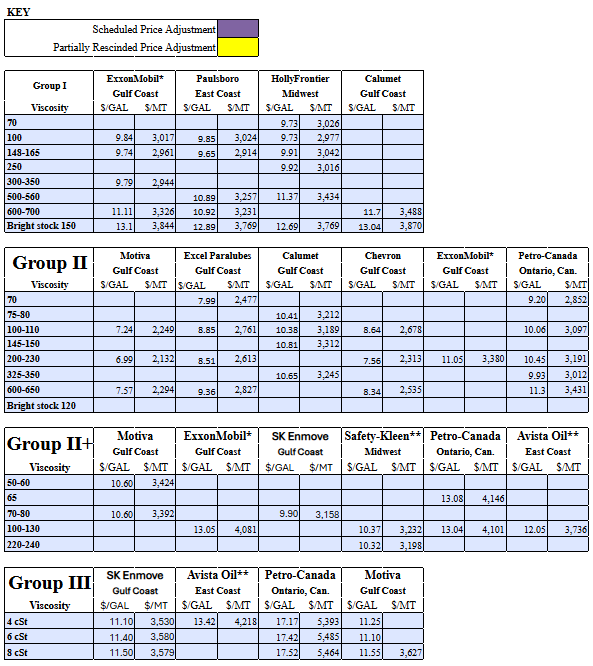
Posted Paraffinic Base Oil Prices November 18, 2026
(Prices are FOB basis, in U.S. dollars per gallon and U.S. dollars per metric ton).
Archived base oil price reports can be found through this link: https://www.lubesngreases.com/category/base-stocks/other/base-oil-pricing-report/
Historic and current base oil pricing data are available for purchase in Excel format.
*ExxonMobil prices obtained indirectly.
**Rerefiner