The United States-Israel war with Iran raged on and the crucial Strait of Hormuz remained closed to tanker traffic, catapulting crude oil and diesel prices to sky-high levels. Several refineries in the Middle East were hit by Iranian drone attacks, forcing refiners to shut down production of refined products, including base oils, which led to a global tightening of supplies. The steep feedstock values and reduced availability drove U.S. base oil producers to announce additional posted price increases – in some cases, their third or fourth round since the beginning of the conflict on February 28.
Suppliers have also suspended spot offers given uncertainties regarding future supply levels and a need to ensure contract commitments were met. Most base oil consumers have sufficient stocks to continue running blending operations, but a protracted conflict could result in product shortages, particularly of Group III base oils as a couple of Middle East base oil plants were forced to shut down following drone strikes, and Asian suppliers have trimmed base oil output as they prioritize competing fuels production.
Crude oil futures surged over the weekend because U.S. president Donald Trump issued an ultimatum to Iran, threatening to destroy its power plants if the country failed to reopen the Strait of Hormuz in two days. Brent touched the $114 mark briefly but fell after Trump extended the deadline for Iran to comply and announced that negotiations with Iran were progressing. Iran denied that any diplomatic progress had been achieved but ostensibly would allow vessels to traverse the Strait with proper permission from Iranian authorities.
In other market news, a large explosion at a Valero oil refinery in Port Arthur, Texas, sent plumes of smoke into the air and forced some nearby residents to shelter in place on Monday, March 23. Valero Energy Corporation confirmed that there had been a fire in a unit at the Port Arthur refinery but reported that the fire had been extinguished and all personnel had been accounted for, with no injuries or fatalities reported. The Valero Port Arthur refinery does not currently produce base oils, although it used to produce them, but sources indicated that it supplies fuels to the U.S. East Coast. The Valero Three Rivers, Texas, refinery still produces hydrotreated naphthenic base oils, according to the company’s website.
Middle East Base Oil Capacity Shutdowns
Iran and its allied militias continued to launch drones and missiles across the Middle East in retaliation to the U.S. and Israeli attacks, targeting energy infrastructure in Saudi Arabia, the United Arab Emirates, Qatar, Kuwait, Bahrain, and Iraq, and putting several facilities out of commission. These strikes exacerbated the dire oil supply situation, as not only were crude tankers unable to transit the Strait of Hormuz, but crude oil and refined products output have also been shut down.
Several Middle East base oil producers have been forced to halt production and declare force majeure.
According to reports, Shell has halted production at its Pearl GTL Group III facility in Qatar after sustaining damage during aerial attacks on March 19. The unit experienced a fire at one of its processing trains and production has been suspended as the company assesses damages, but sources indicated that the plant may remain shut down for a prolonged period. Qatar Energy’s LNG production had already been offline since early March following Iranian strikes that curtailed feedstock supply to the Pearl GTL facility. Even before the latest attack, it was reported that the Pearl GTL unit had been operating below capacity due to export constraints linked to regional disruptions.
Abu Dhabi state oil giant Adnoc has shut part of its Ruwais refinery complex in response to a fire that broke out on March 10, following a drone strike. Sources indicated that while the Ruwais West refinery was shut down for inspection and safety reasons, other operations within the massive complex might be continuing at reduced capacity. According to sources, the Ruwais East unit was running and was expected to continue production, including that of base oils, but this could not be confirmed with the producer directly. The Ruwais complex houses a 600,000-metric-tons-per-year Group II and Group III plant.
In Bahrain, fire erupted at Bapco’s refinery in Maameer on March 5 following an Iranian attack, forcing the refinery to declare force majeure on production. Bapco operates a Group III base oil facility in Sitra, within the Bapco refinery complex. Bapco originally indicated that base oil production had been unaffected, but it was not clear whether the unit was currently producing base oils.
Iran also attacked Iraqi oil facilities last week, further crippling refining operations in the country. In Saudi Arabia, a drone struck the Samref oil refinery in Yanbu, while Saudi forces intercepted a ballistic missile targeting the Port of Yanbu – one of the few ports where tankers are still able to lift cargoes as it is located on the Red Sea.
Base Oil Posted Price Increases
Several base oil suppliers communicated fresh posted price increases during the week—for some of them, this was the third or fourth initiative since the start of the Iran conflict.
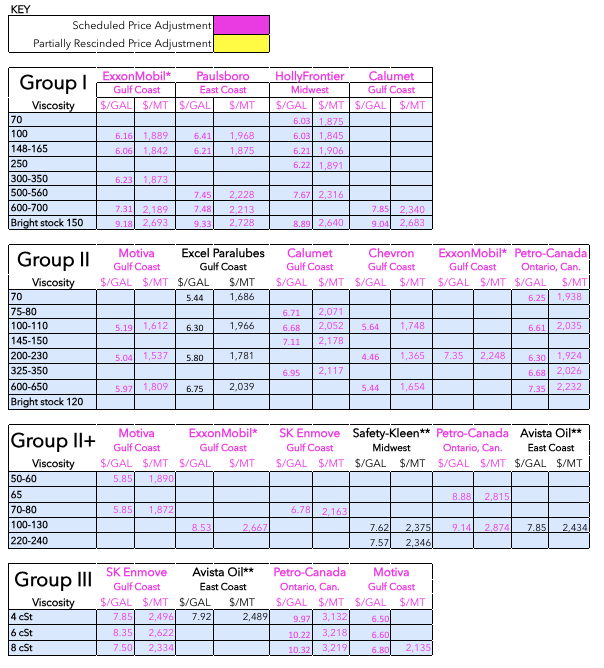
According to reports, ExxonMobil increased all its Group I, Group II and Group II+ grades by 24 cents/gal, effective March 20. The company had previously increased prices on March 9 and March 13.
Motiva announced a posted price increase that went into effect on March 23, the company’s only price adjustment so far this month. Motiva’s Group II 100N went up by 85 cents/gal, its 220N by 95 cents/gal and its 600N by 85 cents/gal. The producer’s Group II+ and Group III products moved up by $1.00/gal across the board.
SK Enmove increased Group II+ and Group III postings by 20 cents/gal on March 19 and then 30 cents/gallon on March 24. These were the supplier’s third and fourth adjustments this month and are reflected concurrently as a 50 cents/gal increase in this week’s Price Table. SK increases total 80 cents/gal since March 1. SKhad previouslyimplemented separate increases for its Group II+ and Group III base oils on March 1 and March 12. Out of all the base oil grades, the Group III segment is experiencing the most direct impact from the conflict in the Middle East.
Chevron informed customers that effective March 24, the company’s USGC Group II posted prices would increase by 40 cents/gal to reflect current market conditions. This is the producer’s second adjustment this month, with a previous increase having gone into effect on March 10.
HF Sinclair/Holly Frontier communicated a price increase of 25 cents/gal across all Group I grades, including bright stock, effective March 27.
HF Sinclair/Petro-Canada announced price increases for its Group II 70N, 100N, 200N, 350N and 650N of 30 cents/gal. The company’s Group II+ 65N and 100N base oils increased 80 cents/gal, and its Group III 4cSt, 6cSt and 8cSt cuts also went up by 80 cents/gal, effective March 24.
HF Sinclair had previously revised prices up on March 10, and had alerted customers that there may further changes in the coming days or weeks “as costs escalate at an unprecedented pace.”
Calumet announced a price increase of 25 cents/gal for all its paraffinic base oils, effective March 25. The company had previously marked up postings on March 10 and March 17.
Paulsboro communicated a posted price increase of 24 cents/gal for all Group I grades, effective March 25. The company had previously increased its Group I light and heavy-vis grades on March 12 and March 18.
During the previous week, Excel Paralubes and rerefiner Avista Oil had also communicated posted price increases that went into effect on March 19 and March 15 respectively.
Lubricant Increases
Lubricant manufacturers have also communicated price increases to offset the sharp increase in production costs as not only base oil prices have gone up, but additive and transportation costs have also increased. Among the manufacturers that have announced increases were Martin Lubricants, Amalie, Highline Warren and Omni Specialty Packaging. Some suppliers announced increases between 9% to 16%, depending on the product, and some marked up prices by 48-50 cents/gal.
Group I and Group II
U.S. base oil producers have withdrawn spot offers, particularly for export business, as they focused efforts on fulfilling domestic contract commitments, as well as to destinations in Latin America and Europe. The surge in gasoline and diesel prices and prospects of potential diesel shortages has started to tilt refinery economics towards increased production of fuels, which would reduce the feedstock availability for base oils.
The reduced output would coincide with the typical spring lubricant production cycle, when blenders build inventories to supply growing consumption from the automotive, agricultural and construction segments and base oil suppliers see increased base oil demand. Consumers were also worried about potential supply shortages, and some were trying to acquire as much product as possible, but several base oil suppliers were restricting sales volumes or have placed customers on allocation.
The light grades within the Group II category were described as particularly tight, with buyers turning to rerefined base oils whenever possible to supplement supplies, propping up rerefined base oil prices and leading to rerefined base oil price increases.
In Brazil, domestic supplies have tightened as the local producer was heard to have suffered a production setback affecting Group I heavy-viscosity base oils and bright stock in mid-February. With imports from the U.S. expected to be reduced, importers worried that there would be product shortages in the coming months. Prices have moved up in line with the recent market developments. Group II prices have also edged up due to the general supply tightness, while Group III have seen the most significant increases due to reduced supplies from the Middle East and a suspension of spot offers from Asian suppliers.
Mexico was still receiving U.S products under contract, but additional volumes were difficult to locate as U.S. suppliers have suspended spot offers and focused on meeting domestic requirements. Most spot offers for Asian base oils into Latin America have also been suspended because of production cutbacks and climbing freight rates. While some consumers appeared to have enough inventories to continue running daily operations, others were concerned about replenishment options. Price indications have moved up because of the current market challenges and the rapidly changing conditions.
Group III
Due to Group III base oil production disruptions in the Middle East following Iranian drone attacks on base oil plants and the refineries that supply their feedstocks, supply shortages of Group III were expected. Aside from these disruptions, there has also been a drop in volumes moving out of the Middle East due to the closure of the Strait of Hormuz. Close to half of all U.S. Group III imports originate in Bahrain, the United Arab Emirates, and Qatar, and these countries have ports on the Persian Gulf, which is effectively closed off to vessel traffic.
A large part of U.S. imports also originates in Asia, and supplies have also been curtailed because
Group III producers rely on Middle East crude imports to run their refineries, and crude exports have plummeted. Governments in several Asian countries have asked refiners to produce more fuel instead of other refined products like base oils that were not considered as essential. Exports of refined products have also been suspended by some countries such as Thailand.
Domestic Group III producers in the U.S. ramped up Group III production whenever possible to supply contract customers and for internal consumption. Group III suppliers in general were trying to meet contract obligations to the best of their ability, with a couple placing customers on allocation, but spot offers have been withdrawn by most suppliers. Prices have climbed significantly, not only because of supply disruptions, but also because of steeper feedstock costs, freight rates and insurance premiums.
Naphthenics
Naphthenic base oil producers have also announced price increases, with at least one supplier announcing subsequent increases following its first price revision, given surging crude oil prices and reduced base oil production.
Calumet announced a 25 cents/gal price increase on all its naphthenic oils, effective March 25. The producer had previously implemented price hikes on March 10 and March 17.
Process Oils communicated a price increase of 45 cents/gal for its line of Cross Oil naphthenic base oils, which went into effect on March 13, adding that the company was closely monitoring developments within the Middle East and would provide pricing updates and adjustments as needed in a timely manner.
Ergon also raised naphthenic base oil prices by 45 cents/gal on March 13.
Healthy demand for the light grades and recent, ongoing and upcoming plant turnarounds contributed to a tightening of naphthenic base oils supplies, particularly that of the light pale oils, further supporting the higher values.
San Joaquin Refining completed a scheduled turnaround at its refinery in Bakersfield, California, earlier this month. The turnaround and a delayed restart depleted the producer’s inventory, and it was expected to be on allocation through March while it rebuilds stocks.
Cross Oil started a turnaround at its plant in Smackover, Arkansas, on February 20. The program was expected to last approximately 23 to 25 days, and after a restart attempt, the plant was heard to have been shut down again. Even though the supplier was expected to have built inventories to fulfill orders during the shutdown, a longer outage might limit supplies from the producer moving forward.
Calumet was expected to build inventories ahead of a turnaround at its naphthenic plant in Princeton, Louisiana, in the first half of April.
Crude Oil
Crude oil futures fell after President Donald Trump said that negotiations to end the war were progressing – although Iran denied these reports – while Iran ostensibly said that “non-hostile” vessels could pass through the Strait of Hormuz.
West Texas Intermediate April 2026 futures settled on the Nymex at $92.35 per barrel on March 24, down from $96.21/bbl for front-month futures on March 17.
Brent front-month futures were trading on the ICE at $101.10/bbl on March 25, down from $102.33/bbl on March 18.
Louisiana Light Sweet crude wholesale spot prices were hovering at $96.43/bbl on March 24. Spot prices had settled at $94.89/bbl on March 16, according to the U.S. Energy Information Administration.
Diesel
Low-sulfur diesel wholesale, March 24 (March 16), EIA
New York Harbor: $4.17 per gallon ($3.90/gal)
Gulf Coast: $4.12/gal ($3.71/gal)
Los Angeles: $4.51/gal ($3.64/gal)
Gabriela Wheeler can be reached directly at gabriela@LubesnGreases.com
LNG Publishing Co. Inc./Lubes’n’Greases shall not be liable for commercial decisions based on the contents of this report.
Posted Paraffinic Base Oil Prices: March 25, 2026
(Prices are FOB basis, in U.S. dollars per gallon and U.S. dollars per metric ton).
Archived base oil price reports can be found through this link: https://www.lubesngreases.com/category/base-stocks/other/base-oil-pricing-report/
Historic and current base oil pricing data are available for purchase in Excel format.
*ExxonMobil prices obtained indirectly.
**Rerefiner