As the conflict in the Middle East showed little sign of abating and the strategically vital Strait of Hormuz remained effectively closed, crude oil and feedstock prices remained at elevated levels, continuing to exert pressure on base oil prices. Several base oil producers announced posted price increases that went into effect between March 1 and March 17. No sooner had this first round of base oil price increases been implemented than a second wave emerged. These back-to-back hikes were not only driven by a sustained escalation in crude oil and feedstock prices, but also by a global tightening of base oil supplies.
Crude oil prices were on a rollercoaster ride, with futures surging one day and retreating the next, depending on news about the war. Prices surged on reports that oil production had been curtailed by some of the main oil producers because storage tanks were filling up and producers on the Persian Gulf were unable to move the oil out as vessels could not reach ports on the Gulf as long as the Strait remained closed. Futures then fell after Iraq resumed oil exports via Turkey’s Ceyhan port.
While oil shipments out of Iran continued to transit the Strait and cargoes were also moving out of the United Arab Emirates, Oman and Saudi Arabia (through the Red Sea port of Yanbu), market observers said that these volumes were not enough to replace the supply losses stemming from the war. Furthermore, a drone strike ignited a fire at the Fujairah oil hub in the U.A.E. this week, forcing a halt to crude and products loadings and further reducing oil shipments out of the region.
Several European nations were discussing ways to facilitate a reopening of the Strait of Hormuz, but rejected United States’ president Donald Trump’s demand that they send warships, arguing that they did not want to be drawn into a wider war.
Middle East Base Oil Capacity Shutdown
Several Middle East refineries have been hit by drone attacks and a couple appeared to have been forced to stop production. In the United Arab Emirates, a suspected drone strike triggered a fire at the Ruwais Industrial Complex, leading authorities to shut down the country’s flagship refinery as a precautionary measure. The Ruwais complex houses ADNOC’s Group II and Group III base oils plant. According to sources familiar with Adnoc’s operations, the base oil unit was not damaged during the drone attack.
In Bahrain, fire erupted at Bapco’s refinery in Maameer on March 5 following an Iranian attack, forcing the refinery to declare force majeure on production. Bapco operates a Group III base oil facility in Sitra, within the BAPCO refinery complex. BAPCO originally indicated that base oil production had been unaffected, but it was not clear whether the unit was currently producing base oils.
In Qatar, Qatar Energy halted production of liquid natural gas (LNG) and other products following drone attacks on its facilities in Ras Laffan and Mesaieed. The company declared force majeure on production. The Qatar/Shell Pearl gas-to-liquids base oil unit in Ras Laffan was heard to have shut down production as the unit utilizes natural gas from the refinery to produce Group III base oils.
Base oil Posted Price Increases
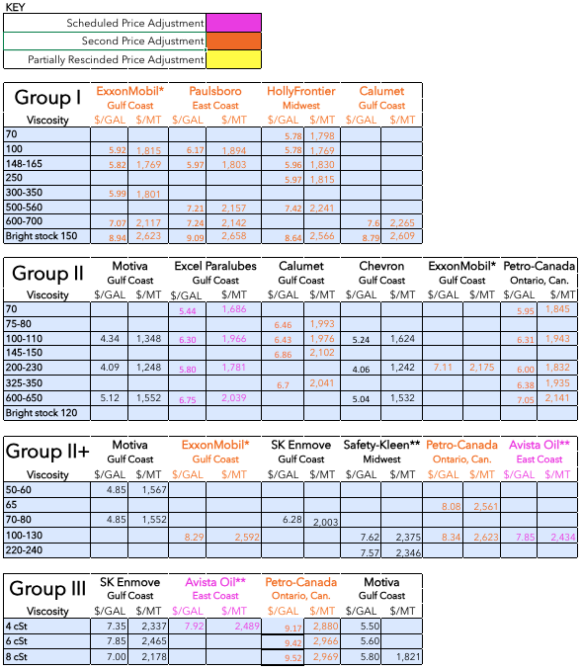
As mentioned above, ExxonMobil, Calumet, SK Enmove and HF Sinclair communicated a second round of hikes after implementing price revisions earlier this month, while Chevron, Excel Paralubes and Avista Oil announced their first price increases since the beginning of the Iran conflict.
According to reports, ExxonMobil increased prices for a second time on March 13 “due to rapidly changing regional and global supply/demand balances.” ExxonMobil’s API Group I base stocks increased by 24 cents/gal, with the exception of bright stock, which went up by 29 cents/gal. The company’s Group II EHC65 and Group II+ EHC45 were also marked up by 29 cents/gal. ExxonMobil had previously increased posted prices on March 9, raising its Group I base stocks by 24 cents per gallon, and Group I bright stock by 19 cents/gal. ExxonMobil’s Group II EHC65 and Group II+ EHC45 were marked up by 36 cents/gal.
Paulsboro announced that the company was increasing Group I light and heavy-vis grades by 24 cents/gal and its bright stock by 29 cents/gal, effective March 18. Paulsboro had previously lifted Group I light and heavy grades by 24 cents/gal and bright stock by 19 cents/gal on March 12.
Calumet announced a price increase of 20 cents/gal for all of its paraffinic base oils, effective March 17.The company had previouslycommunicated a price increase for its Group I cuts of 35 cents/gal, and 45 cents/gal for its Group II grades, effective March 10.
SK Enmove implemented two separate increases for its Group II+ and Group III base oils since March 1. The company’s first increase raised all of its postings by 10 cents/gal, effective March 1. The second increase lifted prices by20 cents/gal, effective March 12.
HF Sinclair communicated a price increase for its HollyFrontier and Petro-Canada base oils, effective March 17. HollyFrontier’s Group I base oils increased 25 cents/gal, except bright stock, which moved up by 30 cents/gal. The producer had previously raised Group I prices by 25 cents/gal, with bright stock increasing by 20 cents/gal on March 10.
Petro-Canada’s Group II base oils will go up by 30 cents/gal, Group II+ cuts by 50 cents/gal and Group III grades by 50 cents/gal as well on March 17. Petro-Canada’sGroup II and Group II+ base oils had previously increased 35 cents/gal, and the Group III grades 30 cents/gal on March 10.
Among those suppliers that have only moved prices only once so far was Chevron. The company implemented a 50 cents/gal price increase for its Group II base oils on March 10.
Excel Paralubes also communicated one round of price increases for its Group II grades that will go into effect on March 19. The producer’s 70N, 110N and 600N grades will move up 55 cents/gal, while the 225N grade will increase by 70 cents/gal.
Avista Oil informed customers that its rerefined base oils would be marked up by 50 cents/gal, effective March 15.
Most base oil participants continued to watch developments intently, as the industry was not only affected by the crude oil supply disruptions, but by a tightening supply situation. The U.S and Europe, for example, largely depend on Asian and Middle Eastern Group III base oil supplies, and some shipments may be either postponed or cancelled.
Lubricant Increases
Lubricant manufacturers were also heard to be implementing price revisions given the sharp increase in production costs as not only base oil producers have increased prices, but additive suppliers have nominated hikes as well.
Martin Lubricants announced that “due to rapid and unprecedented increases in crude oil and base oil costs,” the company would be implementing a price increase of approximately 15% on its products, including Private Label products and greases. The increase will be effective on all orders shipped after the close of business on March 20. The company also explained that “given the speed and magnitude of recent base oil price movements, the company was implementing this adjustment without its usual 30-day notice. Martin also added that should “conditions normalize and input costs decline,” the company would promptly evaluate pricing and make appropriate adjustments.
Amalie will raise lubricant prices by 48 cents per gallon, and grease prices by 7 cents per pound, with an effective date of April 1.
Highline Warren has informed customers that the company would be implementing price increases across several product categories, driven by growing volatility in global energy and chemical markets. Oil and lubricant prices will increase by up to 16%, while washer fluid will rise by up to 9% and diesel exhaust fluid by up to 10%, all effective April 1.
Omni Specialty Packaging will increase prices by 50 cents per gallon across all product categories, effective April 7.
Other lubricant manufacturers have implemented immediate surcharges to their pricing while they discuss and prepare official announcements.
Group I and Group II
U.S. base oil producers have by and large suspended spot offers, particularly for export business, focusing on meeting contract commitments, both in the domestic market, as well as to destinations in Latin America and Europe. Given the surge in gasoline and diesel prices and prospects of potential diesel shortages, refinery economics are tilting towards increased production of fuels in detriment to base oil output. With market conditions changing almost daily, it was also difficult to determine a fair spot price, suppliers explained. Export transactions were also exposed to volatile freight rates, but several continued to be completed as demand in other regions was steady to robust. A 1,000-2,000-metric-ton cargo was being discussed for shipment from Mobile, Alabama, to Antwerp, Belgium, this month.
The challenging environment coincides with a time when activity tends to pick up for the spring lubricant and agricultural planting season. Base oil suppliers typically enjoy improved domestic demand, but buyers were being more cautious in terms of volumes, although some tried to acquire as much product as possible in case there were shortages later, or prices continued to edge up. Some suppliers were restricting sales volumes or have placed customers on allocation.
In Brazil, the domestic producer was heard to have suffered a production setback in mid-February, but was expected to resume output by mid-March. Base oil prices are moving up because of tight domestic supplies and because U.S. and Asian suppliers have suspended spot export offers.
Regular contract shipments of U.S products were anticipated to continue moving to Mexico as suppliers prioritized contract commitments. Buyers were managing inventories carefully in case of stricter allocations. With diesel prices moving up in both the U.S. and Mexico, the light grades, which are often used as diesel extenders, have been exposed to upward pressure. Most spot offers for Asian base oils into Latin America have been suspended because of production cutbacks and climbing freight rates.
Group III
A number of Group III base oil plants in the Middle East have suffered production disruptions due to Iranian drone attacks on the refineries that supply their feedstocks. Aside from these disruptions, Middle East Group III shipments were expected to be interrupted due to the closure of the Strait of Hormuz by Iran. Close to half of all U.S. Group III imports originate in Bahrain, the United Arab Emirates, and Qatar, and these countries have ports on the Persian Gulf, which is effectively closed off to vessel traffic. At least one supplier that imports base oils from the Middle East said that it expected to continue supplying its contract customers as scheduled, but spot offers have been withdrawn by a majority of suppliers.
A large part of U.S. imports originate in Asia, and Group III producers rely on Middle East crude imports to run their refineries. With shortages of gasoline and diesel expected to hit that region, refiners in Asia have started to trim base oil production and increase fuels output. Steeper freight rates and insurance premiums were also expected to exert upward pressure on prices for some time. As a result, producers were heard to have advised customers that Group III base oils may be under allocation.
SK Enmove has implemented two rounds of price increases on its Group II+ and Group III base oils since the start of the war.
A second supplier was also heard to have raised its prices as well and is only fulfilling contract commitments.
Naphthenics
On the naphthenic side of the business, producers also announced price increases the previous week, with at least one supplier announcing a subsequent increase this week on the back of surging crude oil prices and potential base oil production cuts if refineries start to produce more competing fuels and reduce base oil production. Buyers were resisting the price increases, but a tightening of supplies was likely to leave them few alternatives other than to accept the hikes.
Robust demand for the light grades and recent, ongoing and upcoming plant turnarounds also tightened the market and offered further support to pricing.
San Joaquin Refining completed a scheduled turnaround at its refinery in Bakersfield, California, earlier this month. The turnaround and a delayed restart depleted the producer’s inventory and it was expected to be on allocation through March.
Cross Oil started a turnaround at its plant in Smackover, Arkansas, on Feb. 20. The program will last approximately 23 to 25 days, and the supplier was expected to have built inventories to fulfill orders during the shutdown.
Calumet will also likely start to build inventories over the next few weeks as the producer plans to have a turnaround at its naphthenic plant in Princeton, Louisiana, in the first half of April. In terms of pricing, Calumet announced a 25 cents/gal increase, with an effective date of March 17. The producer had previously communicated a 35 cents/gal increase on all of its naphthenic oils, effective March 10.
Process Oils communicated a price increase of 45 cents/gal for its line of Cross Oil naphthenic base oils, which went into effect on March 13, adding that the company was closely monitoring developments within the Middle East and would provide pricing updates and adjustments as needed in a timely manner.
Ergon also raised naphthenic base oil prices by 45 cents/gal on March 13.
Crude Oil
Crude oil futures continued their ascent as president Trump sought to create a coalition of nations to reopen the Strait of Hormuz, with WTI hitting the $102 per barrel mark earlier in the week and Brent topping $106/bbl since the critical waterway remained effectively closed to tanker traffic. Futures then retreated on Wednesday on reports that Iraq had resumed oil exports via Turkey’s Ceyhan port via a pipeline, easing some supply concerns.
- West Texas Intermediate April 2026 futures settled on the Nymex at $96.21 per barrel on March 17, up from $83.45/bbl for front-month futures on March 10.
- Brent futures for May 2026 delivery were trading on the ICE at $102.33/bbl on March 18, up from $87.29/bbl for front-month futures on March 11.
- Louisiana Light Sweet crude wholesale spot prices were hovering at $94.89/bbl on March 16. Spot prices had settled at $104.15/bbl on March 9, according to the U.S. Energy Information Administration.
Diesel
Low-sulfur diesel wholesale, March 16 (March 9), EIA
New York Harbor: $3.90 per gallon ($3.36/gal)
Gulf Coast: $3.71/gal ($3.22/gal)
Los Angeles: $3.64/gal ($3.22/gal)
Gabriela Wheeler can be reached directly at gabriela@LubesnGreases.com
LNG Publishing Co. Inc./Lubes’n’Greases shall not be liable for commercial decisions based on the contents of this report.
Posted Paraffinic Base Oil Prices March 18, 2026
(Prices are FOB basis, in U.S. dollars per gallon and U.S. dollars per metric ton).
Archived base oil price reports can be found through this link: https://www.lubesngreases.com/category/base-stocks/other/base-oil-pricing-report/
Historic and current base oil pricing data are available for purchase in Excel format.
*ExxonMobil prices obtained indirectly.
**Rerefiner